


Bears 34, Seahawks 17: Swift’s Three Touchdowns Seal Chicago’s Road Win
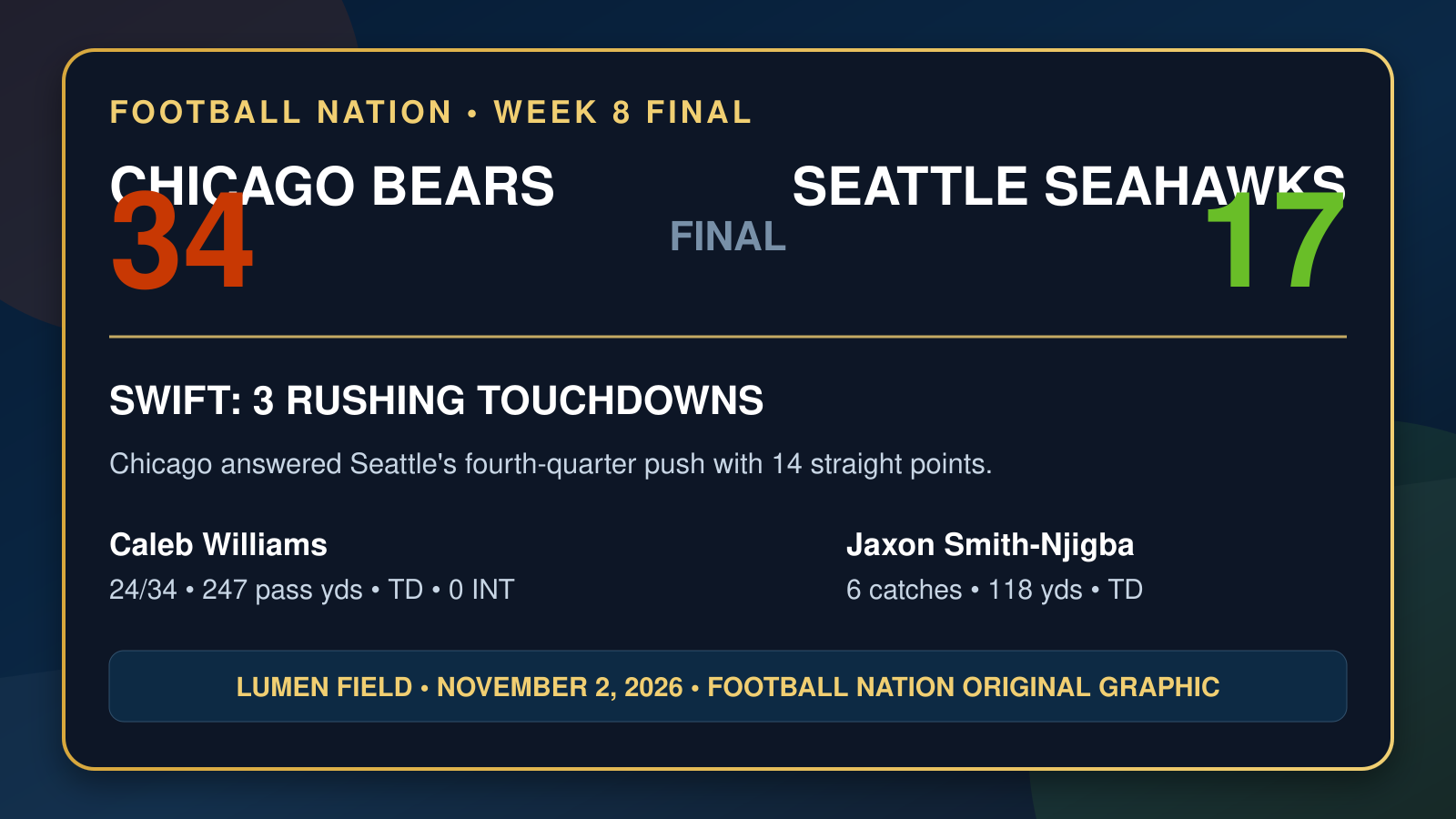
The Chicago Bears beat the Seattle Seahawks 34–17 on Monday night after answering Seattle’s fourth-quarter push with 14 straight points. D’Andre Swift scored three rushing touchdowns, Caleb Williams protected the football, and Chicago’s defense produced the takeaway that ended Seattle’s last realistic comeback chance.
This recap has been expanded from Football Nation’s initial verified summary after review of the official team recap, scoring summary and postgame material. The analysis below uses the final 34–17 score, corrected official totals and the decisive fourth-quarter sequence.
The decisive sequence
Chicago led 20–9 before Seattle cut the margin to 20–17 on Sam Darnold’s touchdown pass to Cooper Kupp and the ensuing two-point conversion. The Bears immediately regained control. Kalif Raymond’s 39-yard reception moved the offense into scoring position, Swift finished the drive with his second touchdown, and defensive lineman James Lynch intercepted Darnold on Seattle’s next possession. Swift’s third rushing touchdown turned the response into a 34–17 finish.
Verified leaders and team performance
Williams completed 24 of 34 passes for 247 yards and one touchdown without an interception. Swift carried 27 times for 69 yards and scored all three of Chicago’s rushing touchdowns. Rome Odunze led the Bears with 87 receiving yards, while Colston Loveland caught seven passes for 65 yards and Luther Burden III added seven catches for 56 yards and the opening touchdown.
For Seattle, Darnold finished 17 of 34 for 188 yards, two touchdowns and one interception. Jaxon Smith-Njigba remained the offense’s most productive receiver with six catches for 118 yards and a touchdown. Chicago finished with 363 net yards to Seattle’s 252 and held the Seahawks to one conversion in 11 third-down attempts. That gap reflected the Bears’ ability to extend drives while repeatedly forcing Seattle off the field.
What the result means
Chicago moves to 6–2 and leaves Seattle at 4–4. The practical football conclusion is that the Bears did not need an explosive rushing average from Swift to get decisive value from him; his short-yardage and red-zone workload converted drives into points. Williams’ interception-free night also kept the game from swinging back toward Seattle after the Seahawks narrowed the deficit.
For fantasy managers, Swift’s three-touchdown night is the headline, but the repeatable signal is his 25 carries and goal-line role rather than expecting another three-score result. Smith-Njigba’s 118 yards confirmed his ability to produce even when Seattle’s overall passing efficiency was uneven. Football Nation’s next update will check the official gamebook, injury follow-ups and postgame comments before treating every secondary detail as final.
How Chicago won the high leverage downs
The Bears’ opening possession established the shape of the game. Chicago used 17 plays and 8:32 to travel 80 yards, finishing with Williams’ one-yard touchdown pass to Burden. Seattle had not allowed an opening-drive touchdown in its previous 16 games, so the drive was more than an early lead: it showed Chicago could stay on schedule against a defense that had been difficult to sustain offense against.
The same discipline mattered after Seattle’s best response. The Seahawks cut the margin to three early in the fourth quarter after DeMarcus Lawrence forced and recovered Loveland’s fumble. Chicago did not retreat into a purely protective offense. Raymond’s 39-yard catch and run flipped the field, Swift finished the drive, and the defense immediately converted pressure into Lynch’s interception. The offense and defense answered on consecutive possessions, which is why Seattle’s surge never became a full comeback.
Seattle’s counterargument and the remaining uncertainty
Seattle can reasonably argue that the game was still competitive at 20–17 and that one clean stop after the Loveland turnover could have changed the closing script. Smith-Njigba also continued to create explosive value even when the rest of the offense struggled. The counter to that argument is down-to-down consistency: one of 11 on third down left Seattle dependent on short fields and explosive plays, while Chicago produced five scoring drives and kept Williams out of turnover trouble.
The strongest uncertainty is what carries forward. Swift’s three scores are unlikely to repeat at that rate, and Chicago’s red-zone workload will remain sensitive to game script. For Seattle, the next checkpoint is whether the offense can create more manageable third downs and a more credible rushing threat. Any injury-related conclusion should wait for official follow-up reporting rather than being inferred from the broadcast.
Official Bears postgame context: the club posted “Statement made.” at 10:24 PM Central on November 2, 2026. The exact public status was opened and verified at 4:35 AM Central on November 3 before native embedding: https://x.com/ChicagoBears/status/2117472888597233928.
Sources and verification
Checked Nov 03, 2026, 4:35:43 AM CST: NFL Week 8 schedule and game center, https://www.nfl.com/schedules/2026/by-week/week-8 and https://www.nfl.com/games/bears-at-seahawks-2026-reg-8; Chicago Bears official game recap and scoring summary, https://www.chicagobears.com/news/game-recap-bears-make-statement-with-impressive-prime-time-win-in-seattle; Seattle Seahawks official rapid reactions, https://www.seahawks.com/news/rapid-reactions-seahawks-struggle-to-find-offensive-rhythm-in-34-17-loss-to-bears; official Bears X status opened and verified, https://x.com/ChicagoBears/status/2117472888597233928. Comparison period: the completed Week 8 game through official FINAL.


Comments