


Bears 59, Panthers 37 Recap: Chicago Sets Week 1 Record
The Chicago Bears beat the Carolina Panthers 59–37 on Sunday, September 13, producing the highest-scoring Week 1 game in NFL history. Chicago set a franchise record for points in a season opener, piled up 552 yards and broke a 31–31 tie with three touchdowns in 7 minutes, 38 seconds.
Caleb Williams accounted for four touchdowns, D’Andre Swift ran for three, and Kyle Monangai turned 10 carries into 100 yards. That combination made this more than a quarterback highlight reel. The Bears won with explosive passing, quarterback movement and a 291-yard ground game that Carolina could not slow once Chicago seized control.
Bears–Panthers final score and key stats
Situational edge, quarter scoring and injuries
CBS Sports’ final box score lists Chicago with a 34:03–25:57 possession edge, 10-of-14 third-down efficiency to Carolina’s 4-of-9, identical 4-of-4 red-zone results and a 3–1 turnover advantage. By quarter, Chicago scored 14, 17, 14 and 14 points; Carolina scored 7, 17, 7 and 6. Both teams finished red-zone drives, but Chicago created two extra takeaways and sustained more of its own possessions. The postgame report listed Bears left tackle Braxton Jones with an upper-body injury, Bears cornerback Tyrique Stevenson with a shoulder injury and Panthers defensive tackle Bobby Brown with a back injury. Their first Week 2 practice reports—not Sunday’s initial descriptions—will control the next availability assessment.
The NFL’s Week 1 analysis supplied the broadest historical context. The 96 combined points surpassed the previous Week 1 record of 88 from Tampa Bay’s 48–40 win over New Orleans in 2018. Williams also became the first Bears player to post at least 200 passing yards, two passing touchdowns, 50 rushing yards and two rushing scores in one game.
The game turned after Carolina tied it
Carolina kept answering early. Bryce Young threw for 361 yards and three touchdowns, ran for another score and twice connected with Jalen Coker for touchdowns. Chuba Hubbard’s 2-yard run made it 31–31 with 9:02 remaining in the third quarter. At that point, the game was still a true shootout rather than a Chicago runaway.
The Bears then changed the shape of the afternoon. Swift scored from 1 yard, Monangai broke a 61-yard touchdown, and Williams found Jahdae Walker for another 1-yard score. Those three drives turned a tie into a 52–31 advantage. Swift’s 28-yard touchdown finished Chicago’s scoring after Coker briefly pulled Carolina closer.
Football Nation’s pregame Bears–Panthers prop analysis centered on volume thresholds rather than predicting an extreme game environment. The result is a reminder that even sound pregame assumptions can be overwhelmed when both offenses create explosives and one defense loses control of the run.
Why Chicago’s rushing production matters
Swift and Monangai became the first Bears teammates since 1980 to each run for 100 yards in an opener. Swift handled 18 carries and all three of his touchdowns came on the ground. Monangai needed only 10 attempts, with his 61-yard score supplying the cleanest evidence that Chicago’s blocking and perimeter effort could turn a successful play into a decisive one.
The concepts matter because the box score was not built from one repeated call. Football Nation’s explainers on Power O, inside zone and Duo blocking show how different run structures create downhill, cutback and double-team answers. Chicago’s Week 1 film will tell us which calls were most repeatable; the production already shows that the offensive line and skill players created more than one path to efficient rushing.

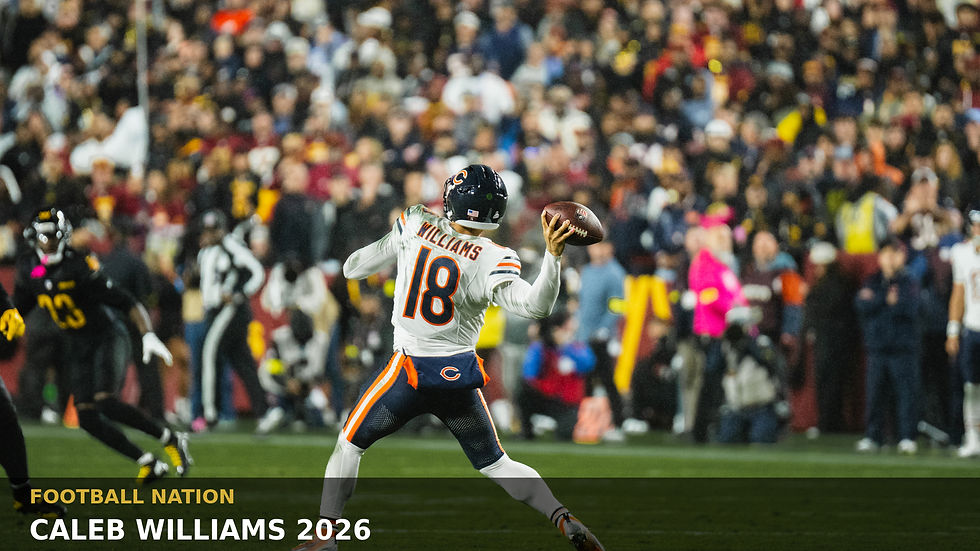
Photo source and license: Wikimedia Commons file page. The exact-player image shows Williams in current Bears uniform and was photographed October 13, 2025.
Caleb Williams supplied the highest-value answer
Williams completed 21 of 29 passes for 269 yards, threw touchdowns to Cole Kmet and Walker, and added 65 rushing yards with two scores. His best result was not merely the four-touchdown total. Chicago scored nine times, and Williams repeatedly converted movement into positive plays without turning the day into uncontrolled improvisation.
Rome Odunze’s 47-yard contested catch helped set up Swift’s first touchdown. It was an encouraging play, but the next useful step is route and snap review, not pretending one spectacular catch settles his calf status for Week 2. Football Nation’s Caleb Williams accuracy analysis provides the broader quarterback context for why consistently converting these chances matters.
What Carolina can take from the loss
The Panthers’ offense produced enough to win many games. Young’s 361 passing yards and four total touchdowns kept Carolina level into the third quarter, while Coker finished with eight catches for 138 yards and two scores. That is meaningful progress for a passing game whose long-term evaluation still revolves around whether Young is Carolina’s franchise quarterback.
But the defensive result was severe. Carolina allowed 552 total yards, 291 rushing yards and a franchise-record 59 points. Reuters’ game account confirms the core production, but the more important Panthers question requires film: were the breakdowns primarily alignment, missed tackles, poor run fits, or Chicago consistently winning blocks? The answer will determine whether personnel or execution receives the sharper correction.
Fantasy football impact
Williams produced the kind of dual-threat ceiling that can move him from fringe QB1 status into a weekly starter. Swift’s three touchdowns cannot be projected forward, but 18 carries and repeated goal-line work are role evidence. Monangai’s efficiency gives him standalone value and makes him an essential rostered handcuff, even if the touch split narrows in less favorable scripts.
Coker is Carolina’s clearest waiver-wire signal after eight catches, 138 yards and two touchdowns. Young’s volume also supports matchup-based fantasy use. Managers should resist the opposite overreaction with every player: a 96-point environment is historically unusual, so Week 1 ceilings are not baseline projections.
The public X status above from Bears senior writer Larry Mayer links to Williams’ postgame remarks after the 59–37 win. Desktop and mobile rendering of the native embed remains a required quality-gate check.
The counterpoint and next checkpoint
Chicago’s defensive performance is the strongest counterpoint to the celebration. Giving up 37 points, 361 passing yards and four Young touchdowns creates a real Week 2 correction list. The offense proved it can win an extreme scoring game; it did not prove the Bears can rely on needing nearly 60 points.
The next checkpoint is the first Week 2 practice report, followed by Chicago’s home matchup with Minnesota. Watch Odunze’s participation, the distribution between Swift and Monangai, and whether the defense repairs its explosive-pass and red-zone breakdowns. For Carolina, the first defensive film review and personnel comments matter more than broad postgame promises.
Football Nation verdict
Football Nation’s verdict: Chicago’s 59-point opener is a legitimate statement because the offense created answers through Williams’ arm, Williams’ legs and two productive running backs. The historical score should not erase the defensive warning, and one game cannot establish a season-long pace. Still, the Bears now have proof that Ben Johnson’s offense can punish a defense in several distinct ways. Treat the offensive roles as actionable evidence, the fantasy ceilings as real, and the record-setting total as something that still requires confirmation against a tougher Week 2 test.


Comments