


Carson Wentz Gives Minnesota Three Offensive Rules While Kyler Murray Heals
Minnesota’s quarterback plan changed Thursday, but the offensive assignment did not. Kyler Murray is week to week with a hamstring strain, and Head Coach Kevin O’Connell ruled him out for Monday while naming Carson Wentz the starter and Max Brosmer the backup. The useful question for Minnesota is not whether Wentz can copy Murray. He cannot. It is whether the Vikings can shape a clean, repeatable plan around the veteran’s own strengths.
What changed and why it matters
The Vikings’ official quarterback update says the team is protecting Murray from turning the strain into a more significant injury because movement is central to his game. Minnesota’s initial Week 9 injury report listed Murray as out and also showed left tackle Christian Darrisaw and receiver Jauan Jennings as limited. Those surrounding pieces matter because the replacement quarterback’s margin is partly a protection and spacing question, not merely a name change.
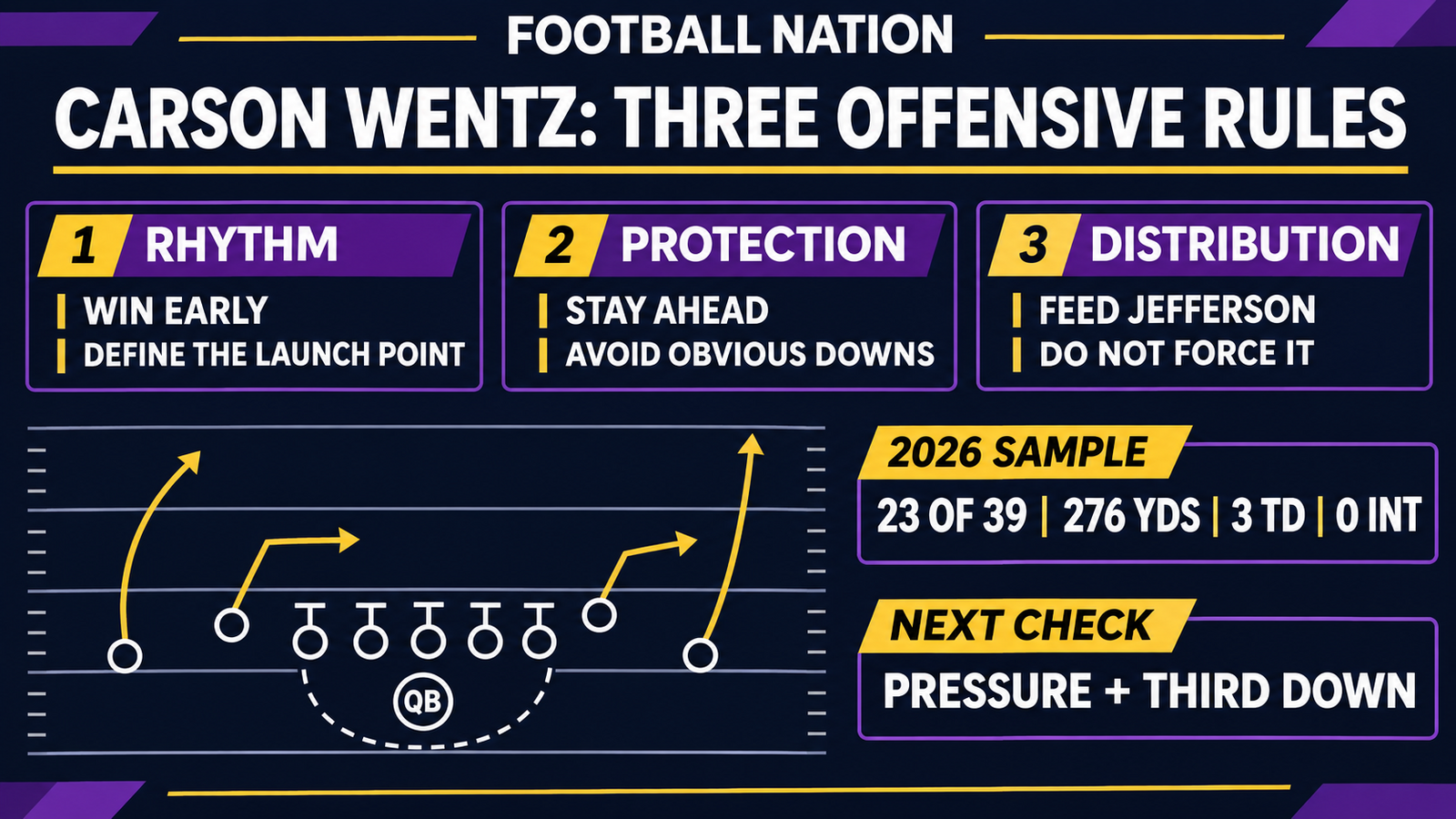
Rule one: win early and define the launch point
Wentz should not be asked to reproduce Murray’s read option volume or second reaction movement. Minnesota can replace some of that stress with early down play action, half field reads and defined launch points. The aim is to let Wentz hit the top of his drop with an answer already developing. A moving pocket can still be useful, but it should change the picture for the rush rather than pretend Wentz is the same kind of open field threat.
That distinction affects the whole call sheet. If first down regularly creates second and six instead of second and ten, Minnesota can keep its full run, screen and play action menu available. If early downs fail, Buffalo can widen the rush and force Wentz into static third down pockets. The first rule is therefore less about conservatism than sequence: earn favorable downs before asking for longer developing concepts.
Rule two: protect the down before protecting the quarterback
The official 2026 team statistics provide a small but useful comparison. In two appearances, Wentz is 23 of 39 for 276 yards, three touchdowns and no interceptions. He has also taken six sacks for 35 lost yards. Murray’s first six starts produced 1,022 passing yards, five touchdowns, three interceptions and 167 rushing yards. The comparison period is Wentz’s two 2026 appearances against Murray’s first six 2026 starts, so it is evidence for role design, not a declaration that one quarterback is better.
Six sacks in a 39 attempt sample are the warning. Protection is not only a five lineman problem. Minnesota can help by using shifts to identify pressure, giving Wentz an immediate outlet, and avoiding empty formations when the defense has earned the right to attack. Running backs and tight ends can chip, but the strongest protection call may be a concept that gets the ball out before the extra rusher arrives.
Rule three: feed Jefferson without forcing the ball
Wentz said he wants to get Justin Jefferson the ball while still distributing to Minnesota’s other weapons. That is the correct tension. The Vikings can manufacture Jefferson’s first few touches with motion, bunch releases and intermediate in breakers, then use the defensive response to open complementary routes. The quarterback should enter each play knowing where Jefferson wins, but he cannot decide before the snap that the ball must go there.
A disciplined distribution plan also gives Wentz a faster answer when the primary picture closes. If a safety leans toward Jefferson, the opposite seam, checkdown or backside dig has to punish that choice. Minnesota does not need equal target shares. It needs each target to make the next Jefferson target harder to defend.
Fantasy consequence
In standard one quarterback fantasy leagues, Wentz is a low floor streaming option until Minnesota shows that he can limit sacks and sustain drives. Superflex managers have a more usable starter because volume and three touchdown upside exist, but the two game sample is too small to treat his 106.4 passer rating as a stable baseline. Jefferson remains the passing game’s volume anchor, although his weekly projection carries more uncertainty with a quarterback change. Aaron Jones and Jordan Mason could benefit if the plan emphasizes early down efficiency and short answers, but there is no verified touch count to project yet.
The strongest counterargument
The counterargument is that Minnesota may not need to shrink the offense at all. Wentz produced three touchdowns without an interception in the opener, and his experience can support vertical concepts and aggressive checks. That deserves weight. The caution is sample quality: the 39 attempts span a comeback relief appearance and a rain soaked start in Chicago. One strong quarter can make the touchdown line look more predictive than it is. The better approach is selective aggression from protected looks, not an assumption that every down should become a quick throw.
The next checkpoint
Friday and Saturday practices will clarify whether Darrisaw and Jennings are trending toward full participation. On Monday, the first 15 calls should reveal whether Minnesota is creating rhythm, protecting early downs and moving Jefferson without forcing him the ball. The most useful live measures are third down conversion rate, pressure to sack conversion and how often Wentz has an outlet against extra rushers. No score projection is necessary to judge whether the plan is working.
Sources and related coverage
Primary sources checked Nov. 6, 2026 at 5:39 a.m. CST: Minnesota Vikings quarterback update; Minnesota Vikings initial injury report; Minnesota Vikings 2026 statistics; and the official Vikings X announcement. The X post was opened at its exact public status URL before embedding.
Continue with Football Nation’s Minnesota Vikings team page and the prior team focused report on DeeJay Dallas’ 53 man promotion.


Comments