


Houston’s Line Report Turns One Clean Game Into a Communication Test
Houston’s cleanest protection result of 2026 created a much bigger passing menu. Now the first injury report of Browns week is testing whether that result was a repeatable structure or a one-game spike.
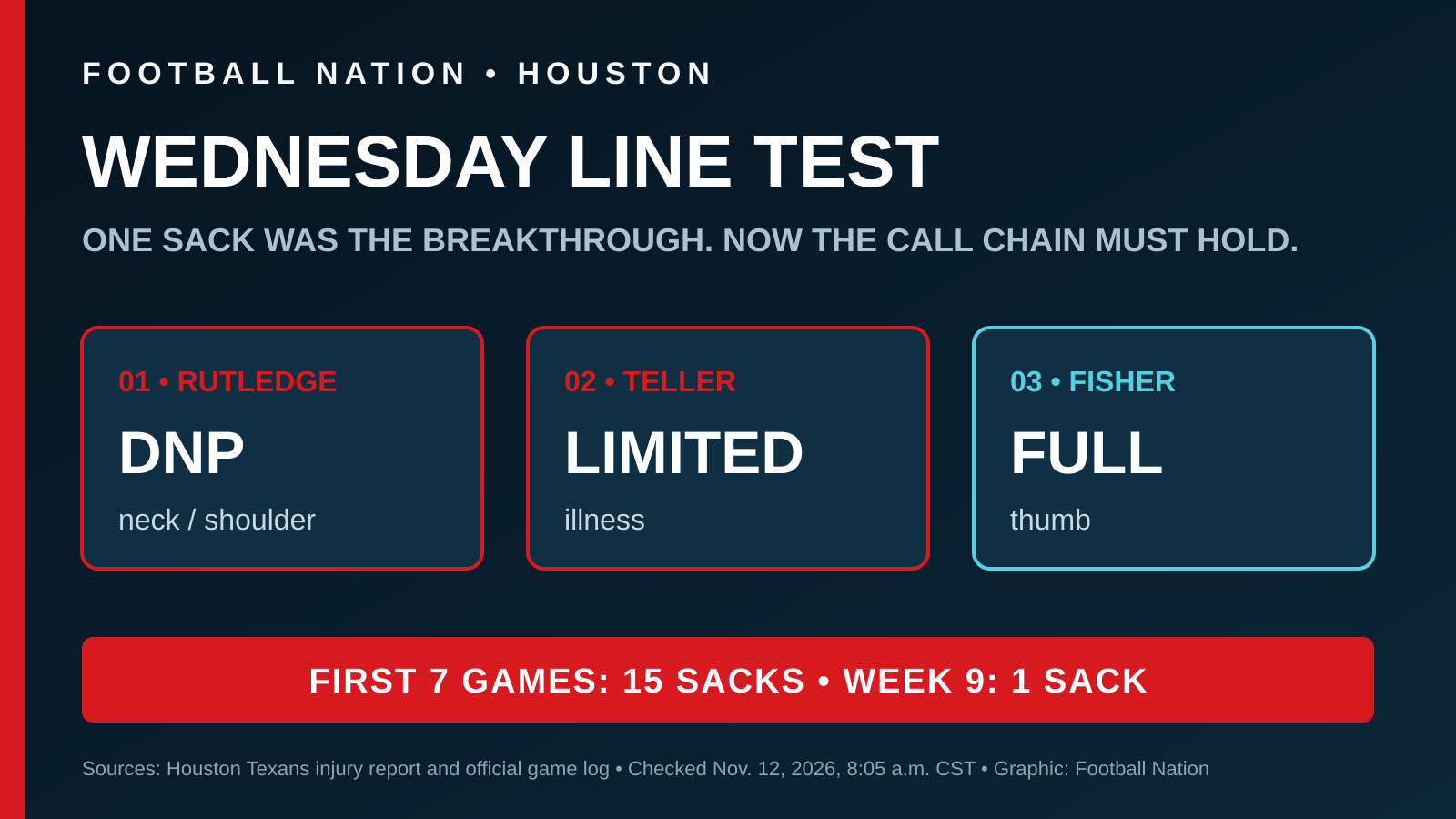
The Texans listed guard Keylan Rutledge as a nonparticipant Wednesday with neck and shoulder issues. Guard Wyatt Teller was limited by illness, while tackle Blake Fisher practiced fully with a thumb issue. Those are participation labels, not final game statuses. Still, they matter because Houston’s Week 9 breakthrough was built on continuity, communication and one stable launch point for C.J. Stroud.
The comparison: 15 sacks, then one
Stroud took 15 sacks across Houston’s first seven games of 2026. In the 44–22 win over the Los Angeles Chargers, he was sacked once for 10 yards. He finished 21 of 35 for 384 yards, five touchdowns and one interception, earning AFC Offensive Player of the Week.
The improvement was not merely cosmetic. Houston could hold the ball for deeper concepts without turning every long-developing route into a race against immediate pressure. The first possession offered the cleanest example: an eight-play, 73-yard touchdown drive on which Stroud completed all five passes for 53 yards.
That is the football consequence of a coherent protection plan. One cleaner pocket does not guarantee another, but it restores options. The quarterback can work through a progression, the receivers can finish intermediate and vertical routes, and the coordinator does not have to live on screens and emergency outlets.
Why Rutledge and Teller affect the call chain
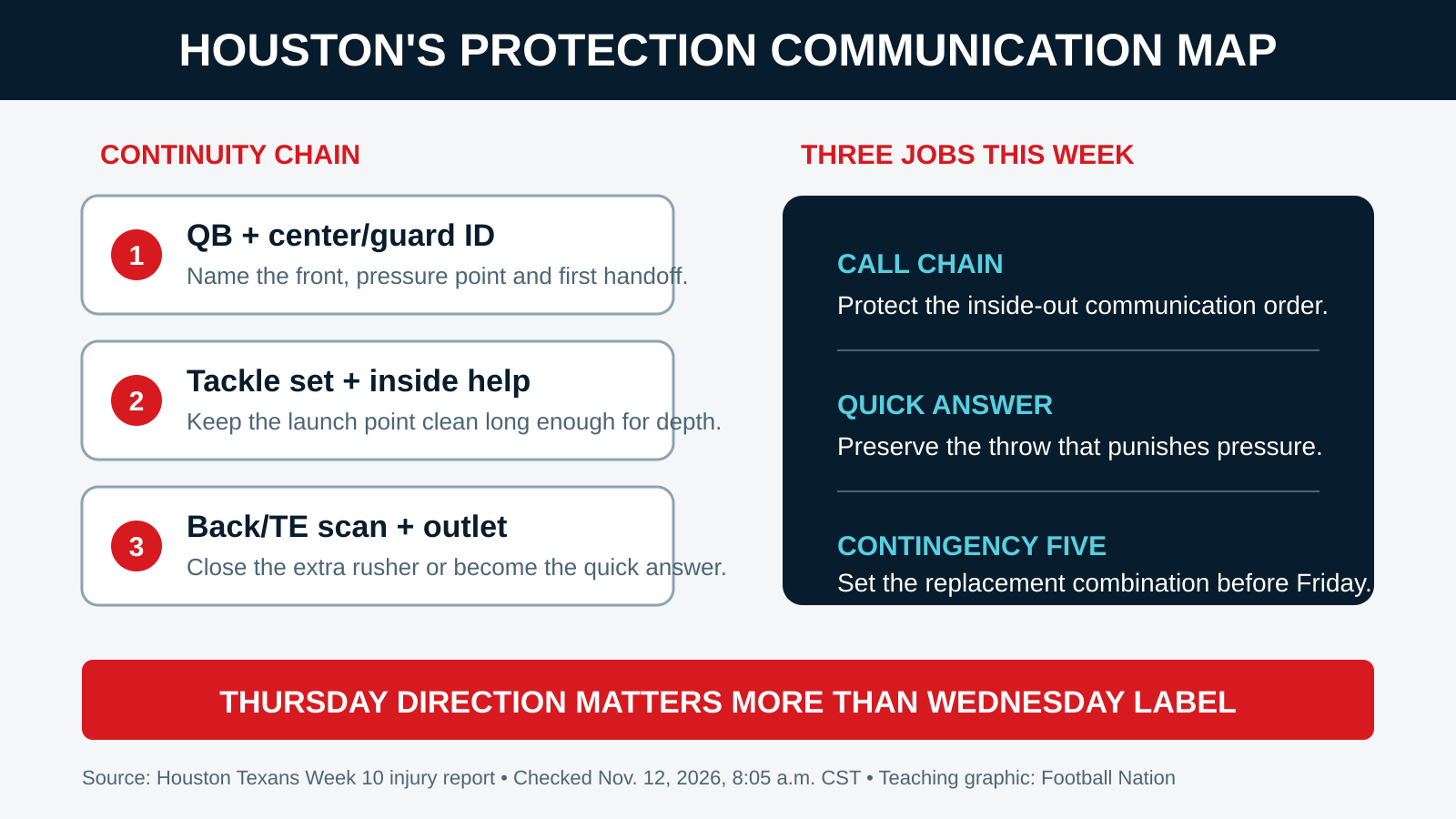
Protection begins before the snap. The quarterback and interior line must identify the front, set the likely pressure point and decide which defender becomes the back’s or tight end’s responsibility. A late change at guard can disturb that sequence even when the replacement is physically capable.
Rutledge has started four games this season, and Houston has emphasized his ability to think like a center while playing guard. Teller brings veteran experience to the same communication chain. If either player trends down Thursday, the Texans need a contingency five early enough for the group to rehearse the same language rather than patching together assignments on game day.
Three jobs preserve the breakthrough
First, protect the inside-out call chain. Houston does not need five spectacular individual blocks if the five linemen and the quarterback agree on who is being passed off and where the free runner should appear.
Second, keep a quick answer attached to every pressure look. That can be a receiver adjustment, a back releasing after his scan or a tight end settling behind the blitz. The purpose is not to abandon the deeper menu. It is to punish Cleveland for sending an extra body and make those deeper concepts available later.
Third, choose the contingency combination before Friday. Thursday direction matters more than a Wednesday label. If Rutledge returns and Teller is full, the concern shrinks. If one or both remain limited, the Texans should spend Friday confirming the replacement interior pairing, not discovering it.
Fantasy consequence and the strongest counterargument
In standard one-quarterback formats, Stroud remains a viable starter after the five-touchdown performance, but his ceiling is more sensitive to protection continuity than the Week 9 box score suggests. Houston’s wide receivers remain usable because the one-sack day proved the offense can support routes beyond the quick game. Managers should treat Thursday’s line participation as a ceiling check, while monitoring Woody Marks, Brevin Jordan, Tank Dell and Marvin Harrison Jr. separately on the same report.
The counterargument is strong: Wednesday is the earliest practice report, Teller’s limitation was illness, and Fisher was full. Houston may have the same starting five available by Sunday. That is why the current evidence supports a communication test, not a prediction that the line will be short-handed.
Houston’s official X account marked Stroud’s latest weekly award on Nov. 11 at 11:00 a.m. Central. The post is embedded from the exact public status URL as context for the performance the line is trying to reproduce.
Next checkpoints
The next useful evidence is Thursday participation, followed by Friday’s final game-status report. After that, watch the announced starting five, the inactive list and Houston’s first two third downs. Those moments will show whether the Week 9 structure traveled: clean identification, a defined outlet and enough depth in the pocket for Stroud to reach the route the play was designed to create.
Sources and related coverage
Official source checked Nov. 12, 2026, 8:05 a.m. CST: Houston Texans Week 10 injury report
Official source checked Nov. 12, 2026, 8:05 a.m. CST: C.J. Stroud named AFC Offensive Player of the Week
Official comparison source checked Nov. 12, 2026, 8:05 a.m. CST: C.J. Stroud 2026 game log
Football Nation comparison: Houston’s Real Breakthrough Was Structure, Not 44 Points
More team coverage: Houston Texans archive

Comments