


How Many Kickers Should You Draft in Fantasy Football? 2026 Strategy
Updated: Sep 22
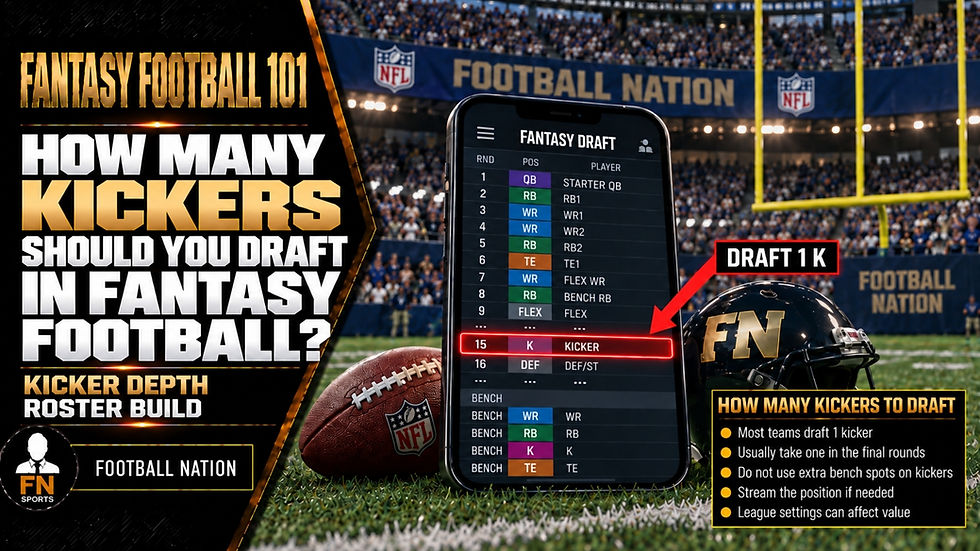
Most fantasy managers should draft exactly one kicker, usually in the final round. Carry one during the season, replace that player during the bye instead of stashing a second kicker, and spend premium draft picks and bench spots on running backs and wide receivers. The exceptions are leagues that start two kickers, impose strict transaction limits or use unusually deep benches.
That answer fits the standard lineup in the NFL Fantasy 101 roster guide: one kicker starts each week. The NFL’s 2026 fantasy draft kit also ranks 20 kickers, a useful reminder that viable choices extend beyond one tiny elite tier.
Why one kicker is the best default
A second kicker offers a second version of the same one starting slot. Backup running backs can gain larger roles after an injury, and young receivers can earn more targets. That makes the second kicker a weak use of limited bench space.
Roster construction matters more than predicting the season’s exact K1. A manager who understands how many running backs to draft, how many wide receivers to draft and how many tight ends to draft should treat kicker as the finishing piece.
Weekly kicker scoring depends on accuracy and leg strength, but also on offensive drives, red-zone outcomes, weather, coaching decisions and distance bonuses. Those conditions can change faster than preseason rankings, so spending for apparent certainty rarely produces enough advantage.
What round should you draft a kicker?
Use the final round as the default. The final two rounds are defensible only when every manager must fill a legal lineup, the kicker pool is moving and your preferred bench targets are gone. ESPN’s published draft-board guidance likewise says not to draft a kicker before the final round.
Do not move earlier because a famous kicker is available. A kicker pick cannot also become a breakout receiver, an injury-away running back or a value who fell beyond average draft position. The patience behind a late-round quarterback strategy is even more important here.
Kicker roster plan by league format
League setup | Draft | Carry | Two-kicker exception |
|---|---|---|---|
Typical 10- or 12-team, 1-K league | 1; final round | 1 | Briefly if waivers are unusually thin |
Shallow bench or early draft | 0 or 1 | 1 by kickoff | Usually never |
Deep bench or transaction limits | 1 | Usually 1 | Temporary second if replacing later is costly |
Two-kicker starting lineup | At least 2 | 2 starters | Third only if rules and bench depth support it |
These are Football Nation recommendations, not historical finish rates. Starting requirements, bench size, waiver rules and scoring settings override the default.
How to choose your one kicker
Start with role security: avoid unresolved competitions. Then prefer an offense likely to cross midfield often. Strong offenses create extra-point volume, while competent but imperfect red-zone offenses can create field-goal attempts. Finally, check whether your league awards extra points for long field goals or subtracts points for misses.
The goal is a stable Week 1 option at the correct price, not a perfect season-long forecast. The difference between a good pick and a bad one is often the opportunity cost paid, not the player’s name.
Should you ever draft zero kickers?
Yes, when league rules allow it and the draft occurs well before Week 1. Use the final pick on a high-upside player, monitor roster news, then add a kicker before lineups lock. Confirm that the platform permits an incomplete roster and waivers will clear before kickoff. This is a short information play, not permission to forget the position.
What should you do during the bye week?
In most leagues, drop the kicker and add a replacement. Holding two sacrifices a bench spot that could contain a running-back handcuff, developing receiver or streaming option at a scarcer position. A strong start should not make a kicker untouchable when replacements are available.
The exception is structural. Deep benches, severe transaction limits, large waiver fees or an unusually scarce player pool can make a temporary second kicker reasonable. Decide from rules and availability, not attachment to early-season points.
Common kicker mistakes
Avoid drafting insurance, selecting the position before useful skill players are gone, ignoring distance-based scoring and confusing real-life reputation with fantasy opportunity. Reassess role, offense, matchup and weather each week.
Managers using Zero RB especially value late bench shots. Football Nation’s D/ST draft strategy applies the same principle: one starting slot rarely deserves two draft picks in a normal shallow league.
Football Nation takeaway
Draft one kicker at the end and plan to manage the position. Draft zero only as a temporary pre-Week 1 tactic when rules clearly allow it. Draft two only when the lineup or transaction structure creates a measurable reason. In ordinary leagues, the second kicker is not protection—it is a lost chance to roster upside.
Frequently asked questions
How many kickers should I draft in a 12-team league?
One. A typical 12-team league starts one kicker, and the replacement pool usually makes another skill-position player more useful than a backup kicker.
What round should I draft a kicker?
The final round. Move to the second-to-last only if a filled lineup is required and your preferred bench targets are gone.
Should I draft a backup kicker for the bye?
Usually no. Replace your kicker during the bye. A temporary second kicker fits only deep or transaction-restricted leagues.
Can I leave the draft without a kicker?
Only if an incomplete roster is allowed and you can add one before Week 1. Confirm waiver timing first.
Does PPR change kicker strategy?
Not directly. Receptions do not affect kickers, but PPR increases the value of pass-catching depth and reinforces waiting until the end.


Comments