


Jeffery Simmons Gives Chicago Three Ways to Improve a Four Man Rush
Chicago did not just add a productive defensive tackle when Jeffery Simmons arrived. The Bears added a player who can change how an offense sets its protection before the ball is snapped. His first game supplied an encouraging test case: six tackles, two tackles for loss, one sack and one pass breakup, according to the Bears' official debut report. The important question is what that performance can make possible for the rest of the front.
This is not a claim that one strong night has solved the defense. It is a film and role based projection built from a one game sample, the Bears' season statistics through Week 8 and Chicago's current personnel. Sources were checked at 2026-11-06 04:40:45 AM CST.
The debut changed the front's math
Seattle averaged 3.0 yards per play while Simmons was on the field in his Chicago debut. The Bears finished with three sacks, six quarterback hits and five tackles for loss. They allowed three points over Seattle's first five possessions and stopped 10 of 11 third downs. Those numbers matter less as a promise than as a map of how the pieces can fit.
Montez Sweat recorded three quarterback hits and one official sack. Two additional sacks were erased by penalties. In the team's Nov. 5 analysis, Sweat said Simmons creates opportunities for other rushers. That is the central football consequence. Interior pressure forces a quarterback to move before the edge rush is finished, while extra protection devoted inside can leave a tackle isolated outside.
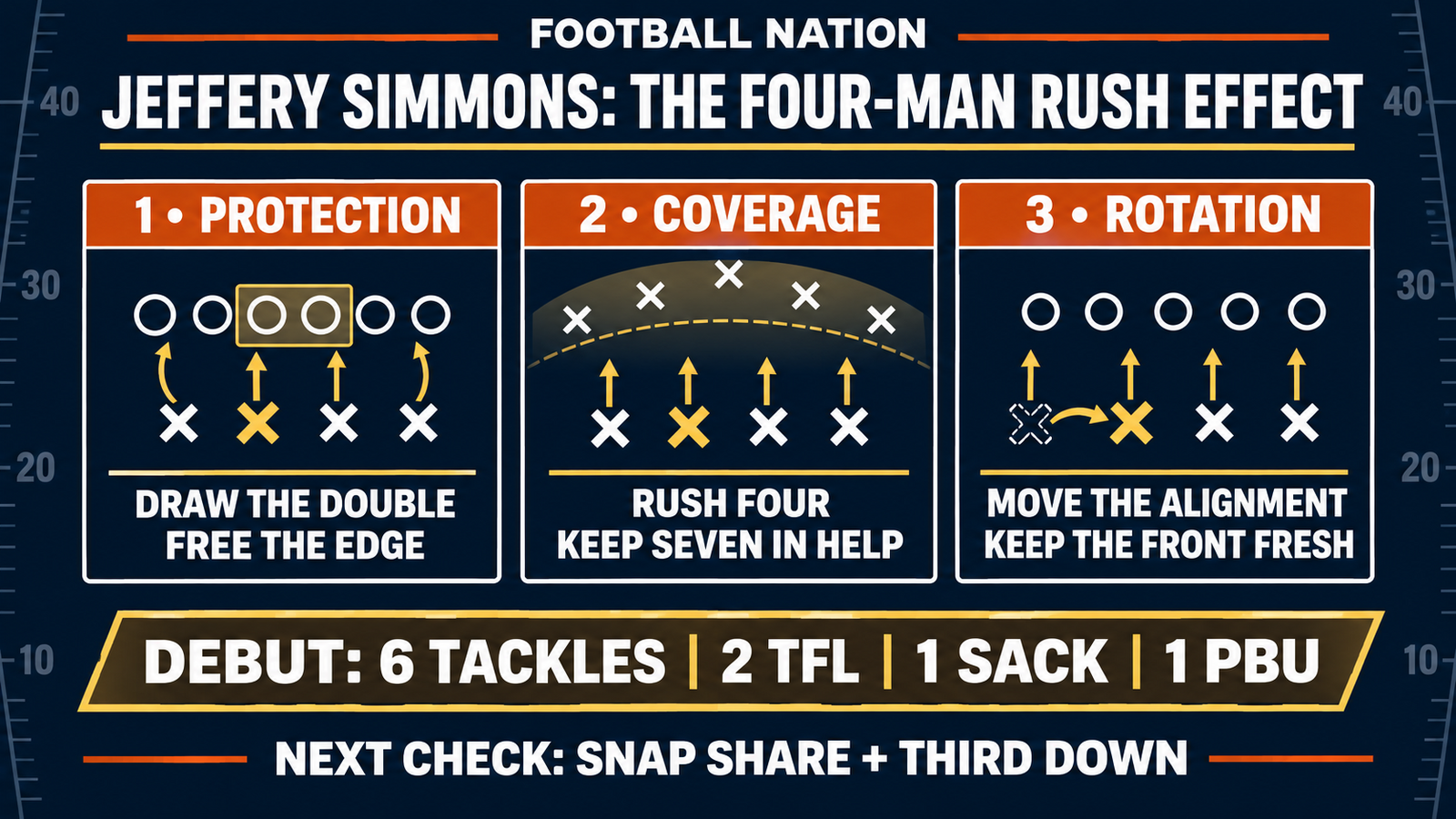
Original Football Nation explanatory graphic. Sources: Chicago Bears Simmons debut report, Nov. 5 teammate analysis and Week 8 statistics. Credit and rights: Football Nation original editorial graphic, created Nov. 6, 2026.
1. Draw the double and free the edge
The first benefit is simple protection stress. If a guard can block Simmons alone, the offense can slide help toward Sweat or chip an edge rusher with a back or tight end. If Simmons wins that matchup quickly, the offense must change the count. A center can turn toward him, a back can scan inside first, or the protection can slide into the tackle gap. Each answer removes help from somewhere else.
Chicago does not need every favorable matchup to become a sack. A hurried throw, a checkdown before the sticks or a quarterback who climbs into a second rusher is a successful pressure result. Simmons can therefore raise Sweat's value even when Simmons does not record the finishing statistic.
2. Rush four and keep seven in help
The second benefit appears behind the rush. Chicago entered the week leading the NFL in third down defense at 23.8 percent, with opponents converting 19 of 80 attempts, according to the Bears' official Week 8 numbers. A front that can create pressure with four lets the defense keep seven players in coverage more often. That gives the secondary more bodies for route exchanges, crossing patterns and late help over explosive targets.
The choice is especially valuable on third and medium. A heavy blitz can speed up the quarterback, but it also opens a clean answer if protection holds or a receiver wins immediately. Four man pressure asks the quarterback to process a fuller coverage picture while the pocket shrinks. Simmons gives Chicago a better chance to win that trade without guessing.
The NFL's public video post shows the disruption from Simmons' Chicago debut. Open the original status on X.
3. Move the alignment and protect the rotation
The third benefit is flexibility. Simmons can attack a guard, shade a center or align wide enough to stress a tackle and guard combination. Changing the picture prevents an offense from building one protection rule around him. It also lets Chicago choose which teammate gets the cleaner lane on a specific down.
That flexibility can make the rotation more useful instead of merely deeper. The Bears can pair a penetrating tackle with a sturdier interior body, move Simmons to hunt a favorable matchup, or reduce Sweat inside for a passing situation without asking one player to carry every snap. The goal is to keep the front's best rush traits on the field while limiting predictable alignments.
Fantasy consequence
In individual defensive player formats, Simmons and Sweat both gain appeal when scoring rewards sacks, quarterback hits and tackles for loss. Simmons has the direct interior role, while Sweat can benefit from protection turning inward. Managers should check their scoring rules before treating either player as an automatic start because big play formats value pressure outcomes very differently from tackle heavy formats.
For team defense formats, Chicago's defense and special teams unit gains a higher sack ceiling if four man pressure remains effective. That is a matchup dependent upgrade, not a guarantee. Turnovers are volatile, and a strong real football rush can still produce an ordinary fantasy total if it does not end drives with sacks or takeaways.
The strongest counterargument
The sample is one game. Seattle's protection plan, game situation and third down distance shaped the result, and future opponents will answer with double teams, quick throws, screens and movement passes. Penalty nullified sacks also are not official production. Chicago needs evidence that the pressure structure travels from one opponent to the next before calling it a stable identity.
The next checkpoint
The next evaluation is not simply whether Simmons records another sack. Watch his snap share, where he aligns on third down, how often protection turns toward him and whether Chicago can rush four while preserving seven defenders in coverage. If the Bears continue creating one on one chances for Sweat and forcing early throws without extra rushers, Simmons' largest contribution may appear in everyone else's stat line.
For continuing team coverage, visit the Football Nation Chicago Bears page. For separate context on the offense, see our analysis of Chicago's run game before contact.
Sources and check time
Chicago Bears official Simmons debut report, Nov. 3, 2026; Chicago Bears official Sweat and Simmons analysis, Nov. 5, 2026; Chicago Bears official Week 8 statistics; Chicago Bears 2026 team statistics; NFL public video status on X. All sources checked at 2026-11-06 04:40:45 AM CST. Comparison period: 2026 regular season through Week 8 and Simmons' first Chicago appearance.


Comments