


Pollard's Two Game Surge Gives Tennessee a Second Half Blueprint
Updated: 2 hours ago
The Tennessee Titans entered their Week 9 bye at 1–7, but the final two games before the break produced the clearest offensive idea of their season. Tony Pollard ran for 246 yards and five touchdowns on 46 carries against Cleveland and Cincinnati. That is 5.35 yards per carry, and it came after he had 319 yards and one rushing touchdown on 87 carries across the first six games.
That comparison matters more than a generic call to run the ball. Tennessee still lost both games. The useful lesson is that Pollard gave the offense a credible early down threat that could force a defense to respect the backfield before Cam Ward made the next decision. The second half plan should preserve that relationship without making Pollard responsible for fixing every down.
The two game split changes the evaluation
Pollard's season line through eight games was 565 rushing yards on 133 attempts with six rushing touchdowns. Subtract the Cleveland and Cincinnati performances and the first six games come to 319 yards on 87 attempts, or 3.67 yards per carry. The final two games lifted that rate by nearly 1.7 yards per carry.
The jump was not merely volume. Pollard averaged 5.2 yards on 25 carries against Cleveland and 5.6 on 21 carries at Cincinnati. He also scored on runs of 36 and 40 yards in consecutive weeks. Explosive plays can make a small sample look stronger than it is, but they also show what Tennessee gains when Pollard reaches the second level instead of absorbing contact before the design has time to develop.
The run game is a quarterback tool
Ward's first career 300 yard passing game came at Cincinnati, where he completed 26 of 40 attempts for 304 yards, two touchdowns and a 104.6 passer rating. It would be too strong to credit every passing gain to play action. The more defensible point is structural: a respected run threat can hold second level defenders, simplify coverage pictures and create cleaner spacing for defined throws.
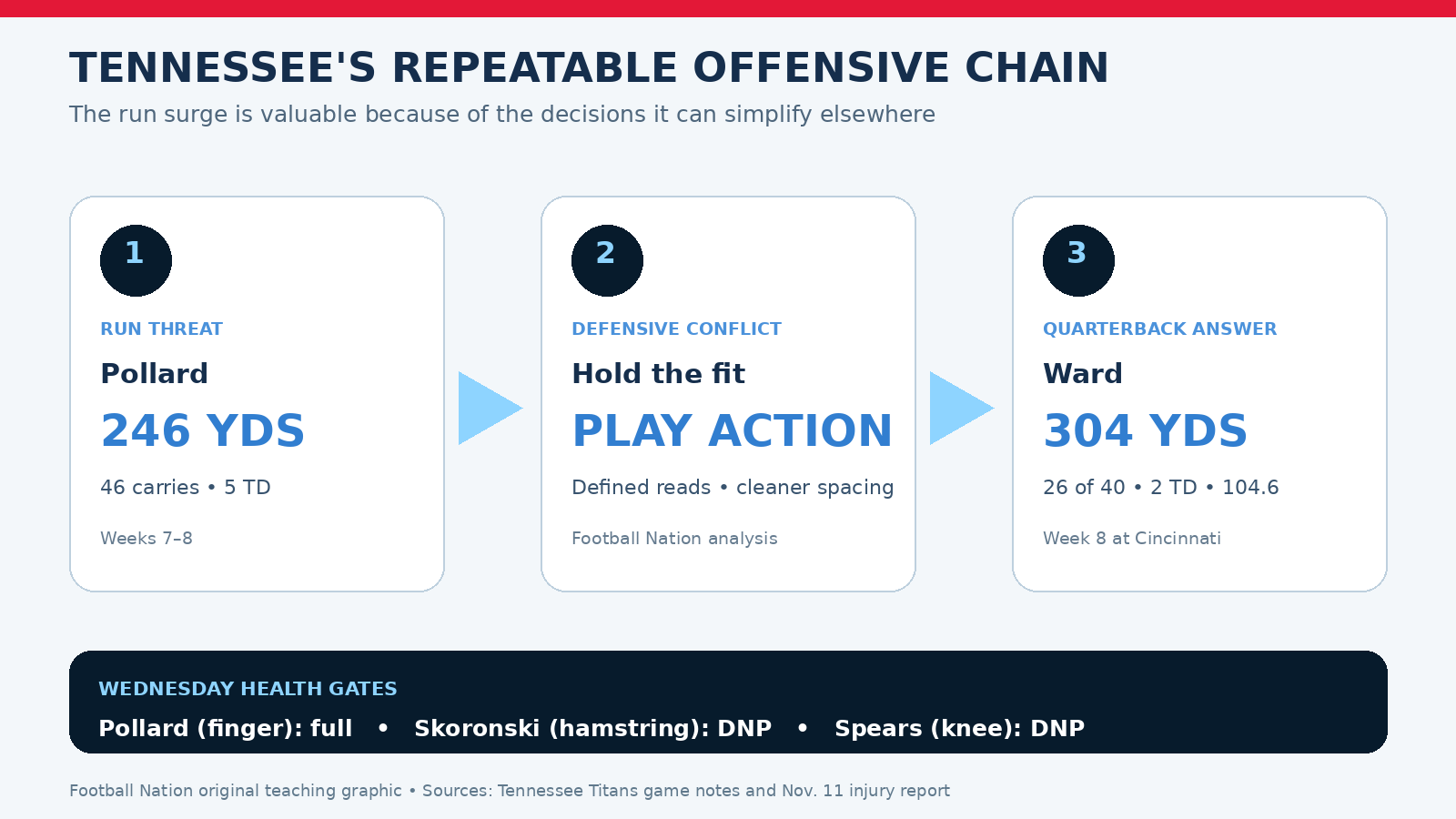
The coaching objective should be balance within the same presentation. Tennessee can use the same backfield picture to run, throw quickly or move Ward's launch point. That keeps the run game from becoming a predictable run on first down, run on second down formula. Pollard's surge is most valuable when it changes what the defense must prepare for.
Wednesday's health report sets the ceiling
Pollard was a full participant Wednesday despite a finger injury. That is encouraging, but it is only the first practice snapshot of the week. Guard Peter Skoronski did not participate because of a hamstring injury, and Tyjae Spears did not participate because of a knee injury. Skoronski's status affects the quality and continuity of the blocking picture. Spears' status affects whether Tennessee can share work and preserve Pollard's burst.
The next two injury reports matter more than projecting a Sunday workload from Wednesday alone. A return to limited or full work for Skoronski or Spears would strengthen the plan. Continued absence would raise both the opportunity and the wear risk for Pollard.
Fantasy consequence
In standard and half PPR formats, Pollard has the strongest Titans case because his touchdown role and recent rushing efficiency can produce value without a large receiving total. In full PPR, his ceiling still depends on targets and game flow. If Spears is active, a more balanced rotation could reduce raw volume while helping Pollard remain explosive.
Ward is better treated as a matchup dependent streamer or superflex option than an automatic one quarterback league starter. His 304 yard game established upside, but one performance does not erase a season of uneven protection and late game mistakes. The better fantasy signal would be another efficient passing day created alongside a functional run game.
The strongest counterargument
The sample is only two games, and both ended in losses. Cleveland limited Tennessee after the fast start, while Cincinnati forced an overtime game in which Tennessee still committed costly mistakes. Five Pollard touchdowns also make the two game production difficult to repeat. If the offense cannot stay on schedule without a long run or a red zone touchdown, the apparent blueprint may be a hot streak rather than a durable identity.
That is why the next test is process, not another arbitrary rushing yard threshold. Watch whether Tennessee creates manageable third downs, protects the football and gives Ward answers when Jacksonville crowds the box. The plan succeeds if Pollard's presence improves the whole offense, even on a play when he does not touch the ball.
Evidence from Wednesday
Jim Wyatt, the Tennessee Titans' senior writer and editor, posted Pollard's Wednesday locker room availability at 12:05 p.m. Central on Nov. 11. Football Nation opened and verified the public status URL before publication.
Next checkpoint
Tennessee's Thursday and Friday practice reports are the immediate checkpoints. The broader test arrives Sunday, Nov. 15 at noon Central against Jacksonville. This is a team self scout, not a game preview: the question is whether the Titans keep the run threat connected to Ward's development across the second half of the season.
Sources and check record
Sources checked Nov. 11, 2026 at 4:10 p.m. CST: Tennessee Titans Week 7 postgame notes, https://www.tennesseetitans.com/news/titans-browns-week-7-postgame-notes ; Tennessee Titans Week 8 postgame notes, https://www.tennesseetitans.com/news/titans-bengals-week-8-postgame-notes ; Tennessee Titans Nov. 11 injury report, https://www.tennesseetitans.com/news/week-10-injury-report-titans-vs-jaguars ; Tennessee Titans Wednesday quick hits, https://www.tennesseetitans.com/news/quick-hits-on-the-titans-from-wednesday-of-jaguars-week-x6270 ; public X status, https://x.com/jwyattsports/status/2120578670285013367. Comparison periods: Weeks 1–6 versus Weeks 7–8 of the 2026 regular season.


Comments