


Saquon Barkley NFL Top 100 Ranking 2026: Is No. 34 Too Low?
Saquon Barkley’s newest NFL Top 100 ranking has produced one of the sharpest reversals in this year’s player-voted countdown. Bleacher Report’s August 6 update listed the Philadelphia Eagles running back at No. 34—33 places below the No. 1 position he held in 2025. That is dramatic enough to sound like a verdict. It is better understood as a snapshot of two very different seasons.
The verified production explains part of the fall. Barkley rushed 280 times for 1,140 yards and seven touchdowns in 2025, according to the Eagles’ official statistics. Bleacher Report credited him with 1,413 scrimmage yards and nine total touchdowns. Those are strong numbers, but they followed a historic 2024 campaign that made him the first running back since Adrian Peterson in 2012 to earn the No. 1 spot on the NFL’s list.
Football Nation’s view: No. 34 is not disrespectful, but it may overcorrect for the difference between an extraordinary peak and a merely very good season. The real 2026 question is not whether Barkley can repeat every record from 2024. It is whether he can restore enough explosiveness and efficiency to remain the centerpiece of a contender.
What the Saquon Barkley NFL Top 100 ranking actually says
The NFL Top 100 is based on player voting, which makes it useful but not absolute. It measures peer perception after the previous season; it is not a projection model, a fantasy ranking or a complete accounting of positional value. A 33-spot fall therefore tells us that Barkley’s 2025 season changed how players evaluated his place among the league’s stars. It does not mean 33 players suddenly became better football players in a laboratory.
The starting point matters. The NFL’s official 2025 Top 100 reveal placed Barkley first after he won Offensive Player of the Year and led Philadelphia’s championship run. He entered that countdown with rare momentum: 2,005 regular-season rushing yards, an NFL single-season record for combined regular-season and postseason rushing yards, and a defining role in the Eagles’ offense.
By contrast, the 2026 placement follows a season in which Barkley remained productive without dominating the league’s weekly conversation. Bleacher Report’s ranking update reported the No. 34 position and noted that Philadelphia fell to 19th in scoring. That team context matters because running-back production depends heavily on blocking, game script and the offense’s ability to sustain drives.

Saquon Barkley at an Eagles Thanksgiving community drive on November 6, 2024. Photo: PistonsFan2223, CC BY-SA 4.0, via Wikimedia Commons.
Why Barkley fell from No. 1 to No. 34
The simplest explanation is regression from an almost impossible standard. Barkley’s 2024 workload and output were career-defining. When the baseline is 2,000 rushing yards and a championship, a 1,140-yard season can look disappointing even though only a small group of NFL backs reaches that mark. Rankings often punish the decline from a peak more aggressively than they reward sustained high-level play.
Efficiency also moved in the wrong direction. Barkley averaged 4.1 yards per carry in 2025. That is workable volume-back production, but it did not create the same fear as the explosive runs that defined his first Eagles season. The difference is not just aesthetic. Long gains change defensive structure, create scoring drives without requiring ten perfect plays and force safeties to honor the run before the ball is snapped.
Philadelphia’s broader offensive downturn supplied another signal to voters. A running back can produce 1,000 yards while the offense still struggles to create points consistently. That is not solely Barkley’s responsibility, and it would be misleading to treat team scoring rank as an individual statistic. Still, top-10 recognition usually follows players who bend games around their presence. In 2025, the Eagles did not consistently look transformed by the run game in the way they did a year earlier.
Availability was not the problem. Barkley appeared in 16 regular-season games, and the Eagles’ current player profile lists him as Philadelphia’s active No. 26 running back entering 2026. The ranking decline is therefore best read as a performance adjustment, not an injury dismissal or a roster-status question.
The case that No. 34 is too low
The strongest argument for Barkley begins with the floor he maintained. He produced a second consecutive 1,000-yard season in Philadelphia and still finished with 1,413 yards from scrimmage. That is not the profile of a player surviving on reputation. It is evidence of a back who remained capable of carrying substantial volume even when the offense around him became less efficient.
His touchdown total also deserves context. Nine scores are a decline from his 2024 peak, but they still reflect meaningful red-zone and open-field value. Touchdowns can swing with offensive line health, quarterback decisions and how often a team reaches the goal line. A voter can reasonably downgrade Barkley without concluding that he ceased to be one of the league’s most complete backs.
There is also a positional-value trap in any cross-position ranking. Quarterbacks, edge rushers and receivers influence the modern game in different ways, and voters do not share one formula. Barkley’s No. 34 placement may say as much about how players value running backs after a down year as it says about his individual tape. The same ambiguity appears in Football Nation’s recent debates over George Pickens at No. 36 and Justin Herbert at No. 39—the list invites comparison, but it cannot fully normalize different jobs.
A ranking in the mid-30s still places Barkley among the sport’s recognized stars. The objection is not that he was treated as ordinary. It is that the fall seems to erase too much of the value in a 1,140-yard season. A more balanced interpretation would place him below the transcendent 2024 tier but keep him closer to the group of players who can dictate a defense’s weekly plan.
What Barkley must prove in 2026
The first test is explosive-play frequency. Philadelphia does not need another 2,000-yard season to validate Barkley’s standing, but it does need more runs that reach the second and third levels. A rise from 4.1 yards per carry would be the cleanest statistical sign that the blocking, decision-making and burst are working together again.
The second test is offensive leverage. The Eagles’ 2026 running-back preview identifies Barkley as the primary back and notes his back-to-back 1,000-yard seasons. If defenses must commit extra bodies to stop him, Philadelphia should gain cleaner play-action windows and lighter coverage outside. Barkley’s value should therefore be judged partly by the opportunities his presence creates, not only by his rushing total.
The third test is how the Eagles manage his workload at age 29. Volume remains one of Barkley’s strengths, but Philadelphia’s objective is to have him fresh for meaningful late-season football. A slight reduction in touches would not automatically signal decline if it produces better efficiency and preserves his impact. The ideal season is not necessarily the one with the most carries; it is the one in which his best carries arrive when the games matter most.
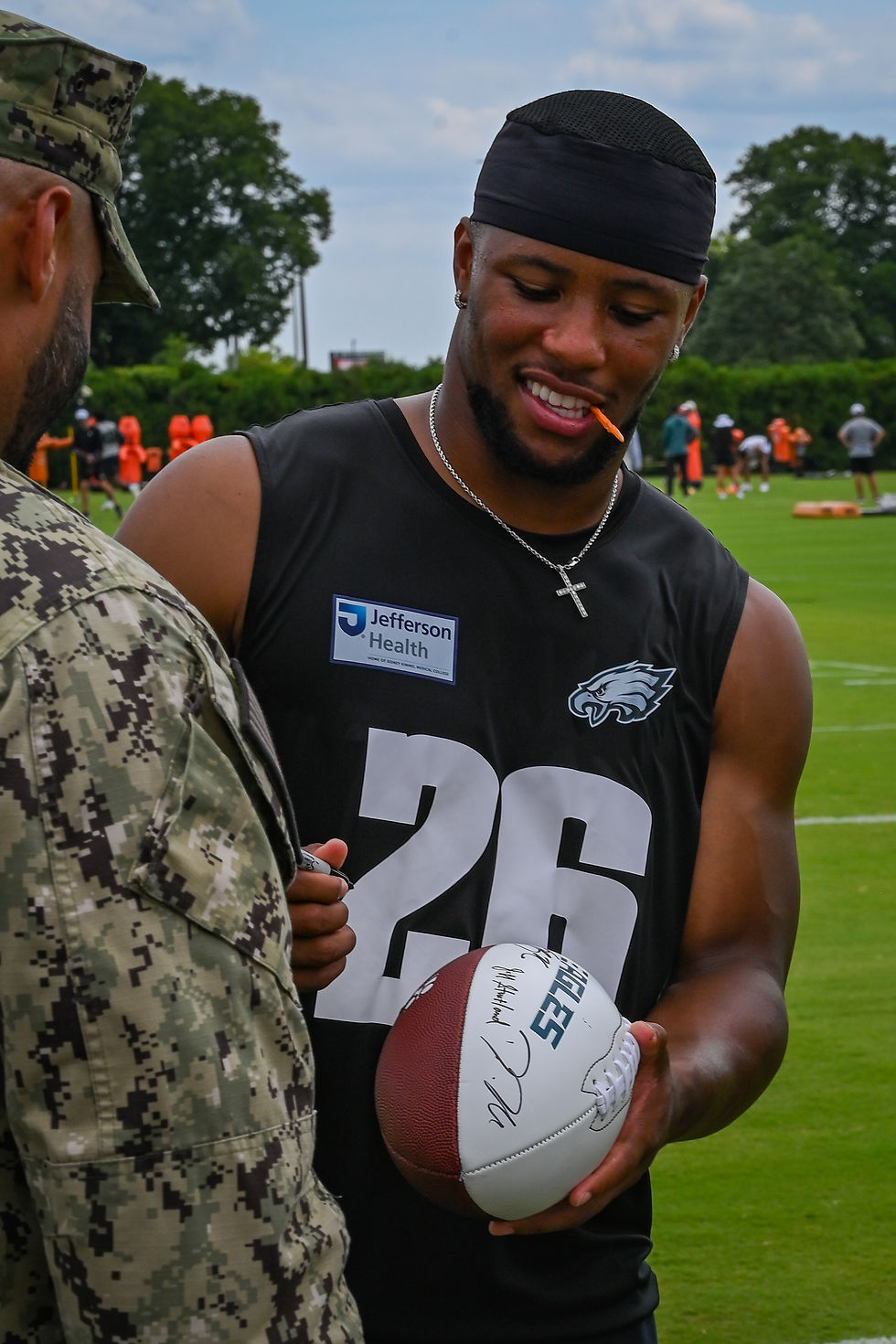
Saquon Barkley signs a football for a service member at Eagles training camp at the NovaCare Complex on July 26, 2025. Photo: Staff Sgt. Charles Casner, public domain U.S. Air National Guard work, via Wikimedia Commons. The branded cover is a 16:9 derivative of this photograph.
Why the ranking matters for the Eagles
Philadelphia’s ceiling is connected to Barkley’s ability to make the offense less predictable. The Eagles can survive with efficient quarterback play and a good defense, but their most dangerous version forces opponents to choose between adding a defender to the box and conceding space elsewhere. Barkley is the player who makes that choice painful.
That is why the 2026 schedule will quickly move this debate from television and social media into real game plans. Divisional opponents already know the personnel and tendencies. Football Nation’s Eagles–Cowboys Week 12 coverage illustrates the kind of rivalry environment in which run-game efficiency affects every down, from protection calls to fourth-quarter clock control. If Barkley again becomes the problem opponents cannot solve with familiar answers, No. 34 will age poorly.
Football Nation takeaway
Barkley’s drop from No. 1 to No. 34 is understandable because the 2025 season did not reproduce his historic first year in Philadelphia. The efficiency declined, the explosive-play aura faded and the Eagles’ scoring offense lost force. Those are legitimate reasons for players to move him down.
The size of the drop is the debatable part. A 1,140-yard rusher with 1,413 yards from scrimmage, nine total touchdowns and a confirmed lead role is still more than a name living off an old highlight reel. No. 34 recognizes Barkley as a star but may undersell how much functional value he retained during a less spectacular season.
Football Nation’s verdict: the ranking is defensible, but slightly too low. Barkley no longer owns the automatic No. 1 case he carried into 2025, yet one efficient rebound could return him to the top 20. His 2026 season will be less about chasing a record and more about proving that last year’s drop was a correction—not the beginning of a permanent decline.


Comments