


What Is the Sting Linebacker? Alabama Terminology Explained
Updated: 6 hours ago
Sting is the name used for a weakside linebacker role in descriptions of Kane Wommack’s Alabama defense. The closest familiar comparison is a Will linebacker: a defender working behind the front who must fit runs, cover space and blitz when assigned.
Part of Football 101. Explore the guide to choose your next topic.

The nickname is scheme language. It does not establish a universal NCAA position or tell you the player’s job on every snap.
Think linebacker away from the line
The central distinction is between an off ball linebacker and a defender primarily attacking from the edge. A Sting generally starts behind the defensive line, reads the blocking and reacts through the appropriate gap or coverage window.
The Sam, Mike and Will guide provides the traditional vocabulary. A Mike commonly works as a central linebacker; Will commonly denotes the weak side. Defenses can define formation strength differently, adjust to motion and exchange tasks, so weak side does not mean one permanent side of the television screen.
Three responsibilities to watch
Against a run, the linebacker must diagnose the path, work around or through blocks and arrive in the assigned gap under control. Speed is valuable only if it reaches the correct place.
Against a pass, he can occupy an underneath zone or match a back or tight end according to the call. Zone coverage requires awareness of routes entering the area; man assignments require staying connected to the designated receiver.
On a pressure call, he can attack a gap from depth. The fact that he blitzes on one snap does not make the position an edge role.
For example, the same linebacker might fill inside against a run, carry a back into the flat on a pass and rush through a gap on third down. The position stays the same while the assignments change.
Keep the name in context
Alabama’s hiring announcement confirms Wommack arrived as defensive coordinator and inside linebackers coach in 2024. The Sting label itself is documented in the cited reporting on that system; the public coaching biography is not a complete playbook.
Use the label as an introduction, then study alignment and responsibility. Another school can use Sting differently, and a staff change can change the terminology.
Keep learning
Wolf linebacker: Contrast the edge role in the same terminology family.
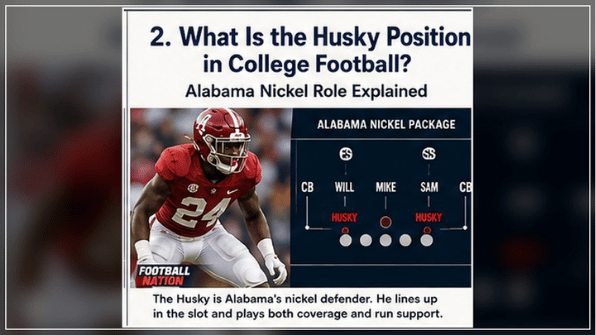
Husky defender: Compare the slot role with the linebacker role.
Quarterback spy: See an assignment a linebacker may receive without changing position.
Browse the Football 101 collection for more rules and strategy guides.


Comments