


Week 3 Fantasy Trade Values: Buy Rice and Tuten, Sell Montgomery
The best Week 3 trade move is to buy role growth before the box scores fully price it in and sell name value when opportunity is already slipping. In half-PPR redraft leagues, Football Nation is buying Rashee Rice and Bhayshul Tuten, selling David Montgomery and Juwan Johnson at the right return, and holding Marvin Harrison Jr. and George Kittle. These are price-sensitive recommendations, not commands to force a deal.
All usage and status checks below were completed at 6:04 a.m. Central on September 23. League size, lineup requirements and scoring can move a player's value by a full tier, so use the example packages as negotiation ranges rather than universal prices.
Related Week 3 context: Football Nation's waiver priorities, the best post-waiver stashes and the current injury report.
Cross-check this price board with the Week 3 fantasy market pulse, Week 3 sleepers, Week 2 running back results, Week 2 tight end results, Week 2 market pulse and Week 2 stashes before accepting a deal.
Week 3 trade board
BUY — Rashee Rice, WR, Chiefs: Pay a solid WR3 plus bench depth; stop before giving a locked-in weekly RB2.
BUY — Bhayshul Tuten, RB, Jaguars: Pay a touchdown-dependent starting tight end or a volatile WR3.
SELL — David Montgomery, RB, Texans: Move him for a younger receiver with six-plus-target upside.
SELL — Juwan Johnson, TE, Saints: Sell only if the return reflects a top-eight tight end.
HOLD — Marvin Harrison Jr., WR, Cardinals: Reject low-end WR3 offers after the two-game target drought.
HOLD — George Kittle, TE, 49ers: Hold unless the return is an every-week top-five option at another position.
Buy: Rashee Rice, Chiefs WR
Rice's four catches for 83 yards on six targets against Indianapolis looked ordinary next to Patrick Mahomes' 382-yard night. That is the opportunity. Rice still produced 20.8 yards per catch and created a 30-yard gain, while the market may focus on Kansas City's crowded target tree and his reduced slot usage. His 2025 baseline was 71.4 receiving yards per game when healthy, a reminder that efficient intermediate work with Mahomes is not a two-week invention.
The strongest case against the buy is real: Travis Kelce, Kenneth Walker III and Xavier Worthy all demand touches, and Rice is spending less time in the slot. A perimeter-heavy role can lower the easy-catch floor that made him valuable. This recommendation changes if Rice stays below six targets or loses routes in each of the next two games.
Example half-PPR offer: a boom-or-bust WR3 plus a useful handcuff. In superflex, do not move a starting quarterback for him. The walk-away point is any price that treats Rice as a secure top-10 receiver today.
Buy: Bhayshul Tuten, Jaguars RB
Tuten has now handled 15 carries in Week 1 and 13 in Week 2. Against Denver, he ran for 65 yards and a touchdown, caught both targets and led Jacksonville's backfield in snaps, routes and touches. NFL Fantasy's current Tuten outlook supports the upside case. The repeatable signal is early-down work plus evidence that he is not automatically removed from the passing game.
The counterargument is that 14.2 fantasy points were touchdown-assisted, while Chris Rodriguez Jr. and other backs can still take passing-down or goal-line work. Jacksonville also scored only 13 points in Denver. The call flips if Tuten falls below 10 opportunities in two straight healthy games or stops leading the backfield in routes.
Example half-PPR offer: a touchdown-dependent starting tight end such as Juwan Johnson, if you have depth at the position, or a volatile WR3. Do not pay a dependable 15-touch back; the discount is the point.
Sell: David Montgomery, Texans RB
Montgomery's 28.9-point opener can still anchor negotiations, but Week 2 exposed the risk. ESPN's workload review found Houston rotated Montgomery and Woody Marks by drive, their snaps were close, and Montgomery finished with eight touches and 4.4 fantasy points while Marks reached 13 touches. A drive-based split creates week-to-week fragility because the back assigned to the wrong series can miss the best scoring chances.
The strongest argument for holding is Montgomery's proven touchdown conversion and potential goal-line role. He can remain useful without dominating snaps. This becomes a hold if he reaches at least 15 opportunities or clears a 60 percent snap share in consecutive games.
Example half-PPR return: target a younger receiver with a realistic six-to-eight-target path, including a discounted Marvin Harrison Jr. if that manager is frustrated. If the best offer is only waiver-level depth, keep Montgomery and use him as a matchup flex.
Sell: Juwan Johnson, Saints TE
Johnson caught all four targets for 66 yards in New Orleans' win at Baltimore, so this is not a panic sell. It is a chance to test whether another manager sees last season's 77 catches for 889 yards and pays for a stable top-eight tight end. The early concern is structural: his route participation fell in Week 2 even though the box score remained efficient, and New Orleans added competition to the position.
The case against selling is that Tyler Shough has established trust with Johnson and the Saints are willing to throw at volume, a relationship Johnson discussed after the Week 2 win. Four catches can be a viable tight-end floor. Withdraw the sell tag if Johnson returns to an 80 percent route-participation range or earns six-plus targets in consecutive games.
Example half-PPR deal: Johnson plus a bench receiver for Tuten, or Johnson straight up for a receiver with weekly flex volume. In tight-end-premium formats, require materially more; scarcity changes the price.
Hold: Marvin Harrison Jr., Cardinals WR
One catch on four targets through two games is alarming, especially because Harrison's Week 2 snap share fell and Michael Wilson handled more single-receiver work. Selling now, however, usually locks in the worst possible version of the market. Harrison remains an active Cardinals receiver and still ranked third among Arizona wideouts in snaps and tied for second in routes in Week 2, leaving a path for targets to recover without an injury ahead of him.
The strongest counterargument is that this may be a role demotion rather than variance. Arizona can continue treating Wilson as the more dependable every-down receiver. Change the hold to a sell if Harrison again runs fewer routes than Wilson and stays below six targets in both of the next two games.
Practical price: reject a single low-end WR3. A two-for-one offer containing one startable receiver and one useful running back is enough to reopen the conversation.
Hold: George Kittle, 49ers TE
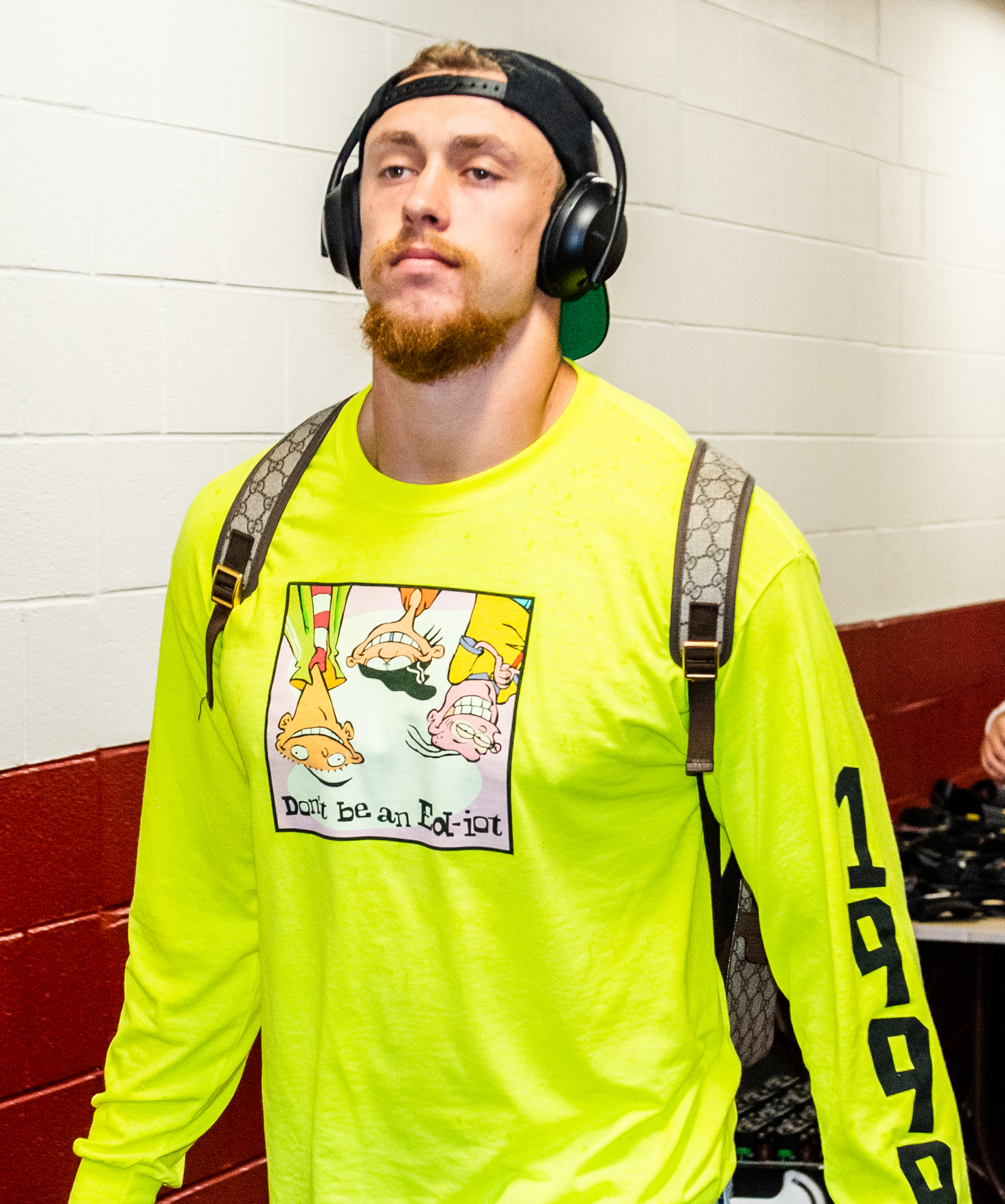
Photo: George Kittle before a 2019 game. AlexanderJonesi, CC BY-SA 2.0 via Wikimedia Commons.
Kittle's four catches on four targets for 80 yards and a touchdown against Miami showed that his ceiling survived the Achilles rehabilitation. More important than the score, his route participation increased from Week 1. San Francisco is still managing his snaps, but a rising route trend matters more for rest-of-season value than one early touchdown.
The downside is obvious: a 32-year-old tight end returning from a torn Achilles carries workload and recurrence risk, and four targets will not support elite production every week. Move from hold to sell if his route rate stalls below roughly 60 percent for two games or if he returns to the injury report with Achilles-related soreness.
Practical price: do not trade Kittle for a streaming tight end and bench piece. Consider a deal only if it solves a weekly lineup problem with a dependable top-20 running back or receiver.
Football Nation conclusion
Trade the workload, not the Week 2 points. Rice and Tuten have routes and touches worth buying before their prices harden. Montgomery and Johnson are useful players, but their recent production can command more than their changing roles guarantee. Harrison and Kittle belong in the hold lane because selling either today would make a two-game sample do too much work. Before accepting any deal, check Wednesday practice reports and confirm that the role—not just the result—still matches the price.
Research note: Official Chiefs, 49ers, Saints and Cardinals reporting; NFL Fantasy; and ESPN fantasy usage analysis were checked September 23, 2026, at 6:04 a.m. Central. Confirmed facts are separated from Football Nation's trade analysis.


Comments