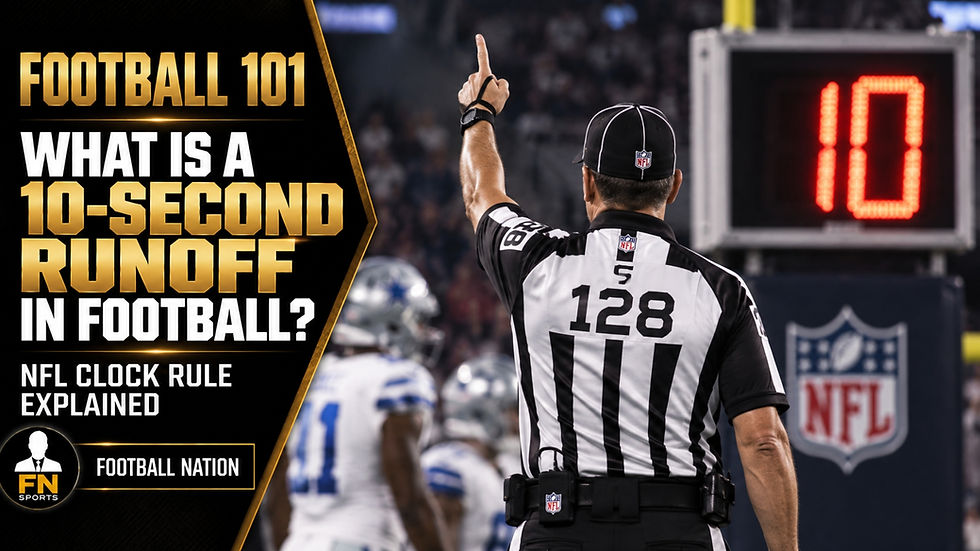
What Is a 10-Second Runoff in Football? NFL Clock Rule Explained
- Football Nation
- 1 day ago
- 6 min read
A 10-second runoff is an NFL clock correction used near the end of a half when an action, foul or replay stoppage would otherwise give a team time it should not receive. The basic idea is simple: if the game clock was running and the rules require the clock to keep moving, officials can remove 10 seconds before restarting play. It is not an automatic penalty for every late flag.
Under the 2026 NFL Rulebook the main runoff rules apply after the two-minute warning of either half. The exact result depends on who caused the stoppage, whether the clock was running, whether a timeout is available and whether replay changed the ruling.
Why does the NFL have a 10-second runoff?
Without a runoff, an offense could gain a clock advantage by committing an act that stops time. Imagine a team with 22 seconds left and no timeout. If an illegal action stops the clock immediately, the offense might be able to regroup and run another play even though the clock would have continued after a legal result. Removing 10 seconds offsets part of that unearned stoppage.
The rule is especially important after the two-minute warning because every second can determine whether an offense reaches field-goal range, earns a first down or runs out of time. The runoff protects the clock from being manipulated, but it does not automatically end the half unless too little time remains and no timeout or other rule option preserves it.

When can a 10-second runoff happen?
Rule 4, Section 7 lists several offensive actions that can trigger the procedure when they occur after the two-minute warning while the game clock is running. The list includes intentional grounding, certain illegal forward or backward passes, illegal batting or kicking out of bounds, and fouls or illegal acts that improperly conserve time. A substitution violation while the ball is dead and time is running can also bring a five-yard penalty plus a runoff.
The most familiar example is intentional grounding. The quarterback cannot escape both the loss of yardage and the running clock by throwing the ball to an empty area under pressure. The grounding penalty already includes loss of down and distance; inside the late-half clock window, the runoff can be added because the incomplete pass stopped the clock.
A pre-snap foul can create a similar issue when it stops a running clock. Football Nation’s false-start guide explains why the play is killed immediately. The late-clock runoff prevents that immediate whistle from becoming a free timeout for the offense. A hard count does not itself create a runoff; the relevant question is whether a qualifying foul or clock-conserving action occurred in the proper time window.
Situation | Timing | Clock action | Timeout/decline option |
Offensive time-conserving act | After the two-minute warning; clock running | 10 seconds removed; clock normally starts on ready | Offense may use a timeout; defense may decline runoff |
Illegal offensive substitution | After the two-minute warning; dead ball with time running | 5 yards plus 10-second runoff | Offense may use a timeout |
Replay reversal or nullified foul | After the two-minute warning; correct ruling would keep clock running | 10 seconds removed; clock starts on ready | Neither team may decline; either may use a timeout |
Defensive foul or excess injury timeout | Last 40 seconds; clock running | Not the standard offensive runoff; the half may end under Rule 4-7-3 | Defense timeout or offense clock option can preserve play |
Source: 2026 NFL Rule 4, Section 7. The table separates procedures that television broadcasts often group together. Football Nation’s broader penalties explainer covers how distance and clock enforcement can operate at the same time.
Can a team use a timeout to avoid the runoff?
Usually, yes—but the team allowed to use the timeout depends on the situation. For an offensive time-conserving action, the offense can spend a remaining timeout instead of losing 10 seconds. The game clock then starts on the snap after the timeout. That choice is valuable when fewer than 10 seconds remain because accepting the runoff could end the half.
The defense also has control in the standard offensive-foul procedure. It may decline the 10-second runoff and accept the yardage enforcement. If the defense declines the yardage penalty entirely, the runoff is also declined, the play clock is set to 25 seconds and the game clock starts on the snap. This is why a defense may reject the runoff when preserving time helps its own chance to possess the ball.
Replay is different. When a review after the two-minute warning changes the ruling and the correct result would have kept the clock running, neither team can simply decline the runoff. Either team may use a remaining timeout to prevent it. That difference matters because replay corrected the clock state rather than penalizing one team for deliberately conserving time.
Does every penalty inside two minutes cause a runoff?
No. This is the biggest misconception. The clock generally must have been running, the stoppage must fit a listed rule, and the play must fall inside the applicable late-half window. A pass-interference flag on a play that already ended with an incomplete pass does not automatically produce a 10-second runoff. Neither does a routine out-of-bounds play when the clock stops legally.
The phrase “inside two minutes” also needs precision. The rulebook says after the two-minute warning of either half. That means the procedure is tied to the official warning and the clock state, not merely a viewer seeing 2:00 on the scoreboard. Officials announce whether the runoff applies and give the appropriate team its timeout or decline option before resetting the clocks.
How replay can end a game
A replay reversal can create the most dramatic outcome. Suppose the on-field ruling stops the clock with eight seconds left, but review shows the runner was down in bounds and the clock should have continued. Rule 4-7-4 directs officials to remove 10 seconds. If neither team uses an available timeout, the correction can reduce the clock to zero and end the half.
The NFL has applied that principle in real games. In the Falcons-Lions game on September 24, 2017, a potential winning touchdown was reversed with eight seconds remaining. The runner was ruled down short, and the required runoff ended the game. NFL.com’s recap illustrates why replay must restore the clock consequence that would have followed the correct live ruling.
How does the clock restart?
After a standard offensive runoff, officials reset the play clock to 30 seconds and normally start the game clock on the ready-for-play signal. The offense must be prepared because the clock can begin before the snap. If the offense used a timeout to avoid the runoff, the game clock starts on the snap instead.
For a qualifying defensive action, the rule uses a different balance. The play clock is generally reset to 40 seconds, and the offense may choose to have the game clock start on the snap. Those options prevent the defense from using a foul or injury stoppage to drain the opponent’s remaining time.
What viewers should check
When a broadcast mentions a runoff, ask four questions: Was the game clock running? Had the two-minute warning occurred? Did a listed foul, illegal act or replay correction stop time that should have continued? Does the team with the relevant option have a timeout? Those answers usually explain both the 10-second deduction and the clock restart.
Do not assume the clock simply loses 10 seconds and stays stopped. The ready-for-play restart can be just as important as the deduction. An offense that is not lined up when the referee signals ready may lose several more seconds before the snap.
Football Nation takeaway
A 10-second runoff is a clock-restoration tool, not a universal late-game punishment. It applies when the rules need to remove time that a foul, illegal act or replay stoppage improperly preserved. Offensive actions, replay reversals and defensive clock issues have different options, so the scoreboard alone never tells the whole story.
The practical rule for viewers is clear: check the original clock status first. If time should have kept running, expect officials to discuss a runoff, a timeout and the restart signal. If the clock was already supposed to stop, a late flag usually brings yardage without the extra 10-second correction.


Comments