top of page

What Is a Gunner in Football? Punt Coverage Role Explained

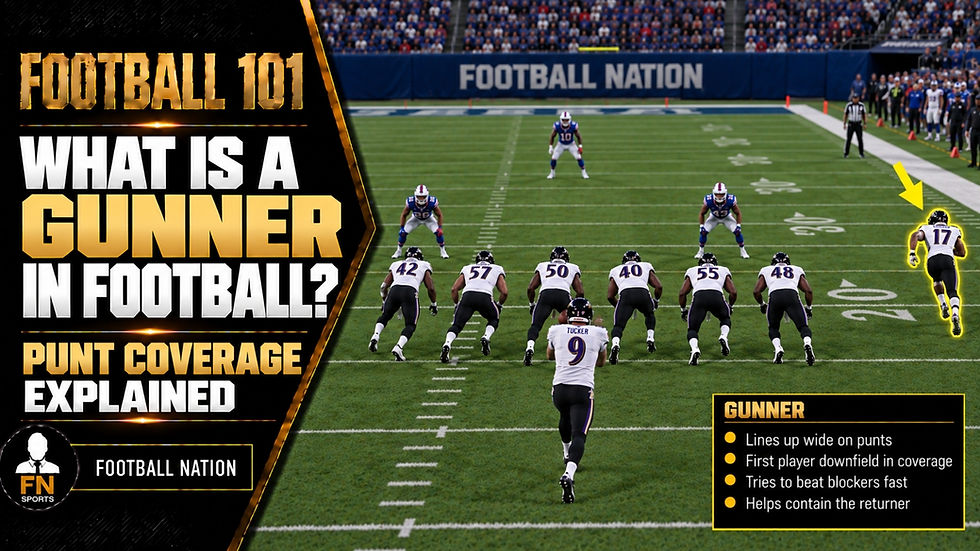
A gunner is the wide punt-coverage player whose first job is to beat the blockers at the line, sprint down the sideline and reach the returner before a return lane develops. Most punt units use one gunner on each side. They are usually fast, physical players—often defensive backs or wide receivers—who can release through contact, track a kick in space and tackle without overrunning the play.

The gunner does not kick the ball, call for the fair catch or decide the official spot. His value is the pressure he creates between the punt and the catch. A strong release can force an early fair-catch signal, squeeze the returner toward the sideline or put the first tackler in position the instant the ball is secured.

Where the gunner lines up

On a standard punt formation, the gunners align wide near the sidelines, separated from the tight group protecting the punter. The return team usually assigns one or two players to each gunner because allowing a clean release creates an immediate coverage problem. That one-on-one or two-on-one battle begins at the snap while the rest of the punt unit protects inside.

Football Nation’s punt guide explains the kick itself. The gunner’s job begins before the ball leaves the punter’s foot: defeat the jam legally, stay in bounds and accelerate into the coverage lane.

Football Nation teaching diagram showing two punt gunners releasing down each sideline, maintaining outside leverage and closing on a returner.
Football Nation AI-assisted teaching diagram of punt-gunner releases and coverage lanes; simplified and not to scale.

The three phases of a gunner’s job

1. Win the release

The return team’s widest blockers try to delay the gunner without holding. The gunner can use speed, hand technique and a change of direction to escape. A clean release matters because every fraction of a second becomes several yards of space by the time the punt descends. If the gunner is pinned at the line, the returner can catch with time to scan the field.

2. Keep outside leverage

Running fastest is not enough. The gunner must approach on a path that prevents the returner from escaping toward the sideline. That outside leverage turns the boundary into an extra defender and funnels the return toward teammates closing from the middle. Charging directly at the catch point without leverage can create an easy cutback.

3. Finish under control

The last five yards require discipline. The gunner must recognize a fair-catch signal, avoid interfering with the opportunity to catch the kick and break down for a legal tackle if the return begins. Arriving early is useless if the player commits kick-catch interference or flies past the returner.

How the roles fit together

This table is a Football Nation summary of punt responsibilities under the 2026 NFL scrimmage-kick and fair-catch rules. It is a role comparison, not a statistical ranking.

Punt-unit role

Primary job

What success looks like

Punter

Deliver direction, distance and hang time

Ball lands where coverage can control it

Gunner

Release outside, sprint and constrain the returner

Returner has no clean edge or is tackled quickly

Interior coverage

Build lanes and close cutbacks

No crease opens between pursuit lanes

Returner

Secure the ball and find space

Possession first; vertical yards when available

Why gunners matter even when they do not make the tackle

A gunner can win the play without appearing in the box score. Early arrival may make the returner signal for a fair catch, drift sideways or hesitate long enough for the rest of the coverage unit to arrive. The first player also sets the return’s geometry: outside leverage closes one escape route and allows inside pursuit to compress the remaining space.

That is why a punt downed near the goal line is usually a unit result. The NFL has highlighted Detroit’s coverage placing a punt at the 3-yard line and a Texans punt downed cleanly by the coverage team. The punter creates the opportunity; the outside coverage players help protect the landing area and prevent a return.

What the rules require

A gunner is not a special rulebook position. He is a Team A player on a scrimmage kick, so the normal kick and player-conduct rules apply. The 2026 NFL Rulebook governs his release, whether he can go out of bounds, the receiver’s opportunity to catch the ball and the legality of the tackle.

The most important viewer-facing rules are these: a kicking-team player cannot voluntarily go out of bounds and simply remain there to avoid a block; the returner must receive an unimpeded opportunity to catch the kick; and a valid fair-catch signal ends the return once the ball is caught. A gunner who reaches the catch point first must see the signal and control his contact.

If the returner touches the ball but does not possess it, the play may become a muffed punt. The gunner then changes from a contain-and-tackle assignment to locating a loose ball without committing an illegal bat or other foul.

The penalties that erase good coverage

Three mistakes commonly destroy the value of a fast release. Holding can occur when a blocker illegally restricts the gunner, while the coverage player can draw a foul by voluntarily leaving the field and failing to return properly. Near the catch, kick-catch interference is the major danger. The rules protect the receiver’s ability to field the ball before contact.

Blocks in the back are another recurring special-teams problem once the return begins. Football Nation’s penalty guide provides the broader enforcement framework, while the blue bean bag explainer shows why officials sometimes mark possession or kick-related reference spots without signaling a foul.

Gunner versus jammer

The gunner belongs to the kicking team. The jammer is the return-team blocker assigned to delay him. A single jammer may shade outside to protect the sideline; two jammers may bracket the gunner and force him to choose an inside or outside release. That duel is separate from the protection battle around the punter.

A double team uses two return-team players away from the middle. If the gunner occupies both, another coverage player may arrive free.

What to watch on television

Find the widest kicking-team player before the snap. At the snap, watch whether he releases cleanly or gets stalled. During the kick, check whether he stays outside the returner rather than chasing the ball’s exact flight. As the returner prepares to catch, look for the gunner to shorten his stride, identify a fair-catch signal and arrive under control.

The spot still depends on what happens to the ball. A punt that reaches the end zone can become a touchback, while a ball fielded or downed in the field of play is spotted under the applicable scrimmage-kick rules. Coverage cannot rescue a punt after the touchback conditions are satisfied.

The biggest misconception

The gunner is not simply the first player running toward the returner, and the word does not describe anyone who makes a special-teams tackle. It is a specific alignment and coverage role. The player starts split wide, faces an immediate release battle and is responsible for constraining the return from the outside. Interior coverage players may make the tackle, but their paths and blocking matchups are different.

Football Nation takeaway

A great gunner changes the punt before contact ever happens. He wins the release, preserves outside leverage and arrives under control, shrinking the returner’s choices until a fair catch or short return becomes the safest outcome. When judging the play, do not follow only the ball. Watch the widest coverage player from the snap through the catch; his path often explains why the return had space—or why it never had a chance.

Gunner FAQs

Are there two gunners on every punt?

Most standard punt formations use one wide coverage player on each side, but teams can change the alignment for field position, protection and return-team tendencies.

Can a gunner go out of bounds?

He cannot voluntarily leave the field to avoid a block and stay out. The 2026 rules require a kicking-team player who goes out voluntarily to attempt to return inbounds promptly.

Can a gunner tackle a returner after a fair catch signal?

No. Once the receiver makes a valid signal and completes the catch, the play is over and avoidable contact can be penalized.

Is a gunner usually a starter on offense or defense?

Sometimes, but not necessarily. The role favors speed, toughness and open-field tackling, so roster players from receiver and defensive-back groups often compete for it.

Does the gunner get credit for forcing a fair catch?

Traditional box scores record the fair catch but do not fully capture which coverage player caused it. Coaches evaluate release, lane integrity, arrival and decision quality on film.

Sources and visual disclosure

Rules: 2026 NFL Rulebook, especially Rules 9, 10 and 12. Examples: official NFL video pages linked above. Cover and body diagram are original Football Nation AI-assisted editorial graphics; they depict no real player, team logo or licensed photograph.

Comments


bottom of page