top of page

What Is Prevent Defense in Football? How It Protects a Late Lead

Aug 18
5 min read

Prevent defense is a late-game strategy that gives extra priority to stopping a fast touchdown and keeping completions in front of the secondary. Defenders align deeper, protect the sidelines and end zone, and often rush fewer players so more can cover. The tradeoff is deliberate: the offense may gain short yards, but it should have to use multiple plays—and precious seconds—to score.

The best way to judge prevent defense is not by asking whether the opponent completed a pass. Ask whether the defense avoided an explosive gain, tackled in bounds, protected the end zone and forced the offense to spend more time than the game situation allowed. If those goals are met, an eight-yard completion can help the defense more than the offense.

How prevent defense works

There is no single universal prevent call. A coordinator can use a three-man rush and eight coverage defenders, a four-man rush with a deep zone shell, or a man-coverage variation with safeties stationed well above the deepest routes. The shared idea is leverage: nobody should get behind the last line of defense.

That is why prevent defense is closely related to zone coverage but is not identical to one named zone. A defense may divide the deep field into quarters, play a loose Cover 3, mix matchup rules underneath or switch to a special last-play package. Personnel can change too. A dime defense adds defensive backs, but dime personnel can play aggressively; prevent describes the late-game objective more than a fixed head count.

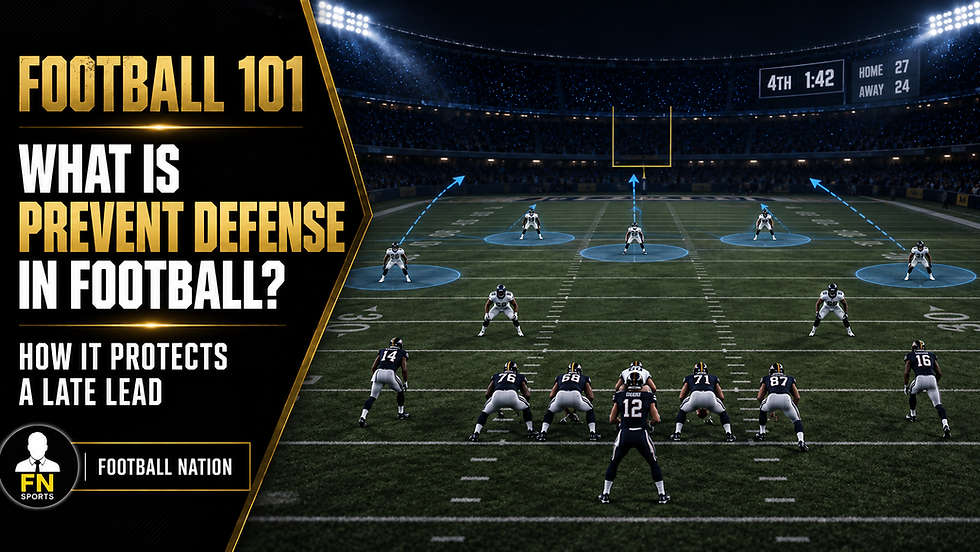
Football Nation prevent-defense diagram showing a three-man rush, four underneath defenders and four deep defenders keeping routes in front.
Original Football Nation teaching diagram: a prevent structure protects the deep field, concedes selected short throws and forces the offense to spend time.

What every defender is trying to protect

The deepest defenders keep the roof on the coverage. Corners and safeties align with enough cushion to see the quarterback, overlap vertical routes and prevent a receiver from crossing their face into open grass. Underneath defenders widen toward the sidelines, rally to checkdowns and try to make tackles that keep the clock moving.

The pass rush still matters. A three-man rush gives the quarterback time, but it also places eight defenders into throwing lanes. A four-man rush can speed the decision while leaving seven in coverage. The choice depends on the quarterback, the offensive line, the remaining time, the number of timeouts and how many yards the offense needs. Football Nation’s analysis: the best late-game call balances coverage numbers with enough pressure to stop the quarterback from waiting indefinitely.

Why the clock changes the meaning of success

A normal defense is trying to deny yards on every snap. A prevent defense is managing yards, time and field position together. If an offense needs two touchdowns with less than two minutes left, forcing a six-play drive can be more valuable than challenging every short route. Each in-bounds tackle moves the game closer to zero.

That clock context is why the two-minute warning and timeout inventory matter. Before the warning, the offense may use the stoppage as a free timeout. After it, every in-bounds completion can force a timeout or a hurried snap. The defense should know exactly which sideline routes, first-down distances and end-zone throws can stop the clock or change the scoring equation.

Why fans hate prevent defense

The strategy looks uncomfortable because it often allows visible yardage. Television viewers see open receivers underneath and assume the defense has become passive. Sometimes that criticism is correct: excessive cushion, missed tackles or a rush that creates no urgency can let an offense cover the field too quickly.

But short completions are not automatically a failure. Packers.com summarized the purpose clearly in a discussion of late-game defense: the priority is to prevent an explosive play. The Packers also traced an early special prevent package to extra defensive-back personnel used in 1977, illustrating that the concept has long been tied to pass situations and matchup coverage. Read the Packers’ historical explanation.

The strongest coaching counterpoint is that protecting the deep field must not become passive football. Steelers coach Mike Tomlin said in December 2024 that he is not a proponent of prevent defense when it means taking the foot off the gas; his late-game priority is to keep a lid on the offense without losing aggression. Read the Steelers’ official interview.

How an offense attacks prevent defense

The offense usually accepts the space underneath. Checkdowns, quick outs, sideline throws and quarterback scrambles can collect manageable gains without testing a crowded deep shell. The challenge is execution: receivers must get out of bounds when possible, the quarterback must avoid sacks and the offense must reach the next snap quickly.

A patient offense can also stress the seams between deep defenders, especially if the rush is light. Flooding one side with routes at different depths can force a zone defender to choose. That does not mean the defense should abandon the shell; it means the underneath coverage, tackling angles and pass rush must work together.

On the final snap, the equation changes again. A true Hail Mary situation may put nearly every defender near the goal line. The defense wants players in position to high-point or knock down the ball while others guard against a deflection. That specialized last-play defense is an extreme version of keeping everything in front, not the template for an entire two-minute drive.

Prevent defense vs. man coverage

Late-game defense does not have to be soft zone. A team can play man coverage with two deep safeties, bracket the most dangerous receiver or use man-match rules that become tighter after routes declare. Man can reduce easy windows, but it creates greater risk if one defender loses leverage or draws a penalty downfield.

Zone keeps more eyes on the quarterback and makes it easier for defenders to rally to the ball. Man can contest throws sooner. Neither choice is automatically correct; down, distance, receiver speed, quarterback mobility and the timeout situation decide which risk is acceptable.

The biggest misconception

The biggest misconception is that prevent defense means conceding a touchdown slowly. Its real goal is to make the offense run out of time before it can complete the required scoring sequence. If the opponent reaches the end zone with enough time to recover an onside kick or take another possession, the defense failed the game-management test even if it avoided one long pass.

The next checkpoint is the scoreboard after every completion: remaining time, score margin, timeouts, field position and next down. Those facts should determine whether the defense can continue trading space for seconds or must tighten the underneath windows and increase pressure.

Football Nation takeaway

Judge prevent defense by the situation it was designed to control. A successful call keeps the deepest receiver in front, tackles short completions in bounds, protects the sideline and end zone, and makes the offense spend more plays than the clock permits. The best version is conservative about explosive plays without becoming passive about pressure, leverage or tackling.

Comments


bottom of page