


49ers 27, Rams 7: Melbourne Prediction Revisited
Updated: Sep 20
Updated September 11, 2026, after the final whistle. This page now preserves the original pregame forecast and grades it against the completed result.
Final result: 49ers 27, Rams 7
San Francisco scored the final 24 points, Brock Purdy threw three touchdown passes and the 49ers ran for 174 yards. A goal-line stand followed by a 99-yard touchdown drive broke the game open at Melbourne Cricket Ground. Los Angeles briefly led 7-3, then did not score again.
Football Nation's original Rams 30-24 pick missed decisively. The forecast underestimated San Francisco's ability to control the rushing game and sustain drives after the defensive availability changes. The complete 49ers-Rams game recap carries the final statistics and postgame injury updates; the pregame analysis below remains visible as an accountable archive, not as a current recommendation.
Los Angeles remains Football Nation's pick in Melbourne, but the defensive availability picture has changed again: Aaron Donald will not play for the Rams, Nick Bosa will play for the 49ers, and San Francisco starting defensive tackle Alfred Collins is out for the 2026 season after tearing his patellar tendon. The Rams 30-24 pick remains, but Collins' loss restores some of the interior advantage Donald's absence removed.
Updated September 9, 2026, at 11:55 p.m. Central after both teams issued final game-status reports. The 2025 statistical baseline retains its original source dates.
The NFL’s official Melbourne game page lists San Francisco at Los Angeles for Thursday, September 10, 2026, at 8:35 p.m. Eastern, 7:35 p.m. Central, on Netflix. The local kickoff is Friday, September 11 at 10:35 a.m. AEST at the Melbourne Cricket Ground. It is the league’s first regular season game in Australia and officially a Rams home game.
Confirmed baseline: two 12 win rivals
Both clubs finished the 2025 regular season 12 5. The Rams went 7 1 at home and 5 4 away; the 49ers went 5 3 at home and 7 2 away. Melbourne makes those splits descriptive rather than predictive because neither team is operating in its normal building. Los Angeles finished its final five regular season games 3 2, while San Francisco went 4 1.
The scoring and down totals come from completed 2025 league data. Red zone rate, turnover margin, sack percentage and yards per play use TeamRankings’ 2025 team tables, checked September 7, 2026. Pressure event volume is based on PFF attributed public totals divided by 17 games; multiple defenders can receive credit on one snap, so it must not be mislabeled as a snap level pressure rate.
2025 regular season | 49ers | Rams |
|---|---|---|
Record / split | 12 5 / 7 2 road | 12 5 / 7 1 home |
Points scored / allowed per game | 25.7 / 21.8 | 30.5 / 20.4 |
Third down conversions | 106/213 (49.8%) | 76/192 (39.6%) |
Red zone TD rate | 65.2% | 64.4% |
Turnover margin per game | -0.6 | +0.7 |
Sacks / defensive sack rate | 20 / 3.49% | 47 / 6.85% |
Pressure events per game* | 13.5 | 19.9 |
Offensive yards per play | 5.5 | 6.1 |
*Pressure events show disruption volume rather than the percentage of dropbacks pressured. The comparison is still useful because the sack and pressure indicators point in the same direction: Los Angeles created substantially more negative passing plays and begins 2026 with more individual rush talent.
The setting matters, but it is not the pick
Both teams must manage long travel, unusual practice timing, sleep adjustment and an oval venue converted for American football. Those factors are real, but neither side deserves a mythical travel edge without evidence. The practical question is which team establishes normal communication, substitutions and special teams operation fastest. The Rams have Stafford and Sean McVay controlling the offensive rhythm; the 49ers have a veteran core familiar with Kyle Shanahan’s system.
The venue can affect pacing early, yet the prediction must rest on football. Los Angeles owns a stronger scoring baseline, a better turnover profile and a deeper rush. San Francisco owns the superior third down rate and one of the league’s hardest skill position players to defend in space. The first two drives should reveal whether travel and timing are creating genuine execution problems or merely background noise.

Rams offense vs. 49ers defense
Los Angeles owns the clearest matchup advantage: 30.5 points per game and 6.1 yards per play against a San Francisco defense that finished with only 20 sacks. Stafford can move coverage before the snap, Puka Nacua can align across the formation, and Davante Adams can punish isolated leverage. That forces the 49ers to defend every horizontal level before the Rams attack downfield.
San Francisco’s answer begins with Nick Bosa, and his availability is now confirmed. Defensive coordinator Raheem Morris said Bosa is going to play after the edge rusher reached a full practice during his ACL recovery and worked through a patellar-tendon flare-up. The remaining variable is workload, not activation. Even in a managed role, Bosa can force chips, quicker throws and protection slides; a normal workload would change the protection math throughout the game.
The Rams’ final injury report lists Puka Nacua and left tackle Alaric Jackson without game designations, clearing both for the opener. Jackson’s availability is especially important because San Francisco’s best path is to compress the pocket before Matthew Stafford reaches deeper combinations. Los Angeles can help its protection with efficient runs, screens and motion, forcing the linebackers to defend width before the offense hunts explosive plays.
San Francisco's most consequential new problem is the loss of Collins, a projected starting tackle. Kyle Shanahan confirmed the torn patellar tendon and season-ending status, as recorded in the NFL's September 8 news roundup. Football Nation's full Alfred Collins injury analysis explains why the 49ers may need a committee inside and why the Rams can test that rotation immediately.
49ers offense vs. the Rams front
San Francisco’s 49.8% third-down conversion rate can keep the game away from the Rams’ rush. Purdy and McCaffrey give the offense answers because the ball can leave quickly or the formation can create favorable box counts. Mike Evans changes the receiving structure, and George Kittle carries no game designation on the final report. Kittle is cleared to play; the remaining question is how large his route and snap workload will be in his first game back from an Achilles injury.
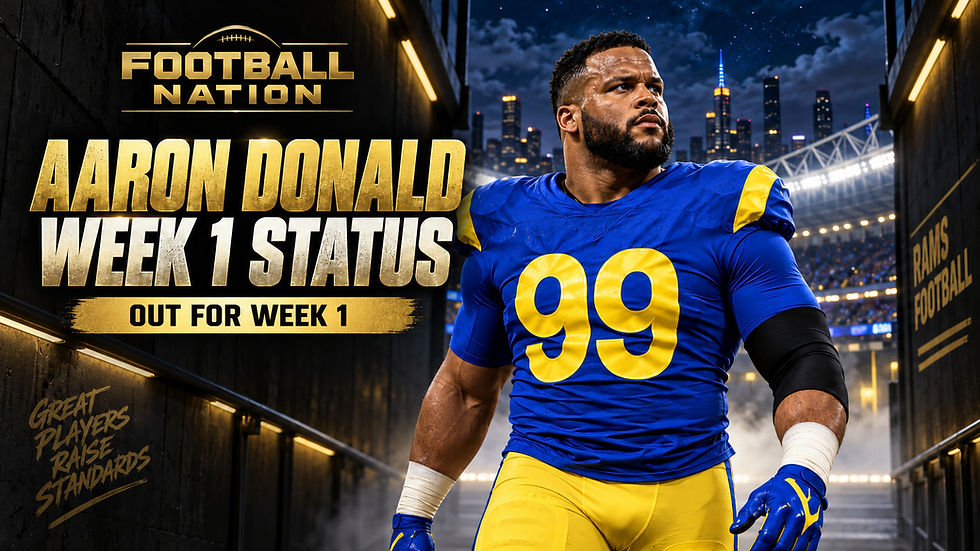
Donald is out and will not travel to Melbourne. The Rams' September 8 update also says Garrett is ready. Los Angeles can therefore plan around Garrett, Jared Verse and Byron Young without assuming a Donald workload. An earlier depth chart listing no longer leaves his Week 1 participation unresolved.
Donald's absence gives San Francisco one fewer interior threat to account for, but it does not remove the challenge of Garrett and the remaining rushers. The 49ers can use motion, chips and McCaffrey's route flexibility to slow the rush. Purdy's best possessions will avoid obvious passing downs rather than repeatedly asking protection to hold against favorable defensive fronts.
Availability and depth checkpoints
The final reports remove most status uncertainty. The 49ers’ report lists Alfred Collins out and defensive tackle James Thompson Jr. questionable; Bosa, Kittle, Luke Gifford, Renardo Green, Dre Greenlaw, Gracen Halton, Romello Height, Kyle Juszczyk and Upton Stout have no game designation. The Rams’ report lists Donald out, while Grant Stuard, Myles Garrett, Jaylen Watson, Tyler Higbee, Alaric Jackson and Byron Young have no designation. San Francisco's game-day list now confirms James Thompson Jr. is active; six players on rookie contracts, including running back Jordan James, are inactive. Los Angeles's final game-day announcement remains the last late checkpoint.
The reported 49ers inactive list names Kurtis Rourke, Ephesians Prysock, Jordan James, Jordan Watkins, Tatum Bethune and Enrique Cruz as out. The list keeps Kittle, Bosa and James Thompson Jr. active.
Donald’s absence, Bosa’s availability and Kittle’s clearance are confirmed. The current Nick Bosa update explains why a confirmed appearance still does not establish a full workload. For San Francisco, Thompson is the only player on the final report carrying a questionable designation.
Explosive plays, red zone and turnovers
The Rams’ 6.1 yards per play is the strongest explosive play signal in the table. Los Angeles can create chunk gains through Nacua after the catch, Adams against leverage and McVay’s play action. San Francisco’s 5.5 yards per play is efficient enough to punish mistakes, especially when McCaffrey forces defenders to tackle in space.
Both offenses finished above 64% in red zone touchdown rate, so the larger separation is possession value. Los Angeles averaged a +0.7 turnover margin per game; San Francisco was at -0.6. Turnover margin can swing year to year, but the game logic is stable: Purdy cannot give the Rams short fields while facing a rush that already owns the better negative play profile.
Fantasy football consequences
Nacua remains a must-start after receiving no game designation; Adams carries touchdown and boundary-target appeal. Stafford is viable in superflex leagues and matchup-dependent in one-quarterback formats. The Rams backfield benefits if Los Angeles controls the score, but managers need the finalized role distribution rather than assuming one preseason pattern will hold.
Purdy’s ceiling still depends on protection, while Bosa’s return raises San Francisco’s defensive ceiling. McCaffrey remains a foundational start because his receiving role can defeat pressure even when rushing efficiency is uneven. Mike Evans has touchdown upside and opening-week uncertainty in a new offense. Kittle is cleared, but managers with a healthy established alternative should still weigh the 49ers’ reported workload management. The Rams defense retains spike-week potential; the 49ers defense is more viable with Bosa but remains volatile against the 2025 scoring leader.
Football Nation prediction
Prediction: Rams 30, 49ers 24. Los Angeles has the better combination of explosive offense, turnover profile and pass rush depth. San Francisco’s third down efficiency and McCaffrey’s versatility keep the game within reach, but the 49ers need several health dependent pieces to hit their best case form at once. The Rams’ ability to pressure without abandoning coverage is the projected separator.
Donald sitting, Bosa playing, Kittle being cleared and Collins being lost for the season are now part of the forecast, not future conditions. Nacua, Alaric Jackson and Garrett also have no game designation. The Rams 30-24 pick remains because of their explosive offense, turnover profile and ability to test San Francisco’s emergency interior rotation.
More Football Nation context
U.S. kickoff and network: 2026 NFL Week 1 schedule
How the event is being staged: Rams to 49ers Melbourne logistics
Los Angeles availability: Donald ruled out for the opener.
San Francisco availability: Nick Bosa confirmed for Week 1
Division context: 2026 NFC West predictions
Team coverage: San Francisco 49ers hub
Team coverage: Los Angeles Rams hub


Comments