


Aaron Rodgers Final Season Starts 1-0 With Steelers Win
Updated: Sep 14
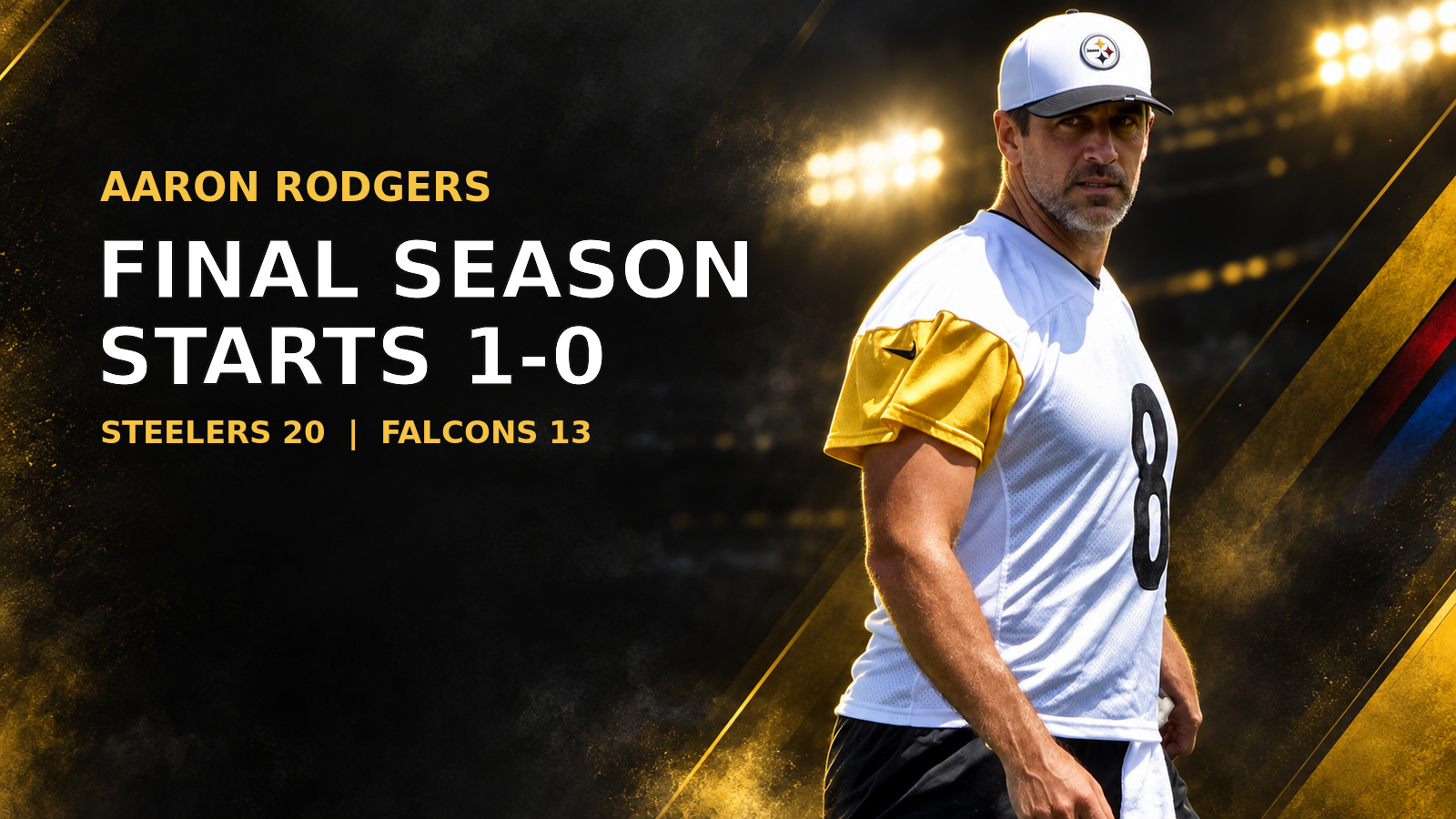
The answer: Aaron Rodgers began the confirmed final season of his NFL career with a win, but Pittsburgh's 20-13 victory over Atlanta was more proof of survival than proof of an elite offense. Rodgers completed 24 of 40 passes for 221 yards and one touchdown. He avoided the catastrophic mistake, extended the play on his scoring throw and helped the Steelers finish the game with the ball. T.J. Watt and the defense supplied the decisive points.
That is a useful opening result for a 42-year-old quarterback in Year 22, especially after Rodgers removed any retirement ambiguity during camp. The NFL documented his final-season declaration as a settled decision. Week 1 turned that declaration from an offseason storyline into a weekly countdown: Pittsburgh now has one win and at least 16 regular-season games left to discover how high this reunion with Mike McCarthy can climb.
What Rodgers did against Atlanta
The Steelers' official recap credits Rodgers with 221 yards and a touchdown on 24-of-40 passing. His best sequence followed Jaquan Brisker's interception, which gave Pittsburgh the ball at the Atlanta 31. On third-and-3, Rodgers escaped pressure, kept his eyes downfield and found Pat Freiermuth in the back of the end zone for a six-yard touchdown.
That play mattered because it looked like the version of Rodgers Pittsburgh needs: controlled movement, patience after the first read and accuracy after the pocket changed. It also separated his regular-season performance from the debate covered in Football Nation's Aaron Rodgers Preseason Stance: Why He May Sit vs. Packers. August restraint is no longer the question. The relevant evidence now comes from meaningful downs.

The performance was steady, not dominant
A win should not erase the limitations in the box score. Rodgers averaged 5.5 yards per attempt, calculated from the official 221 yards on 40 throws. Michael Pittman Jr. led Pittsburgh with 58 receiving yards on three catches. Freiermuth caught five passes for 46 yards and the touchdown. No Steelers receiver reached 60 yards, and the offense scored only one touchdown.
Measure | Rodgers / Steelers | What it says |
Final score | Steelers 20, Falcons 13 | Pittsburgh starts the final-season run 1-0 |
Passing | 24 of 40, 221 yards, 1 TD | Rodgers handled volume but averaged 5.5 yards per attempt |
Touchdown | 6 yards to Pat Freiermuth | Third-and-3 conversion with 10:39 left in the second quarter |
Top targets | Michael Pittman Jr. 3-58; Freiermuth 5-46-1 | Useful production, but no receiver reached 60 yards |
Defensive swing | T.J. Watt: 2 sacks, 3 TFL, 35-yard pick-six | The defense supplied Pittsburgh's decisive touchdown |
Sources: Pittsburgh Steelers official recap and Reuters game report. The 5.5 yards-per-attempt figure is 221 passing yards divided by 40 attempts.
Why the Steelers still won
Pittsburgh did not ask Rodgers to win a shootout. Watt produced two sacks, three tackles for loss and a 35-yard interception return for a touchdown in the fourth quarter. Brisker also intercepted Cooper Rush, who finished with 143 passing yards, one touchdown and two interceptions. Atlanta generated 173 scrimmage yards from Bijan Robinson, but its quarterback mistakes and two missed field goals kept that production from becoming a win.
The defense gave Pittsburgh the margin that the offense could not create by itself. That is both encouraging and a warning. A contender can win this way, particularly in September, but asking Watt to manufacture touchdowns is not a sustainable offensive plan. Football Nation's Steelers 20, Falcons 13: Week 1 Prop Results separates the final results from the pregame market and shows why process matters more than grading every outcome from the final score.
What the win means for Pittsburgh's quarterback future
Rodgers giving McCarthy the game ball connected the present to their 13 seasons together in Green Bay. NBC Sports reported that McCarthy's first Steelers victory was the 175th of his head-coaching career. It was a meaningful reunion moment, but it does not slow the succession clock.
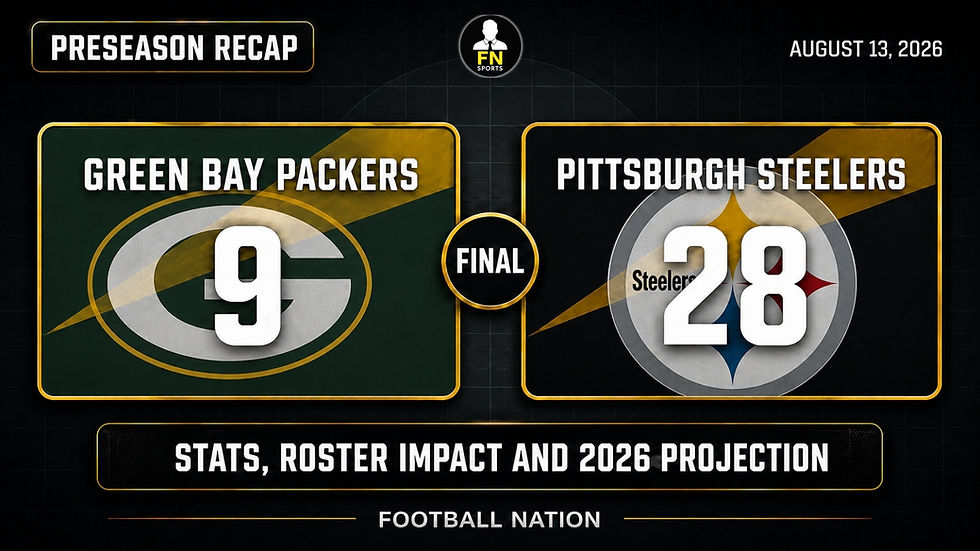
Drew Allar remains a developmental option rather than an appointed 2027 starter. His strongest preseason evidence is covered in Football Nation's Steelers 28, Packers 9: Drew Allar's Three Touchdown Night Changes Pittsburgh's Depth Picture. The correct plan remains dual track: give Rodgers the preparation and freedom required to chase a playoff run, while evaluating Allar without allowing one preseason performance to make the decision in advance.
The comparison with Cleveland is instructive. Football Nation's Will Deshaun Watson Start Week 2? Browns Will Review After 34-10 Loss shows what happens when a Week 1 quarterback result creates immediate uncertainty. Pittsburgh does not have a starter controversy. Its uncertainty begins after the season, which makes every real Allar rep valuable without making Rodgers' job conditional.
Fantasy football impact
Rodgers' 40 attempts are more encouraging than the single touchdown, because passing volume creates opportunity. The Week 1 distribution still argues for measured expectations. Pittman and Freiermuth produced the clearest receiving results, but the offense did not create a 60-yard receiver. Fantasy managers should track target concentration, red-zone work and explosive plays rather than treating a famous quarterback's farewell season as an automatic upgrade for every pass catcher.
Football Nation's What Is Target Share in Fantasy Football? explains why weekly target volume matters more than one highlight. The same logic applies to protection calls before the snap; the Why Do Quarterbacks Point at the Mike Linebacker Before the Snap? provides a quick guide to the identification process quarterbacks use to organize blocking responsibilities.
The strongest counterpoint and next checkpoint
The strongest counterpoint is simple: Pittsburgh won without Rodgers playing his best football. September offenses are rarely finished products, and a veteran quarterback who protects the ball can become more efficient as timing improves. Rodgers also showed that his movement and improvisation can still rescue a third down.
The next checkpoint is the September 20 road game against New England. Watch whether Pittsburgh creates more yards per attempt, produces multiple offensive touchdowns and finds a receiver who can consistently win beyond the sticks. Those indicators will say more about the offense's ceiling than the emotion surrounding one successful opener.
Football Nation verdict
Rodgers' final season started exactly where Pittsburgh needed it to start: 1-0. The performance was competent, controlled and good enough to complement an impact defense. It was not yet the offensive proof required to call the Steelers a championship threat. The farewell tour has a win; Week 2 must show whether the passing game can add efficiency and explosiveness to it.
More Football Nation Steelers coverage
Photo credit and license: Cramerwiki, CC0 1.0, via Wikimedia Commons. The official Steelers X status is embedded above; the live article remains the reference for interactive media.


Comments