


Baker Mayfield Contract: What Jason Licht’s “Franchise QB” Message Really Means
Jason Licht did not announce a Baker Mayfield extension on Thursday. He did something that matters almost as much for the direction of the Tampa Bay Buccaneers: the general manager publicly reaffirmed that the organization still views Mayfield as its franchise quarterback even after contract talks failed to produce a deal before training camp.
That distinction is the center of Tampa Bay’s newest contract debate. The relationship has not broken, the club is not shopping its quarterback and Mayfield remains the unquestioned 2026 starter. But an endorsement is not an agreement. The Buccaneers and Mayfield can believe in the same football partnership while remaining far apart on price, guarantees, structure or timing.
Football Nation’s earlier analysis of Mayfield’s possible $50 million market examined what a new deal could cost. The fresh development on August 6 is Licht’s response after negotiations stalled: Tampa Bay’s football commitment remains firm even though its contractual commitment has not changed.
What Jason Licht actually confirmed
Verified fact: Reuters reported on August 6 that Licht said the Buccaneers still consider Mayfield their franchise quarterback. The same report said Licht rejected the idea that Tampa Bay is looking to move defensive tackle Vita Vea. Both comments were responses to uncertainty surrounding high-profile veterans, not announcements of completed transactions.
Reported information: Mayfield entered camp without the extension he sought and has said he felt undervalued after talks did not get close enough to continue. NFL.com reported in June that he set a training-camp deadline for negotiations. FOX Sports reported on July 28 that the sides ended their extension talks, leaving him set to play the final season of his current contract.
The verified status is therefore straightforward. Mayfield is on Tampa Bay’s roster, is practicing as the starting quarterback and remains under contract for 2026. Licht’s statement reinforces the club’s plan to compete with him. It does not establish a new salary, new guarantees, a resumed negotiating window or a promise that he will remain beyond the season.

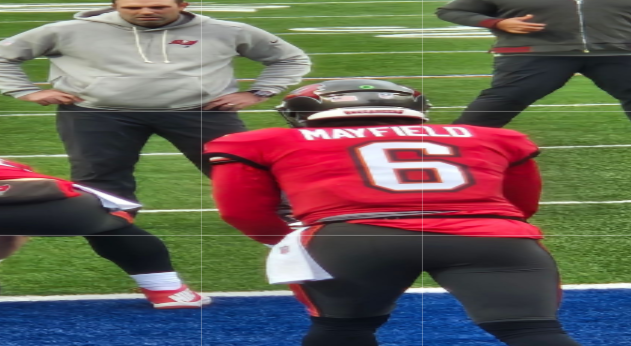
Baker Mayfield warms up in his current Tampa Bay Buccaneers No. 6 uniform before the November 16, 2025 game at Buffalo. Photograph: WuTang94. Source: Wikimedia Commons. License: CC BY 4.0.
General managers choose their words carefully when a negotiation becomes public. Calling Mayfield a franchise quarterback closes off one interpretation: Tampa Bay is not treating 2026 as a bridge season while it quietly searches for an exit. The club still sees him as the player around whom its offense, locker room and championship ambitions are built.
That message has practical value. It tells teammates that the contract dispute has not changed the depth chart. It tells coaches they can install the offense without preparing for a late-summer quarterback pivot. It also tells Mayfield’s representatives that the disagreement is about contract economics, not whether the organization believes he can lead the team.
Football Nation analysis: Licht’s language may lower the emotional temperature, but it does not reduce Mayfield’s leverage. If the Buccaneers truly view him as a franchise quarterback, they eventually must decide whether to pay him like one, use a future tag mechanism if available, or accept the risk of competing with other clubs for his services. Praise can stabilize August. Only contract structure can stabilize 2027.
The current deal explains the pressure
Mayfield signed a three-year, $100 million contract in March 2024 after reviving his career in Tampa Bay. The agreement gave the Buccaneers continuity without immediately committing to the very top of the quarterback market. It also created the exact pressure point now in view: the final contract year arrived after Mayfield produced two more seasons of evidence as the starter.
The Buccaneers’ official roster lists Mayfield as their current No. 6 quarterback. In 2025 he passed for 3,693 yards with 26 touchdowns and 11 interceptions. Tampa Bay’s official 2025 quarterback review also notes his 2024 career highs of 4,500 passing yards, 41 touchdown passes and a 71.4 percent completion rate.
Those numbers do not automatically determine a contract. Quarterback compensation also reflects age, durability, postseason expectations, salary-cap timing, guarantees and the alternatives available to both sides. They do explain why Mayfield no longer sees himself as the reclamation project who signed in Tampa Bay in 2023. His role and production have changed; he wants the next agreement to reflect that change.
The Buccaneers still have reasons to wait
Tampa Bay’s caution is not necessarily a rejection of Mayfield. Extending a veteran quarterback at the top of his market can narrow future cap flexibility and transfer injury or performance risk to the team. The Buccaneers may want another season of evidence, more clarity on the next quarterback market or contract language that protects the roster around him.
The club also has to manage more than one expensive veteran decision. Licht’s refusal to entertain a Vita Vea trade matters because it points to Tampa Bay’s broader stance: the Buccaneers are trying to preserve a competitive core, not dismantle one. Football Nation’s Vita Vea trade-request analysis explains why the defensive tackle’s situation creates a separate leverage test for the front office.
Every major extension affects the next one. Committing more guaranteed money to Mayfield can change the timing and structure available for other cornerstone players. That does not mean Tampa Bay must choose between its quarterback and its defense. It means Licht has to fit multiple legitimate priorities into the same cap plan.
Mayfield’s leverage comes from playing, not talking
Once Mayfield’s camp deadline passed, the cleanest leverage shifted to the field. A strong 2026 season would let him argue that Tampa Bay received franchise-quarterback performance while declining to make a franchise-quarterback commitment. A regression or injury would strengthen the team’s case for caution.
That dynamic can produce uncomfortable headlines without producing dysfunction. Players frequently enter contract years while maintaining their roles. The meaningful indicators are participation, leadership, command of the offense and how the team responds when the season becomes difficult. So far, Licht’s message supports continuity rather than confrontation.
The most useful day-to-day context is Football Nation’s Buccaneers training-camp report, which tracks how Tampa Bay is building around Mayfield. The offense’s development matters to the negotiation because quarterback value is ultimately judged through wins, efficiency, availability and performance in high-leverage moments—not through August sound bites alone.

Baker Mayfield leads the Tampa Bay Buccaneers offense toward the Buffalo end zone on November 16, 2025. Photograph: WuTang94. Source: Wikimedia Commons. License: CC0 1.0.
What would restart the negotiations?
A public endorsement does not require immediate talks, but it preserves the relationship needed to restart them. The most natural windows are during a quiet point before the regular season, after a major market-setting quarterback deal elsewhere, or after the season when both sides have a complete 2026 performance record.
Any renewed negotiation would have to solve more than average annual value. Mayfield will care about guaranteed money, cash flow and protection against a quick exit. Tampa Bay will care about cap flexibility, injury protection and its ability to keep the roster competitive. Two proposals can carry the same headline number and create very different commitments.
The franchise-quarterback label also raises the cost of waiting. If Mayfield plays well, the market could become more expensive and outside competition more credible. If the Buccaneers extend him now, they assume more risk before the season provides new information. There is no risk-free choice; there is only a decision about which risk Tampa Bay prefers.
What this means for the 2026 Buccaneers
For the immediate season, Licht’s statement removes one layer of ambiguity. Mayfield is not being treated as a temporary starter, and the Buccaneers are not signaling a rebuild. Tampa Bay intends to pursue the NFC South with the quarterback who has led its offense since 2023.
The contract question will still follow every major result. A sharp start will produce renewed calls for an extension. A difficult stretch will revive debate about whether the club was right to wait. Neither reaction should be confused with confirmed negotiating movement unless the team, Mayfield or reliable reporting establishes that talks have resumed.
That distinction is especially important in an era when television debate and social speculation can make a relationship sound either repaired or broken after a single quote. The verified middle ground is more accurate: Tampa Bay believes in Mayfield, Mayfield wants a commitment that matches that belief and the two sides have not yet agreed on how to price it.
Football Nation takeaway
Jason Licht’s words are good news for Baker Mayfield’s standing and incomplete news for his future. The Buccaneers still see him as their franchise quarterback. They have not converted that belief into a new contract, and nothing in Thursday’s statement proves negotiations have restarted.
The football partnership remains intact. The business stalemate remains intact too. Mayfield’s best path is to keep making the franchise-quarterback label look undeniable; Tampa Bay’s challenge is to decide when waiting stops creating flexibility and starts making its most important position more expensive.

Comments