


Vita Vea Trade Request: Why the Buccaneers Still Hold the Leverage
Updated: Aug 7
Vita Vea asked the Tampa Bay Buccaneers for a trade after extension talks stalled. The request is verified; a trade is not. That distinction defines the leverage battle now facing one of the NFL’s most important interior defenders.
Vea’s agent, Collin Roberts, confirmed the request to NFL Network on July 27. Reuters, NFL.com, CBS Sports and Bleacher Report all reported the same core development. The renewed landing-spot discussion has kept the story among Bleacher Report’s currently popular NFL coverage.
What is confirmed about Vita Vea’s trade request
Vea is entering the final season of the four-year extension he signed in 2022. Reuters reported that his 2026 base salary is $17 million and not guaranteed. CBS Sports noted that the deal’s $17.5 million average annual value ranks 19th among interior defensive linemen, a number that helps explain why the 31-year-old sought another extension before the season.
The request followed a contract-related hold-in during mandatory minicamp. Vea still reported for training camp, so this is not the same as a player disappearing from the team or refusing every football activity. The public facts show a player using one of the few leverage tools available in the final year of a contract.
Why Tampa Bay cannot replace Vea with one roster move
Vea’s value is not captured by sack totals alone. NFL.com cited Next Gen Stats showing 40 quarterback pressures in 2025, ninth among defensive tackles, while his 4.5 sacks were paired with 13 quarterback hits and a full 17-game workload. At 6-foot-4 and roughly 347 pounds, he can absorb double teams on early downs and still compress the pocket on passing downs.
That combination changes the assignments around him. Edge rushers receive cleaner one-on-one opportunities, linebackers can attack gaps instead of taking on climbing guards, and Tampa Bay can play light boxes without surrendering the middle. A replacement-level nose tackle may reproduce some of Vea’s run fits. Reproducing his power, snap volume and pass-rush stress in one player is far less realistic.

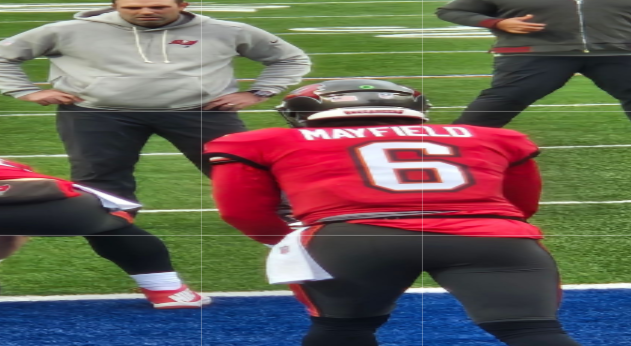
Photo: Vita Vea and the Buccaneers defense against Buffalo on November 16, 2025. WuTang94 via Wikimedia Commons, licensed CC BY 4.0.
The Buccaneers’ leverage—and the risk of using it
Tampa Bay can simply refuse to trade Vea. He remains under contract, and a holdout would expose him to fines and lost salary. The club also knows that a public request does not automatically create a market strong enough to justify removing the center of its defense.
But leverage is not the same as resolution. If the Buccaneers force Vea to play out the year without a new deal, they preserve the 2026 roster while increasing the chance that the relationship ends after the season. If they extend him at the top of the market, they accept age-related risk on a massive interior lineman. If they trade him now, they would need compensation and an immediate football plan that make a contender better—not merely cheaper.
The parallel contract tension with Baker Mayfield makes the decision more delicate. Football Nation’s analysis of Mayfield’s extension talks shows why Tampa Bay is balancing two expensive negotiations at once. Paying both stars would protect the team’s current identity, but it would also concentrate more future cap space in veterans already past age 30.
What a credible trade offer would have to include
A serious offer must solve three problems for Tampa Bay. First, it must return premium draft value or a starting-caliber defender. Second, the acquiring team must have enough cap flexibility to absorb Vea’s 2026 compensation and negotiate the extension he wants. Third, the Buccaneers must believe their remaining defensive front can survive without the player who has organized its run defense for eight seasons.
CBS Sports and Bleacher Report identified teams such as the Raiders, Rams, Giants, Bills and Packers as possible football fits. Those are projections, not confirmed negotiations. Each destination has a different cap, scheme and draft-capital problem, and none should be treated as an imminent deal without reporting from the clubs or Vea’s representatives.
Buffalo is an especially natural speculative fit because a powerful nose tackle could anchor its changing front, but the cost would matter. Football Nation’s 2026 Bills defense analysis explains why Buffalo already invested heavily in personnel and a new coordinator. Adding Vea would raise the ceiling while forcing another significant resource decision.

Photo: Vita Vea and Tampa Bay’s defense set against Buffalo on November 16, 2025. WuTang94 via Wikimedia Commons, dedicated under CC0 1.0.
What changes next
The next meaningful development will be concrete: a new contract, a verified trade negotiation, or Vea returning to full work without a deal. Until one of those happens, the request remains a pressure tactic rather than a completed transaction.
For Tampa Bay, the best football outcome is still an extension that reflects Vea’s impact without ignoring his age. The second-best outcome is keeping him for a playoff push and accepting the future uncertainty. A trade only becomes the better choice if another team pays for the scarcity of what Vea provides.
The takeaway is simple: Vea has asked out, but the Buccaneers still control the timing. Their challenge is deciding whether short-term control is worth the long-term risk of losing a defensive cornerstone.


Comments