top of page

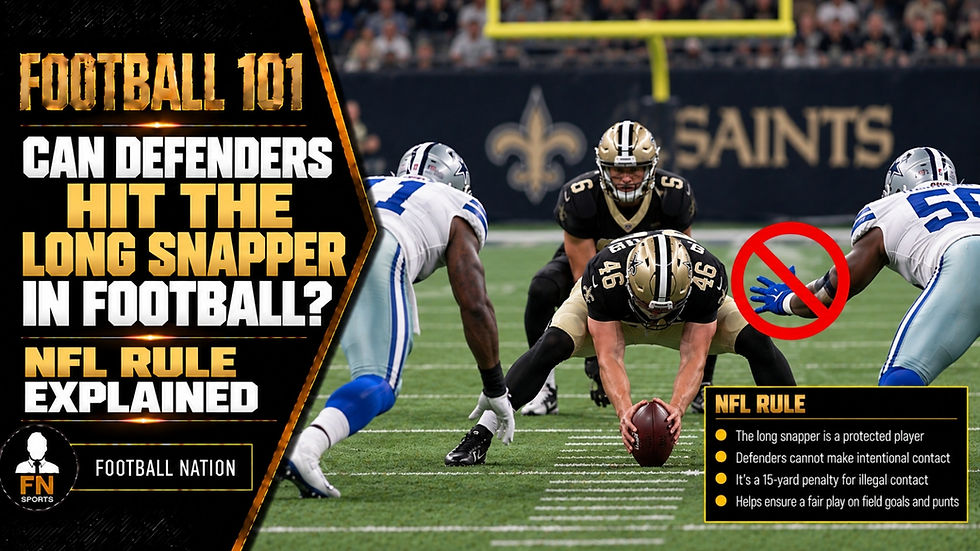
Can Defenders Hit the Long Snapper? NFL Rule Explained

Yes. NFL defenders can make legal contact with a long snapper, but they cannot simply line up head-up and blast him at the snap. The league combines a formation rule with defenseless-player protection: defenders near the line must align outside the snapper’s shoulder-pad frame, and the snapper is protected from forcible head or neck contact, lowered-head helmet contact and launching until he can defend himself or moves downfield.

That distinction matters. The rule does not create a contact-free bubble. It limits the angle, timing and type of force a defense may use while still allowing a legitimate rush.

Why the long snapper receives special protection

A long snapper begins a punt, field goal or extra point with his head down and both hands committed to sending the ball backward. Compared with a normal center making a shorter exchange, he needs more time to complete the motion and recover his balance. Football Nation’s guide to what counts as a snap explains why the ball is live as soon as that backward action begins.

That vulnerable posture is the safety problem. A defender directly over the snapper could drive through a player who cannot see the collision or brace for it. The NFL therefore uses two layers: pre-snap spacing and post-snap protection.

The alignment rule: no defender head-up in the protected lane

Under Rule 9, Section 1, Article 3 of the 2026 NFL Rulebook, a defender who is within one yard of the line of scrimmage at the snap must have his entire body outside the frame of the snapper’s shoulder pads. In practical terms, a defender may shade the snapper from the side, but cannot place any part of his body directly over that protected frame. A violation is five yards.

On field goals and Tries, the defense also may not place more than six players on either side of the snapper. That rule helps prevent an overload from collapsing one narrow point of the protection unit. The NFL’s safety-rule explanation describes the alignment change as a protection for a player in a vulnerable position.

There is another important restriction: a defender may not push or pull a teammate into the offensive formation in an attempt to block the kick. That action carries a 15-yard penalty. If you are wondering why the holder can keep a knee on the ground during the same sequence, Football Nation has a separate explanation of the field-goal holder exception.

What contact is legal after the snap?

Once the ball is snapped, a defender who began from a legal alignment may attack a gap and engage the snapper. A controlled shoulder-to-shoulder block or ordinary hand contact can be legal. Incidental helmet or facemask contact during a conventional block is not automatically a foul.

An official NFL ruling from Dean Blandino is a useful corrective to the common myth that the snapper cannot be touched. In that case, the league said an overload penalty should not have been called merely because contact occurred; the question was whether the defensive formation and action actually violated the rule. Read the NFL’s explanation of that ruling for the specific example.

The snapper is still a defenseless player while he has not had a reasonable opportunity to protect himself, unless he moves downfield. A defender cannot use a helmet, facemask, forearm or shoulder to strike the snapper forcibly in the head or neck. A defender also cannot lower his head and deliver forcible helmet contact anywhere on the snapper’s body, or launch into him. Those acts are 15-yard fouls with an automatic first down and can lead to disqualification.

Football Nation diagram showing legal alignment beside the long snapper, a legal shoulder attack after the snap, and prohibited head or neck contact.

Original Football Nation teaching diagram, created with AI assistance and reviewed against the 2026 NFL Rulebook. It shows the legal alignment lane and the difference between a shoulder attack and a prohibited high hit.

Long-snapper rule and penalty summary

Rule checkpoint

NFL requirement

Enforcement

Defender within 1 yard at the snap

Entire body outside the snapper’s shoulder-pad frame

5 yards

Field goal or Try overload

No more than 6 defenders on either side

5 yards

Pushing a teammate into the formation

Prohibited against a presented kick formation

15 yards

Prohibited contact on defenseless snapper

Head/neck blow, lowered-head helmet contact or launch

15 yards + automatic first down

Source: 2026 NFL Rulebook, Rules 9-1-3 and 12-2-9. Enforcement can be affected by the play result, offsetting fouls and the normal administration of the penalty.

Punts, field goals and extra points are not identical

The shoulder-frame alignment restriction applies when the offense presents a standard punt or field-goal formation. On a field goal or Try, the six-defenders-per-side limit also applies. The protection against prohibited contact applies to an offensive player who attempts a snap during any scrimmage kick.

A normal punt also creates different jobs once the ball leaves the snapper. The coverage team releases players such as the gunner, while the return team communicates around a dangerous bounce with calls such as “Peter,” but those downstream roles do not erase the snapper’s protection at the line.

There is a formation exception worth watching on fakes. If the offense does not present a standard kick formation—or if it shifts or sends a player in motion after setting—the special alignment restrictions in Rule 9 may no longer apply. That does not give the defense permission to commit an illegal blow to a defenseless player. It changes the formation rule, not the separate safety rule.

The biggest misconception: “You cannot touch the long snapper”

That shorthand is too broad. The accurate version is: a defender cannot align head-up in the protected frame and cannot deliver specified forcible contact while the snapper is defenseless. Legal gap pressure, hand fighting and shoulder contact remain part of the play.

This is why a clean block attempt can look violent without drawing a flag, while a seemingly smaller high hit can produce 15 yards. Officials judge alignment at the snap, the point and method of contact, and whether the snapper had a reasonable chance to protect himself.

What fans should watch on the next kick

First, look at the two defenders closest to the snapper. Their bodies should be completely outside the shoulder-pad frame. Second, watch whether a defender attacks with his shoulder and hands or lowers his helmet. Third, look for one defender propelling another into the formation. Finally, remember that a five-yard alignment foul and a 15-yard personal foul protect against different problems.

A long field goal makes the details especially visible because every rusher is trying to reduce the kick’s launch angle. Football Nation’s breakdown of Harrison Butker’s 69-yard record kick shows why fractions of a second and inches of interior penetration matter on a maximum-distance attempt. If a foul is enforced close to a goal line, our guide to half-the-distance enforcement explains why the marked yardage can change.

Football Nation takeaway

Defenders may hit the long snapper legally, but the NFL does not allow a straight-on ambush. The defense must start outside the protected shoulder frame and use a legal block. The clearest flag indicators are a head-up alignment, a teammate being shoved into the formation, or forcible helmet, head or neck contact before the snapper can protect himself.

Frequently asked questions

Can a defender line up directly over the long snapper?

Not when the offense presents a standard punt or field-goal formation. A defender within one yard of the line must keep his entire body outside the snapper’s shoulder-pad frame at the snap.

Is there a one-second rule before the snapper can be contacted?

The NFL rule is not written as a universal one-second grace period. It uses legal alignment plus defenseless-player standards tied to the snapper’s opportunity to protect himself or his movement downfield.

Can a defender use his shoulder against the long snapper?

Yes, if the defender starts legally and does not make prohibited forcible contact to the head or neck, lower the helmet into the snapper, launch, or commit another foul.

What is the penalty for lining up over the long snapper?

The illegal-formation restriction is a five-yard penalty. Pushing or pulling a teammate into the formation is 15 yards, while prohibited contact against a defenseless snapper is 15 yards plus an automatic first down.

Does the rule apply on a fake punt or fake field goal?

The special formation restrictions can change if the offense does not present a standard kick formation or shifts or motions after setting. General player-safety rules still apply.

Sources and visual disclosure

Rule mechanics and penalty labels were checked against the 2026 NFL Rulebook, the NFL’s long-snapper safety explainer and the league’s Blandino ruling on legal contact. The cover and teaching diagram are original Football Nation visuals created with AI assistance; they depict generic players, use no team marks or unlicensed photography, and were reviewed for accurate equipment, spelling and rule context.

Comments


bottom of page