top of page

Why Isn't a Field Goal Holder Down With His Knee on the Ground?

No. In the NFL, a field-goal holder is not automatically down just because one knee is on the ground when he catches the snap. The ball remains live because NFL rules do not treat every uncontacted knee as the end of a play. The holder is making an immediate football action—catching, placing and stabilizing the ball for a kick—rather than surrendering.


That distinction is what makes every ordinary placekick possible and also keeps a fake field goal legal. The holder can receive the snap, rise and run or pass if the play design calls for it. The play ends only when another dead-ball rule applies, such as defensive contact with the grounded holder, a clear act of giving up, an incomplete pass, an out-of-bounds play or the result of the kick.


The NFL rule that keeps the holder live


The controlling language is in Rule 7, Section 2, Article 1 of the 2026 NFL Rulebook. It says a runner is down when contacted by an opponent and touching the ground with something other than a hand or foot. It separately ends the play when a runner falls or kneels and clearly makes no immediate effort to advance.


A holder does not fit that voluntary-surrender description merely by assuming the standard placekick posture. His knee provides a stable base while his hands complete an urgent job: secure the snap, rotate the ball, place its point on the turf and present it to the kicker. The NFL's official football glossary identifies the holder as the player who catches and sets the football on a field-goal or extra-point attempt.


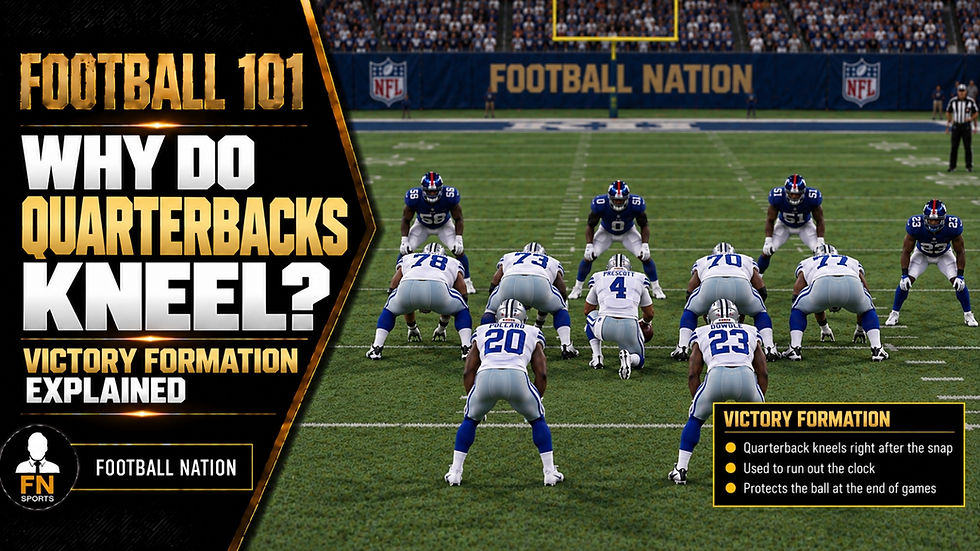
This is different from a quarterback taking a deliberate victory-formation kneel. On that play, the quarterback immediately drops or simulates dropping to a knee specifically to end the down. The holder's body position may look similar, but his purpose and immediate action are the opposite: he is continuing the play.


Three-panel Football Nation diagram showing a kneeling holder live after the snap, down after defensive contact, and live when rising for a fake field goal.
Football Nation teaching diagram: the kneeling holder keeps the play live for a kick or fake until a dead-ball condition occurs.

What happens from snap to kick


The sequence begins like any other scrimmage down. Once the officials make the ball ready and the offense legally snaps it, the ball is live. That is why an official may briefly stand over the ball before the snap while substitutions and readiness are being handled, but moves away before the operation begins.


The long snapper sends the ball backward to the holder, usually seven or eight yards behind the line. The holder tracks the snap into his hands, finds the spot and turns the ball so the kicker can strike the preferred surface. His knee stays down because stability and repeatability matter; a small wobble at the spot can change the contact point.


The kicker then completes the attempt. The defending team may rush, but it still must follow the protections explained in the NFL's roughing-the-kicker rule. The holder also receives protection against avoidable roughing after the ball has been kicked, although contact caused by a defender who legally blocks the kick is judged differently.


When the holder actually is down


The common misconception is that the holder receives a blanket immunity from dead-ball rules. He does not. The live-ball result depends on what happens next.


Situation

Ball status

Why

Holder catches a clean snap while kneeling

Live

He is performing the immediate holding action, not surrendering the play.

Holder rises to run or pass on a fake

Live

The snap started a normal scrimmage down and the holder may continue the play.

Grounded holder is contacted by a defender

Dead

NFL down-by-contact rules end the play once the grounded ball carrier is contacted.

Holder clearly gives himself up

Dead

A runner who kneels and makes no immediate effort to advance has declared himself down.

Kick crosses the uprights or otherwise reaches a dead-ball result

Dead

The scoring or kick result ends the down.


The most important practical checkpoint is defensive contact. If the holder is still on the ground with possession and a defender contacts him, the down-by-contact principle applies and officials can end the play. The same posture that is legal for the hold does not let him absorb a tackle and then get up.


Likewise, if the holder abandons the kicking action, keeps a knee down and unmistakably gives himself up, the officials do not have to wait forever for contact. The rule looks at whether he is making an immediate effort to continue the play.


Why fake field goals are still legal


Because the snap begins a normal live scrimmage down, the offense is not locked into a kick. A holder can catch the ball, rise and execute a designed run or pass. That threat is one reason defenses cannot sell out without assignment discipline even when the formation strongly suggests a field goal.


The situation resembles the logic behind a legal quarterback spike: football rules sometimes distinguish between actions that look similar by asking what the player is doing and whether a specific dead-ball or penalty provision applies. A spike intentionally stops the clock under a defined rule. A standard hold continues the play because the kneeling player is actively setting up a kick.


A fake does not erase every other rule. The passer must still be eligible to throw, linemen must respect pass restrictions, and the offense still has to reach the line to gain. If the holder bobbles the snap, he can try to recover and continue, but the broken-play risk rises quickly because the rush is already arriving.


Why the holder kneels in the first place


The kneeling stance lowers the holder's center of gravity and creates a repeatable triangle between his planted foot, grounded knee and hands. That makes it easier to receive snaps that are slightly high, low or off line while still presenting a predictable spot to the kicker.


Consistency matters because a field-goal unit operates on a compressed timeline. The long snap, catch, placement and kick unfold in roughly one coordinated motion. Teams can also vary the situation around the kick, whether they are trying to defeat an icing timeout or deciding that a late-game intentional safety creates a better possession tradeoff than a conventional kick.


The holder is usually a punter because punters already work closely with the specialist group and can devote practice repetitions to the timing. Some teams use a backup quarterback or another player with strong hands and passing experience, which may slightly increase the credibility of a fake.


The strongest misconception: a knee always means down


That shortcut is useful in many levels of football, but it is incomplete for the NFL. Pro football generally uses down-by-contact: an uncontacted runner who slips can often get up and continue. The special give-up rules cover deliberate kneels, slides and dives so players cannot exploit safety protections.


The holder is a perfect illustration of why context matters. His knee is down, but he has not ended his football action. He is using the turf as part of the mechanics of the kick. Treating the snap as dead on contact with his hands would erase the ordinary field-goal play before the kicker ever arrived.


Football Nation takeaway


Watch the holder, not just the kicker. At the snap, ask three questions: Did the holder secure the ball? Is he still performing the immediate holding action? Did a defender make contact or did the holder clearly surrender? If the first two answers are yes and the third is no, the play is live—even with a knee on the grass.


That same live-ball awareness helps explain why unusual kicking situations can change quickly. A low, bouncing squib kick creates different recovery rules after the ball is kicked, but the field-goal holder question is decided earlier: the legal snap and continuing football action keep the down alive.


Frequently asked questions


Is a field-goal holder down when his knee touches the ground?

Not automatically in the NFL. The standard kneeling hold is a continuing football action, so the snap remains live unless another dead-ball condition occurs.


Can the holder get up and run on a fake field goal?

Yes. He may rise and run, pass or otherwise continue the play, subject to the normal rules for a scrimmage down.


What if a defender touches the kneeling holder?

The holder can be ruled down by contact when he possesses the ball while grounded and is contacted by an opponent. Defenders must also avoid illegal roughing.


Why does the holder put one knee down?

The stance creates a stable, repeatable base for catching the snap, rotating the ball and presenting the spot to the kicker.


Is the holder always the punter?

No, but the punter commonly holds because he practices daily with the specialist unit. Teams may instead use a backup quarterback or another reliable ball handler.

Comments


bottom of page