


Watson Gets the Week 10 Start. Sanders Changed the Evidence.
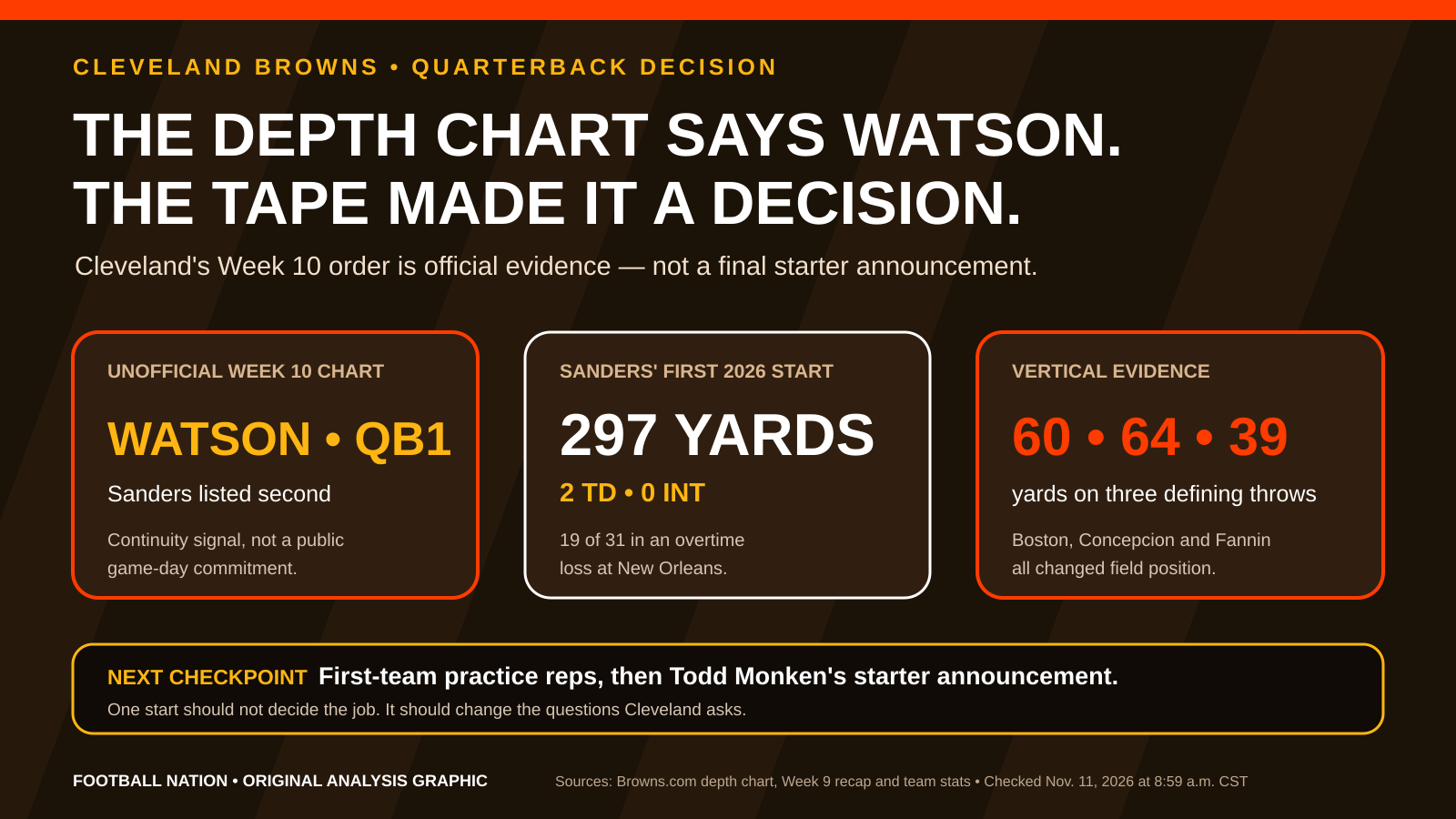
Cleveland has named Deshaun Watson its Week 10 starter against Houston. The official announcement closes the depth chart question but not the football evaluation. Watson returns after missing Week 9, while Shedeur Sanders' 297-yard start changed the explosive-play standard Cleveland should carry forward.
Sanders still produced evidence the Browns did not have a week ago. In his first start of the 2026 season, he completed 19 of 31 passes for 297 yards, two touchdowns and no interceptions in a 23-22 overtime loss at New Orleans. The result was not good enough. The way Cleveland threatened the field was different enough to shape what Watson must preserve against Houston.
Watson will start. The evidence still matters
The unofficial depth chart preserved Watson at No. 1, and Cleveland's official Nov. 11 announcement then confirmed he will start. That gives Watson the continuity case and makes Sanders the contingency against Houston. It does not erase the new evidence Sanders supplied or reduce the need to carry those explosive-play answers into the Week 10 plan.
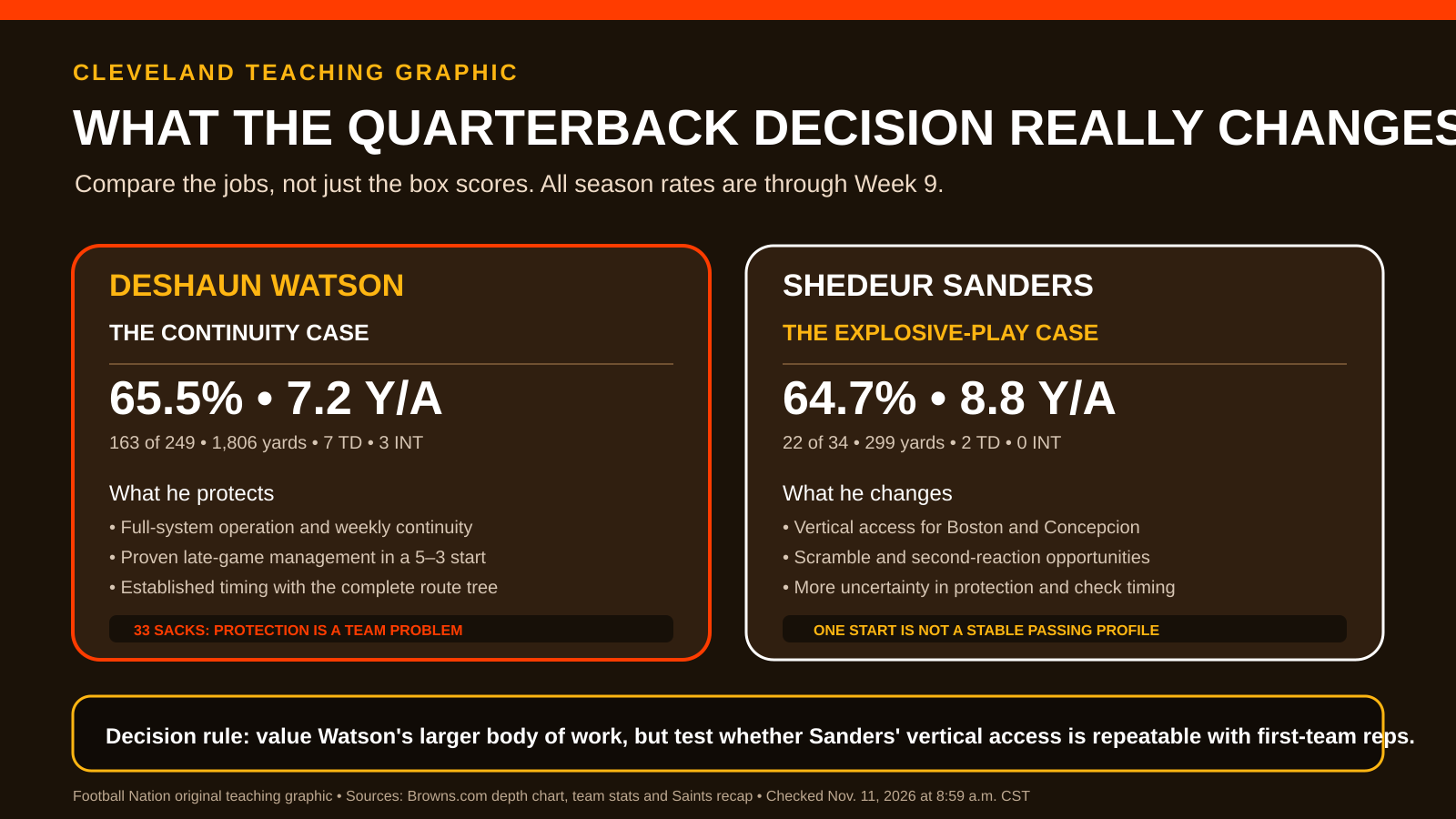
That restraint is reasonable. Watson owns the larger 2026 sample: 163 completions on 249 attempts for 1,806 yards, seven touchdowns and three interceptions. His 65.5 percent completion rate and 7.2 yards per attempt describe an offense that has moved the ball efficiently enough to reach 5-3 before his concussion absence. He also has the full installation history and the weekly timing that comes with starting eight games.
The counterweight is the protection cost. Watson has taken 33 sacks. That number cannot be assigned to the quarterback alone because route timing, line play, receiver separation and game situation all matter, but it is part of the operational record. Cleveland cannot evaluate continuity without asking whether that continuity exposes too many negative plays.
Sanders changed the geometry of Cleveland's offense
Sanders' New Orleans start was uneven before it was explosive. He had only 38 passing yards in the first half. He then completed a 60-yard ball to rookie Denzel Boston, a 64-yard touchdown to rookie KC Concepcion Jr. and a 39-yard overtime touchdown to Harold Fannin Jr. Those plays attacked three different defensive problems: leverage downfield, pursuit after the catch and pressure against a checkdown.
The official NFL X post below captures the Concepcion touchdown. Sanders delivered from a closing pocket, Concepcion worked back to the ball and then turned the catch into a field-changing score. The play is evidence of a vertical ceiling. It is not proof that Cleveland would get the same efficiency across an entire game or against a different coverage plan.
Through Week 9, Sanders is 22 of 34 for 299 yards, two touchdowns and no interceptions. His 8.8 yards per attempt is attractive and his 112.2 rating is strong, but almost the entire sample comes from one start. The responsible question is not whether those rates are better than Watson's. It is whether the vertical access, pocket movement and late-down creation remain present after a full week of opponent-specific first-team preparation.
The decision changes four other jobs
First, it changes the rookie receiver plan. Boston and Concepcion combined for 10 catches, 183 yards and one touchdown against New Orleans. Sanders showed a willingness to let both attack space beyond the sticks. Watson has more experience managing the complete route tree and can give the offense more answers before the snap. Cleveland must decide whether it values established sequencing or explosive access more against the next defensive plan.
Second, it changes Fannin's fantasy profile. Sanders found him for the overtime touchdown when pressure forced a quick decision. That creates a plausible high-value role near the goal line and on scramble-adjustment plays. Watson's larger sample may produce steadier target volume, while Sanders could create more volatile chunk opportunities. In standard fantasy formats, Fannin remains startable but sensitive to the quarterback announcement; Boston and Concepcion are upside options whose floor depends on route volume.
Third, the choice affects Quinshon Judkins. A credible vertical threat can remove a safety from the run fit, but an offense that misses early-down completions can also leave Judkins facing predictable carries. Fantasy managers should not assume Sanders automatically improves the running back. The useful checkpoint is box count and early-down success, not quarterback reputation.
Fourth, it changes the protection menu. Sanders can extend a play, but extension can become pressure if the check timing is late. Watson can operate more of the installed protection system, but the 33 sacks show that experience has not eliminated the problem. The winner of the decision must reduce wasted plays without removing Cleveland's new explosive element.
Why Cleveland chose Watson
One game did not erase eight starts. Watson helped Cleveland reach 5-3, has five game-winning drives this season according to current team reporting, and has worked with the starting offense since camp. Sanders' best plays arrived late against a team that had entered the week with two wins, while Cleveland's offense produced only three points in the first half. Cleveland's choice prioritizes the established starter while treating Sanders' performance as useful evidence rather than an automatic transfer of the job.
The choice is defensible, but Sanders' Week 9 traits remain part of the standard Watson now has to meet: vertical timing with two rookie receivers, composure after a slow start and scoring answers when the pocket deteriorates. Cleveland can value Watson's larger body of work and still preserve the explosive elements Sanders revealed.
Next checkpoint
The next checkpoint is Watson's Wednesday and Thursday first-team workload after the concussion absence. The decisive football evidence will be whether he protects the ball, reduces sacks and keeps Boston, Concepcion and Fannin involved without abandoning Judkins or removing the vertical access Sanders created. Sanders remains the immediate contingency if Watson has any setback.
For the earlier passing-game injury and role context, read Harold Fannin's Thursday Limitation Puts Three Cleveland Passing Jobs in Focus.
Sources and verification record
Initial sources were checked Nov. 11, 2026 at 8:59 a.m. CST. The article was refreshed after Cleveland's official 9:22 a.m. CST announcement that Deshaun Watson will start Week 10. Official source: https://www.clevelandbrowns.com/news/deshaun-watson-set-to-start-week-10-against-the-texans. Browns.com also supplied the Nov. 10 unofficial depth chart, the Week 9 recap and season statistics through nine games. The NFL X status was opened at https://x.com/NFL/status/2119530360220319933; direct retrieval returned HTTP 403, while the exact status identity and text rendered in the supported native embed. Comparison periods: Watson's first eight starts of 2026, Sanders' 2026 season through 34 attempts, and Sanders' Week 9 start against New Orleans. Refresh check: Wednesday, November 11, 2026 at 9:23:31 AM CST.


Comments