


Cleveland’s Wednesday Line Report Creates Three Protection Jobs
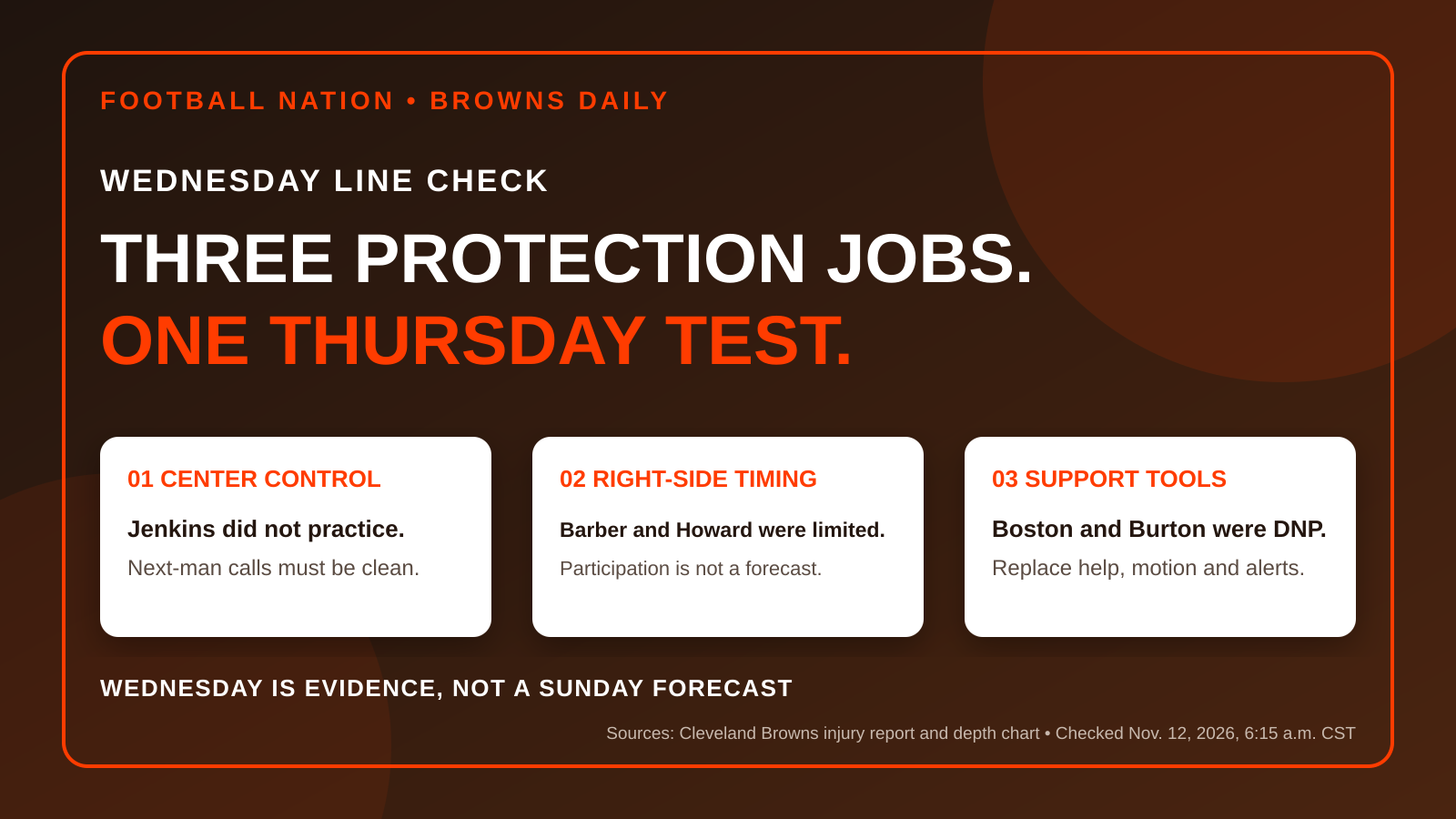
Cleveland’s first practice report of Week 10 did not decide Sunday availability. It did define Thursday’s most important work. Starting center Elgton Jenkins did not practice with a knee issue, while right guard Austin Barber and right tackle Tytus Howard were limited. With Deshaun Watson set to return after a week in which Cleveland said he took no team reps, those participation lines create a protection communication test before they create a lineup prediction.
What Wednesday actually established
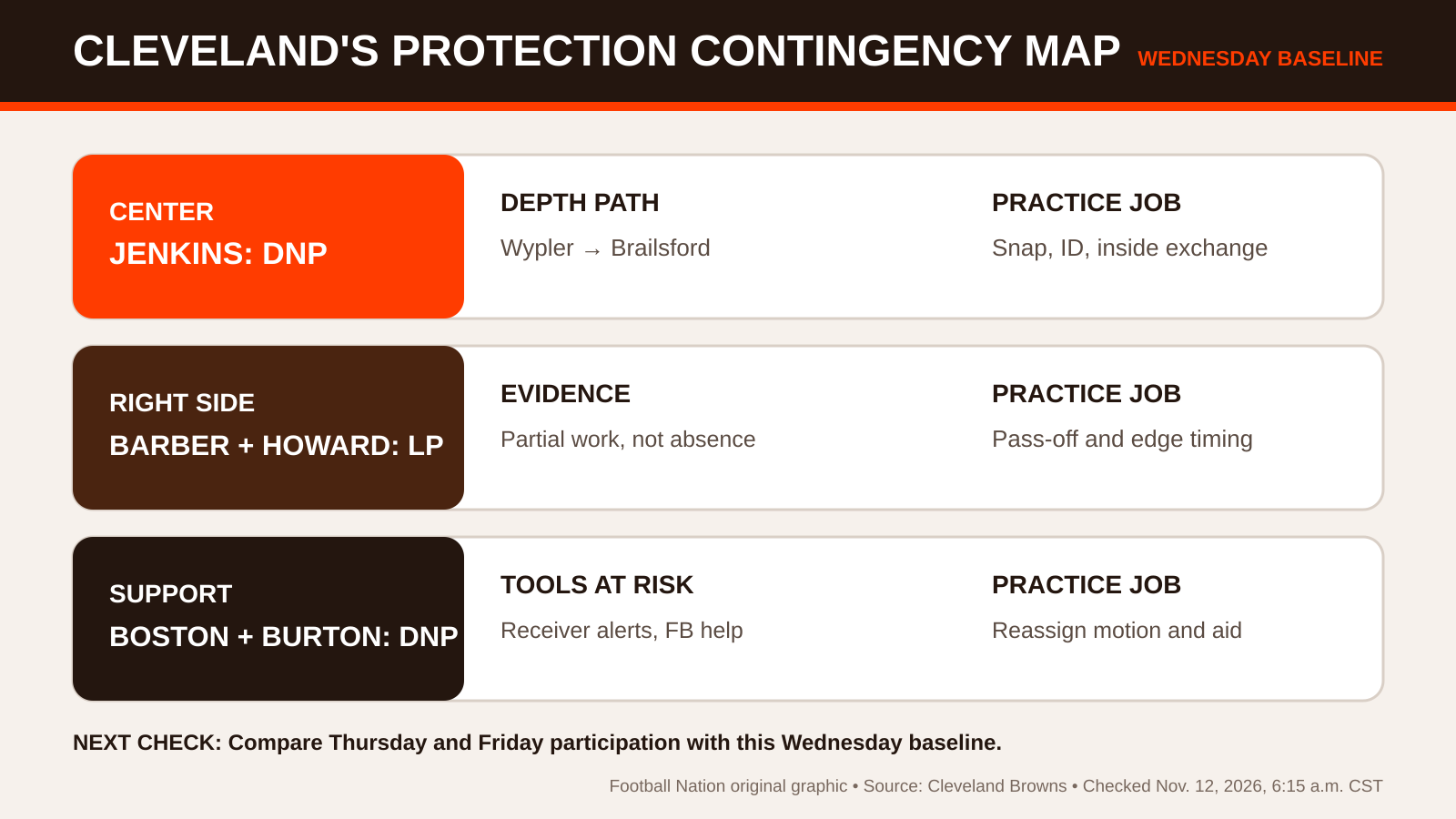
Cleveland listed Jenkins as did not participate. Barber and Howard were limited. Wide receiver Denzel Boston and fullback Michael Burton also did not practice, while tight end Harold Fannin Jr. was limited. Those labels describe Wednesday only. They do not say that a player will be inactive, and a limited practice is not the same as a projected absence.
Job 1: keep the center exchange stable
The Browns’ published depth chart places Luke Wypler and rookie Parker Brailsford behind Jenkins at center. If Jenkins cannot take the full Thursday workload, the relevant question is not simply who snaps the ball. The replacement must own the identification process before the snap, set the inside combination rules and keep the exchange clean when protection changes late. A quarterback returning after limited recent team work benefits from fewer moving parts, so the center’s command matters as much as the name on the depth chart.
Job 2: rebuild right-side timing
Barber and Howard being limited is useful evidence without being a verdict. The right guard and right tackle must pass interior movement, sort games at the edge and agree on when a back or tight end becomes part of the answer. Partial work can still produce those communication reps, but Thursday will show whether the pair progresses together or whether Cleveland has to split repetitions with its next options. The risk is not one isolated matchup. It is two adjacent players using different timing on the same pressure.
Job 3: replace protection support
Boston and Burton add a less obvious layer. A receiver can carry sight adjustments and hot-route responsibilities, while a fullback can change the launch point, insert into protection or sell a run look before helping the edge. If either player remains unavailable, Cleveland must decide which alternatives inherit those jobs. That does not mean the offense becomes less aggressive by default. It means the substitute must understand the protection consequence of the motion, alignment and alert.
Why Watson’s recent practice context raises the value of clean calls
The Browns said Watson took only individual work last Friday and no team reps before sitting out Week 9 after clearing concussion protocol. That fact does not predict how he will play. It does make Thursday’s shared repetitions important. The quarterback, center and right side need the same protection language when the defensive picture changes. If Cleveland has to alter two positions at once, the staff can reduce the communication burden with clearer declarations, motion that reveals coverage and protection answers built into the formation.
Fantasy consequence: monitor the line, do not overreact
In standard PPR formats, Wednesday alone is not a reason to downgrade Watson, Jerry Jeudy or the Cleveland backfield. The actionable signal is whether Jenkins, Barber and Howard progress on Thursday and Friday. Stable center and right-side participation would support cleaner pocket timing and more predictable run combinations. Continued absences or reduced work would increase uncertainty around efficiency, especially on obvious passing downs. Treat that as a lineup-management input, not a standalone bench decision.
Strongest counterargument and uncertainty
Early-week injury reports are noisy. Veterans often receive managed work, limited players frequently play and Jenkins could progress quickly. That is the strongest case against drawing a large conclusion now. The reason the report still matters is the concentration of communication jobs across adjacent positions while the starting quarterback is re-entering the team period. The test is whether Thursday reduces that concentration, not whether Wednesday predicts the active list.
Next checkpoint
Compare Thursday and Friday participation with the Wednesday baseline. Look for Jenkins to return in some capacity, for Barber and Howard to progress rather than regress, and for Boston or Burton to restore the offense’s support tools. The final injury designations and Sunday active list are the decisive availability checkpoints.

Comments