Edge vs. Defensive End vs. Outside Linebacker: What Is the Difference?
- Football Nation
- Aug 18
- 4 min read
Edge is a broad description of where a defender plays. Defensive end and outside linebacker are traditional position labels.
Auburn's official 2026 roster shows why the terminology matters in real life: it lists players separately as EDGE, defensive end, defensive line, and linebacker. An April team feature also says the same position coach works with the Tigers' bucks and edges and quotes him describing players who can handle both Buck and defensive end. The label follows the scheme; the assignment reveals the player.
That difference is why one player can be called an edge rusher by draft analysts, a linebacker on his college roster, and a defensive end after he reaches the NFL.

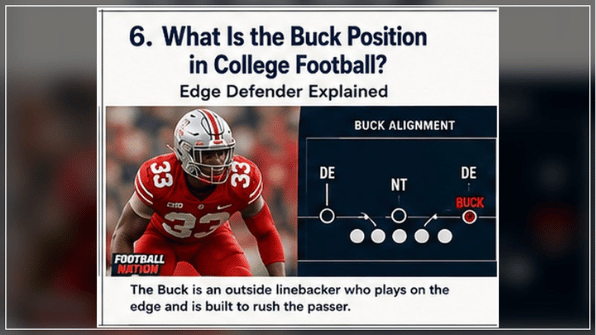
Original Football Nation teaching graphic.
Modern football has blurred the old boundaries.
What is an edge defender?
An edge defender lines up at or near the outside edge of the defensive front.
His job usually begins with two priorities:
Pressure the quarterback.
Keep outside runs from escaping the defense.
The word EDGE does not tell you whether the player has his hand on the ground or stands up.
Edge pressure can also be disguised. In a zone blitz, one outside defender may rush while another drops, which is another reason the pre-snap position label does not explain the entire assignment.
It is intentionally broad.
What is a defensive end?
A defensive end is part of the defensive line.
In a traditional four man front, the end aligns outside the defensive tackle and attacks the offensive tackle or tight end.
He must rush the passer, defend the run, squeeze gaps, and keep contain.
NFL Football Operations describes defensive ends as players on the outside ends of the defensive line who pressure the quarterback and stop the run.
What is an outside linebacker?
Outside linebacker belongs to the linebacker family.
In a traditional four three defense, an outside linebacker may play off the ball and handle more coverage and pursuit.
In a three four defense, an outside linebacker can become the main edge rusher and look very similar to a defensive end.
That second version is where the labels begin to overlap.
Personnel changes matter too. In a nickel defense, an off-ball outside linebacker may leave the field while a true edge rusher stays, making the difference visible even when both players were called linebackers on the roster.
Why does EDGE exist as a label?
EDGE solves a classification problem.
A stand up three four outside linebacker and a hand down four three defensive end may have nearly the same primary job: defeat the tackle and rush from the outside.
Calling both players edge defenders lets analysts compare their actual role instead of getting trapped by the roster label.
The NFL draft now groups many prospects under EDGE for that reason.
Defensive end vs outside linebacker
The biggest traditional difference is coverage and stance.
A defensive end normally begins on the line and spends more time engaging offensive tackles and tight ends.
An outside linebacker may stand up, move before the snap, play off the ball, or drop into coverage.
But hybrid fronts can erase much of that difference.
NFL.com has described the challenge of finding players who can rush from the line and still function off the ball.
Where Jack, Buck and Wolf fit
College football loves custom names for players who live between these positions.
A Jack is commonly an edge hybrid.
A Buck can serve as a stand up edge defender.
A Wolf in Kane Wommack's defense combines edge rushing with box and coverage responsibilities.
Those names are different playbooks solving the same roster problem.
Where Bandit fits
Bandit is even more scheme dependent.
North Carolina used it as a defensive end and linebacker hybrid. Alabama's current version is closer to the defensive line.
Football Nation's Bandit guide shows why the assignment matters more than the nickname.
Does a hand down stance make someone a defensive end?
Not necessarily.
A hybrid edge player can put his hand down on one call and stand on the next.
Stance is a clue, not a complete position definition.
Watch how often the player drops into coverage, moves into the box, or aligns inside the tackle. Those snaps reveal the true range of the role.
What type of body fits each role?
Traditional defensive ends are often heavier because they spend more time taking on offensive linemen.
Traditional outside linebackers are often lighter and more comfortable moving in space.
Edge defenders can fall anywhere between those profiles.
The best modern players combine enough power to survive against the run with enough burst to threaten the quarterback.
The strongest misconception
The biggest mistake is assuming EDGE is simply a newer name for defensive end. EDGE is an umbrella that can include defensive ends and rush linebackers, but not every defensive end or outside linebacker belongs under it. An interior-focused end is not primarily an edge rusher, and an off-ball linebacker who rarely attacks the tackle is not one either.
The same rule applies to scheme names such as Star: start with alignment, then track the assignment. If a player lives outside the tackle, sets the perimeter against the run, and regularly threatens the quarterback, EDGE is probably the clearest functional description regardless of what the depth chart calls him.
What to watch on television
Find the defender outside the offensive tackle.
If he rushes almost every snap and plays with his hand down, he looks like a defensive end.
If he stands, moves off the ball, covers, and still rushes, he looks more like an outside linebacker hybrid.
If the broadcast simply calls him an edge defender, that may be the most accurate description of all.
Football Nation's QB spy guide also shows why an edge player may sometimes slow his rush and account for a mobile quarterback instead.
Football Nation takeaway
Edge describes the job location. Defensive end and outside linebacker describe traditional position families.
A four three defensive end and a three four outside linebacker can both be edge defenders. Modern college roles such as Jack, Buck, Wolf, and Bandit blur the line even more.
When evaluating a player, study what he actually does before trusting the roster abbreviation.


Comments