


Lions vs. Bills Prediction: Allen Wins a Thursday Shootout
Football Nation prediction: Buffalo 34, Detroit 30. Josh Allen’s explosive passing game is the narrow separator in a matchup built to become a Thursday-night shootout. Detroit can control long stretches with Jahmyr Gibbs and its offensive line, but the Lions just allowed 410 passing yards to New Orleans. Buffalo, meanwhile, generated 409 yards on only 52 plays and finished its opener with a 96-yard winning touchdown drive. The pick is Buffalo because Allen has the clearest path to punish Detroit’s depleted secondary before the Lions’ run game can dictate the pace.
The official NFL game center lists both teams at 1–0 and confirms Highmark Stadium in Orchard Park as the venue. The Bills’ official Week 1 recap confirms kickoff at 8:15 p.m. Eastern on Thursday, September 17, 2026 — 7:15 p.m. Central — on Prime Video. It will be the first regular-season game in Buffalo’s new stadium, adding a genuine national-event layer to a matchup that already features two of the league’s highest-ceiling offenses.
Every efficiency number below is a one-game 2026 sample. That is useful evidence of current personnel and style, but it is not a stable season-long rate. The preview therefore separates confirmed Week 1 results from Football Nation interpretation and keeps the injury call provisional until the final Wednesday report.
Lions vs. Bills Week 2 snapshot
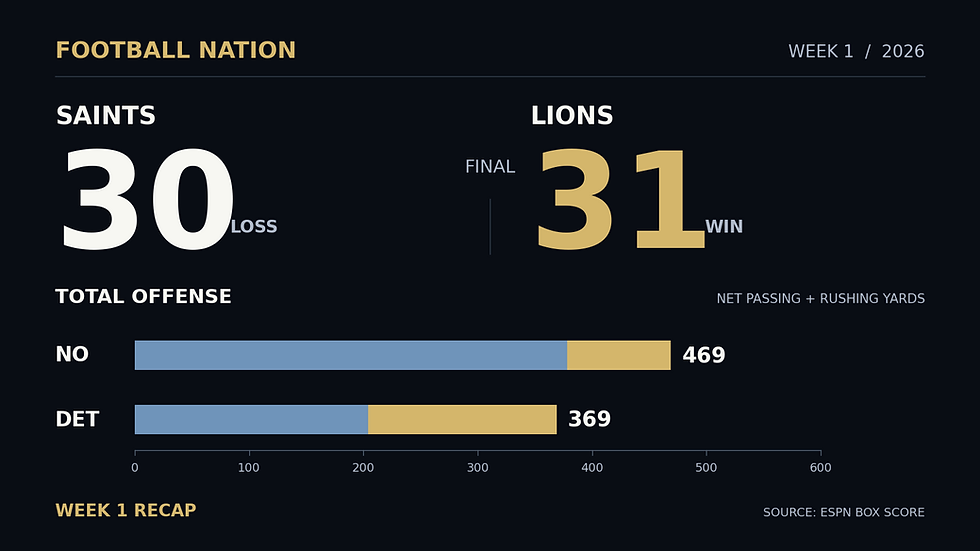
Detroit beat New Orleans 31–30 in overtime after leading 21–0. Buffalo won 36–31 at Houston after four fourth-quarter lead changes. Both clubs are unbeaten, but neither defense produced a clean opener. That combination raises the scoring ceiling and makes possession value — turnovers, fourth downs and red-zone finishes — more important than raw yardage.
Sources for the table: the NFL matchup page, the Bills’ official opener recap, the Lions’ official opener recap and the official game-center/box-score totals. Detroit’s 5-of-13 third-down line and 4-of-5 red-zone line are from the Week 1 box score; Buffalo went 3-of-9 on third down and 1-of-3 in the red zone.
Why Buffalo owns the passing-game edge
Allen completed 20 of 29 passes for 334 yards and two touchdowns at Houston, then added 23 rushing yards and two more scores. The production was not empty volume: Buffalo averaged 7.9 yards per offensive play. Dalton Kincaid caught five passes for 130 yards, D.J. Moore had five for 100 and a touchdown, and Joshua Palmer supplied the 34-yard winner with 1:36 left.
The stress point for Detroit is depth. Tyler Shough completed 35 of 56 passes for 410 yards and three scores in the Lions’ opener, while Chris Olave reached 182 yards. Detroit did intercept Shough twice and finished with five sacks, which is why the defense was not simply bad. It was volatile: pressure created takeaways, but the secondary allowed New Orleans to erase a three-touchdown deficit and force overtime.
Allen is a harsher test because he extends plays without needing the offense to abandon its structure. Kincaid can attack the middle, Moore can win after the catch, and Palmer showed that one vertical mistake can flip the game. For more Buffalo context, Football Nation’s Bills–Texans recap explains how the final drive changed the opener, while the Week 1 Bills–Texans preview supplies the preseason baseline that should now be read alongside the real Week 1 evidence.

Josh Allen with Buffalo before a 2021 home game. Photo: All-Pro Reels / Wikimedia Commons / CC BY-SA 2.0. Commercial reuse is permitted with attribution and share-alike terms.
How Detroit can control the game
Detroit’s counter is Gibbs. He carried 29 times for 156 yards and two touchdowns against New Orleans, added five catches for 30 yards and produced seven runs of at least 10 yards. The Lions held the ball for 36:51. That profile attacks Buffalo’s biggest Week 1 concern: Houston sustained long possessions, converted 7 of 16 third downs and scored touchdowns on four of five red-zone trips.
The Lions do not need Jared Goff to match Allen’s 334 passing yards. They need Goff to stay efficient after the run game creates manageable down-and-distance. He completed 26 of 39 for 206 yards, two touchdowns and no interceptions in Week 1, and Amon-Ra St. Brown caught both scores. Detroit’s 4-of-5 red-zone result matters here because Buffalo settled for three Tyler Bass field goals and scored only once on three red-zone possessions.
The larger risk is the offensive line on a short week. Christian Mahogany and Blake Miller were estimated nonparticipants Monday, while Juice Scruggs was limited. If that trio remains restricted, Detroit may have to protect the edge with tighter formations or quicker throws, shrinking the route menu. Football Nation’s Jahmyr Gibbs contract analysis explains why his role is designed to carry this kind of game, and the Jameson Williams development report frames the vertical threat Buffalo cannot ignore.
Pressure, sacks and explosive plays
Detroit’s official five-sack total came on 61 New Orleans dropbacks, a derived sack rate of 8.2 percent. Buffalo recorded three sacks on 41 Houston dropbacks, a derived 7.3 percent rate. Those calculations use pass attempts plus sacks and are labeled as Week 1 derivatives, not official pressure rates. Public official summaries did not publish a comparable full pressure percentage for both teams, so this preview does not pretend that pressures and sacks are interchangeable.
The explosive-play evidence points in opposite directions. Buffalo produced four completions of at least 34 yards in its official recap: gains of 35 and 38 to Kincaid, a 43-yard touchdown to Moore and the 34-yard winner to Palmer. Detroit’s explosiveness came primarily on the ground through Gibbs. That contrast shapes the prediction: the Lions can create repeated efficient gains, but Buffalo can erase a deficit in one snap.
Injury and availability checkpoint
The Lions’ Monday practice report estimated Mahogany (hip) and Miller (knee) as nonparticipants, Scruggs (knee) as limited and defensive back Christian Izien (groin) as full. Detroit also remains without safeties Brian Branch and Kerby Joseph on reserve/PUP, so the secondary that surrendered 410 passing yards is still missing two central pieces.
Buffalo’s first short-week report listed Ty Johnson (hamstring), T.J. Sanders (knee) and Terrel Bernard (calf) as limited, with Bradley Chubb, Cole Bishop and Jordan Hancock full participants. These are Monday estimates, not final game designations. The next checkpoint is Tuesday participation, followed by the decisive Wednesday report. Any downgrade for Detroit’s linemen or Bernard would materially change the matchup.
Football Nation’s Sam LaPorta injury file provides additional Detroit passing-game context. For Buffalo’s environment, the new Highmark Stadium report explains why Thursday is more than a routine home opener.
Fantasy football consequences
Allen remains an automatic QB1 after producing four total touchdowns in Week 1. Kincaid’s 130 yards elevate him from touchdown-dependent tight end to a featured matchup problem, although one game should not be treated as a permanent target-share guarantee. Moore’s five-catch, 100-yard debut gives him a strong starting case. Palmer is a volatile flex because the winning touchdown was his only reception.
Gibbs is Detroit’s most secure fantasy asset and the clearest volume play in the game. St. Brown remains a must-start because his red-zone role survived even when the passing yardage was modest. Goff is a viable streamer or superflex starter, especially if Buffalo’s offense forces pace, but the injured line lowers his floor. Williams carries the classic boom-or-bust profile: Buffalo must honor the run, yet reduced protection time could erase deep routes before they develop.
The change conditions are specific. Downgrade Goff and Detroit’s receivers if two of Mahogany, Miller and Scruggs are ruled out. Upgrade Buffalo’s rushing expectation if Bernard is cleared but Detroit’s line remains compromised, because the Bills can create shorter possessions and keep Allen out of unnecessary risk. Do not treat Monday practice estimates as final availability.
The matchup swing points
First, can Detroit keep Buffalo below five explosive completions? Second, can Buffalo force the Lions below their Week 1 red-zone rate after allowing Houston to score on four of five trips? Third, which offensive line handles the short week? Finally, can either defense maintain its Week 1 plus-two turnover margin without relying on another opponent mistake?
Football Nation prediction
Buffalo 34, Detroit 30. Detroit’s run game is good enough to lead at halftime and protect Goff from obvious passing downs. The Lions should also finish more efficiently in the red zone than Buffalo did in Houston. The difference is Allen against a secondary that just conceded 410 passing yards and remains without Branch and Joseph.
This is not a blowout call. A healthier Detroit offensive line or a turnover-free, 35-minute possession game would flip the result. On the information available Monday, Buffalo has the more forgiving path: explosives through Allen, Kincaid and Moore, plus a home crowd opening a new stadium. The Wednesday injury report is the final checkpoint before treating 34–30 as Football Nation’s settled score.


Comments