


Middle Open vs Middle Closed Coverage Explained
Middle open and middle closed are fast ways for a quarterback to describe the deep structure of a defense. They are not complete coverage calls. They are a first answer to a practical question: is a safety occupying the deep middle of the field after the snap?
Information cutoff: October 26, 2026 at 4:13 AM Central. The terminology reflects common coaching usage. Individual teams can attach different rules and checks to the same words.
The short answer
Middle of field open, often shortened to MOFO, means there is no defender stationed in the deep middle. The defense usually has two deep safeties split toward the hashes or sidelines. Cover 2, quarters, Cover 6 and two man can all produce a middle open picture.
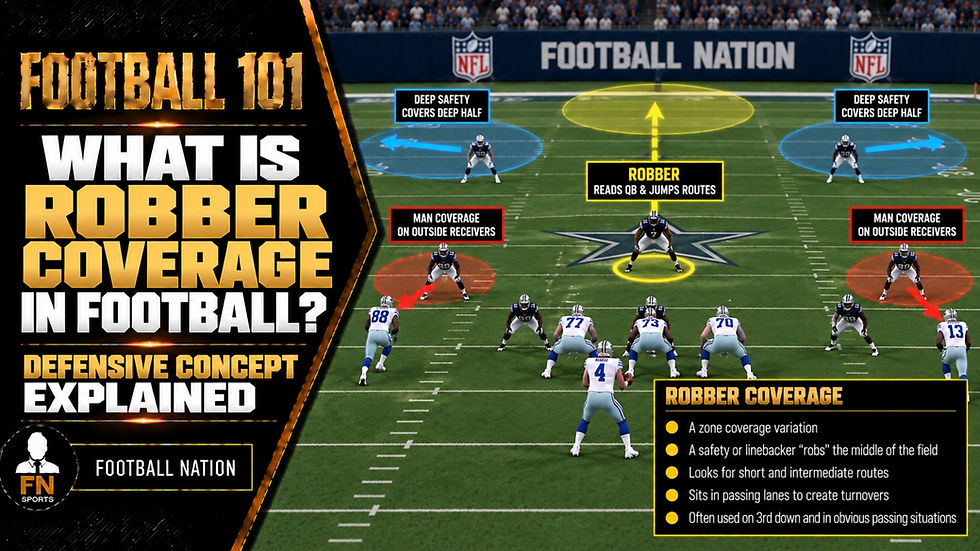
Middle of field closed, often shortened to MOFC, means one deep defender controls the post. Cover 1 and Cover 3 are the most familiar examples. The other safety may be in the box, over a slot, in a robber position or disguising pressure.
The labels tell the quarterback where the deep help begins. They do not, by themselves, tell him whether the defense is playing man, spot zone or match coverage.
Read | Deep picture | Common families | Usual stress point |
Middle open | No post safety | Cover 2, quarters, Cover 6, two man | Seams and the space between safeties |
Middle closed | One post safety | Cover 1 and Cover 3 | Outside isolation and underneath voids |
Disguised shell | Picture changes after snap | Rotated Cover 3, robber, inverted Cover 2 | Quarterback confirmation and timing |
How a quarterback identifies the structure
The first landmark is the deep safeties. Two high defenders suggest an open middle. One high defender suggests a closed middle. The quarterback then checks corner leverage, the nickel alignment, linebacker depth and the location of the extra safety.
That first picture is only a clue. Modern defenses regularly begin with two high safeties and rotate one player into the post after the snap. They can also show one high and expand into an inverted two high structure. The quarterback must confirm the rotation during his drop rather than throw only from the presnap picture.
USA Football teaches the same sequence: find the safeties, use the boundary corner and other secondary indicators to confirm the shell, then recognize that disguise can change the answer after the snap.
What middle open coverage gives the defense
A split safety structure can cap both sides of the formation and make explosive outside throws harder. It also gives a defense flexible answers against balanced formations because each half can apply its own rules. In quarters match, a corner may carry an outside receiver vertically while the safety relates to the slot. In Cover 2, the corner can defend the flat while the safety protects the deep half.
The tradeoff is structural. With both safeties removed from the box, the offense may gain a favorable run count. The quarterback can also attack the seam or bend an inside route between the safeties if the underneath defender cannot carry it. Tampa 2 answers that problem by asking the middle linebacker to run deep through the middle, but that creates space elsewhere.
What middle closed coverage gives the defense
A post safety lets the defense place another player near the line of scrimmage. That can strengthen the run fit, disguise pressure and add a low hole defender against crossers. In Cover 3, the post safety owns the deep middle while the corners protect the outside thirds. In Cover 1, the post safety is the last deep helper behind man coverage.
The offense responds by stretching that one helper. Two vertical routes can force the post safety to choose. Play action can pull underneath defenders forward and open digs or glance routes behind them. Outside receivers can also receive true one against one chances when the post safety leans toward the opposite side.
Example one: two high becomes Cover 3
The offense sees two deep safeties and calls a concept designed for a middle open picture. At the snap, the weak safety spins to the post while the other safety drops toward a curl or flat zone. The defense is now middle closed. If the quarterback keeps reading the presnap shell, he may throw a seam directly toward the rotating post defender.
The correct response is to confirm the post safety during the first steps of the drop. If the middle closes, the quarterback works the outside leverage or the underneath route vacated by the rotation.
Example two: one high becomes inverted Cover 2
The offense sees a single high safety and expects a closed middle. At the snap, an outside corner drops into a deep half while the apparent post safety expands to the other half. A second defender replaces the corner in the flat. The picture is now middle open.
The quarterback should not force the original outside shot. The seam, middle read or underneath route may become the better answer after the safeties divide the field.
Rules that govern the technique
NFL terminology such as MOFO and MOFC is coaching language, not a rulebook classification. The relevant enforcement appears when defenders execute the coverage.
Under 2026 NFL Rule 8, Section 4, Article 1, a defender may use legal contact within five yards when the rule conditions are satisfied. Rule 8, Section 4, Article 3 governs illegal contact beyond that zone. The penalty is five yards and an automatic first down.
Defensive holding is governed by Rule 12, Section 1, Article 6 and carries five yards plus an automatic first down. Once a forward pass is in flight, Rule 8, Section 5 governs pass interference. Contact that significantly restricts a receiver without a legal play on the ball can produce defensive pass interference at the spot of the foul.
Application: a Cover 1 corner may legally use an initial chuck, but he cannot ride the receiver downfield beyond five yards. A split safety defender can occupy space and play the ball, but he cannot cut off a receiver through restrictive contact while the pass is airborne.
Football and fantasy consequences
Middle open structures often reduce clean deep sideline throws, but they can create targets for slots, tight ends and backs underneath. Seam players gain ceiling when the middle linebacker cannot carry vertically. Running backs can benefit when two safeties remain deep and the offense has a lighter box.
Middle closed structures can create volatile fantasy outcomes. An isolated outside receiver may see fewer easy completions but more valuable deep chances. Crossers and digs can become productive when the post safety is stretched by another route. Mobile quarterbacks may also find scramble space if man defenders turn their backs, although a spy or low hole player can erase that advantage.
Fantasy action: use the shell as context, not as a standalone start or sit rule. Target share, route participation, protection, quarterback timing and the defense's actual post snap rotation matter more than a simple two high percentage.
The strongest counterargument
The strongest objection is that middle open and middle closed are too simple for modern defense. That criticism is correct if the terms are treated as final answers. Match coverages, three safety structures, trap calls and rotations can blur the picture. The value of the labels is speed. They organize the quarterback's first read, then the post snap movement supplies the real coverage answer.
Common misconceptions
Two high does not automatically mean zone. Two man is a middle open man coverage. One high does not automatically mean man. Cover 3 is a middle closed zone family. The number of deep safeties before the snap does not guarantee the final structure because the defense can rotate after the snap.
Frequently asked questions
Is the middle literally empty in MOFO? No. An underneath linebacker or robber may occupy the middle. The term describes the lack of a deep post safety.
Can Cover 0 be called middle open? Some coaches group it that way because there is no post safety, while others treat it as its own pressure category. Terminology varies by system.
What is the easiest visual clue? Find the deepest safeties, then watch whether one rotates to the post during the snap.
Why do offenses use motion? Motion can reveal man leverage, force the defense to communicate and make the rotation easier to identify.
The takeaway
Middle open and middle closed are not magic coverage identifiers. They are the first branch in a quarterback's decision tree. Middle open usually means split deep help and possible space between the safeties. Middle closed usually means one post defender, a stronger box and more isolated matchups outside. The best quarterbacks make the first classification before the snap and confirm it after the snap.

Comments