top of page

What Is Robber Coverage in Football? Safety Trap Explained

Robber coverage is a defensive call that leaves one safety deep while another defender drops into the short-to-intermediate middle and reads the quarterback. That underneath defender—the robber—tries to close crossing routes, digs, glance routes and other in-breakers. The design is often paired with man coverage, but the word robber describes the helper’s job more than one universal play.

How robber coverage works

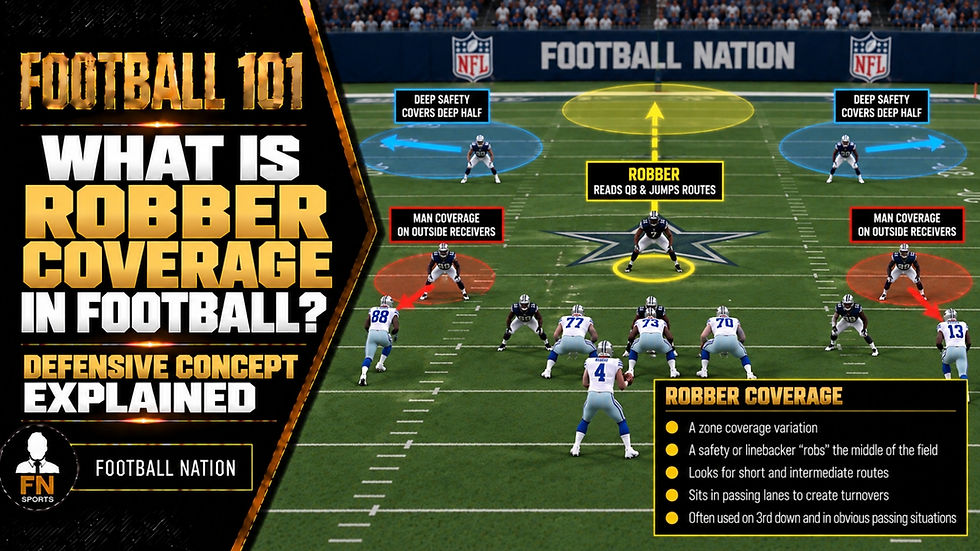
Start with the coverage shell. In a common Cover 1 robber call, one safety protects the deep middle and the cornerbacks or other defensive backs match receivers man to man. The robber sits below the post safety, usually between the hashes. If the quarterback stares down an in-breaking route, the robber can drive into the window rather than carrying one receiver from snap to whistle.

That makes robber coverage an important variation of Cover 1 defense. Standard Cover 1 already gives the secondary a deep middle helper. Robber adds a second free set of eyes underneath, usually by assigning a safety, linebacker or hybrid defender to hunt routes instead of playing a normal man assignment.

The NFL’s film study of Seattle’s Cover 1 robber structure described the same two-level picture: one safety stayed deep while Kam Chancellor worked the intermediate middle. The official NFL breakdown showed how the robber limited tight-window throws and punished routes entering his zone.

What each defender is responsible for

The deep safety is the last line of defense. He must stay on top of vertical routes, overlap throws toward the seams and prevent the quarterback from turning the robber’s aggression into an easy touchdown. If he drives downhill too soon, the coverage loses the protection that makes the call viable.

The robber must balance patience with anticipation. He reads the quarterback’s drop, shoulders and eyes, but he cannot simply chase the first flash of movement. A pump fake can pull him out of position. Good robbers hold their depth, understand the route distribution and break only when the throw or concept declares itself.

The man defenders play with knowledge of help. A corner who expects robber help inside can sit more aggressively on an outside release. A slot defender may trail a receiver across the field because the robber is waiting in the next window. That relationship is why a basic understanding of man coverage matters: leverage is chosen around where the help actually lives.

Which routes robber coverage is designed to stop

Robber coverage is most dangerous against routes that enter the middle at predictable depths. A dig asks a receiver to push vertically and break inside. A glance route does the same thing more quickly, often behind play-action. Deep crossers and option routes can also lead a receiver directly toward the lurking defender.

That puts the robber in the path of concepts such as Dagger, where a clear-out route tries to open a deep dig. It can also disrupt Levels by squeezing the two in-breaking routes from inside out. The coverage does not automatically erase either concept, but it inserts a defender into the area the offense wants to exploit.

New England’s official game-plan analysis showed Miami using Cover 1 robber to close Cooper Kupp’s choice route against the Rams. The Patriots breakdown emphasized how the robber let the primary defender play outside leverage while inside help removed the preferred break. That is the coverage’s central bargain: man defenders can be more aggressive because the robber protects their vulnerable leverage.

Football Nation teaching diagram of Cover 1 robber showing a deep safety, man coverage and a robber driving toward a dig and crossing route.

Football Nation original AI-assisted teaching diagram. It illustrates the coverage relationship and quarterback read; it is not a copied playbook image or game photograph.

Why the quarterback’s eyes matter

The robber has unusual freedom because he is not responsible for matching one eligible receiver throughout the play. That lets him look through the quarterback to the route. If the passer locks onto a dig before the receiver breaks, the robber can start moving early and arrive at the catch point.

Quarterbacks counter that freedom with eye discipline. They may look the robber toward one hash, reset to the opposite side or use a pump fake to make him jump a shorter route. The goal is not theatrical deception. It is to move the helper far enough that he cannot close the actual throwing window.

Pre-snap disguise makes the exchange harder. A defense can show two high safeties, then spin one defender deep and the other down into the robber role after the snap. The quarterback must confirm the rotation while the rush is closing. New England’s analysis of its one-cross family explains how the robber can overtake the first crosser while the original man defender replaces him, turning the coverage into a coordinated exchange rather than a stationary zone.

How offenses beat robber coverage

The cleanest answer is to attack where the robber is not. Outside-breaking routes, fades and comeback routes can stress isolated corners because the underneath helper is concentrated inside. If the deep safety is occupied by a vertical route, the quarterback may get a true one-on-one throw near the sideline.

Offenses can also layer routes around the robber. The Mesh concept sends shallow crossers from opposite sides and can force traffic, exchanges and communication. A patient quarterback can throw underneath the robber, lead a receiver away from him or wait for a second route to replace the space he vacates.

Another answer is to manipulate both safeties. The Yankee concept pairs a deep post with a deep over route. The post occupies the deep safety while the over route challenges the robber’s depth and angle. If either safety takes a false step, the offense can create an explosive window between them.

Protection still matters. Robber coverage often asks defenders to play man-to-man long enough for the helper to read and react. If the quarterback escapes the pocket, those man defenders may have their backs turned. A scramble can punish the call, while quick pressure can prevent the passer from ever moving the robber with his eyes.

The biggest misconception

Robber coverage is not automatically a zone defense, and the robber is not always a safety. Cover 1 robber is usually man coverage with a deep post safety and an underneath helper. Other playbooks may use a linebacker as a low-hole or rat defender, rotate a nickel into the middle, or use robber language in a pattern-match zone call.

The terminology is not standardized across every team. “Rat,” “robber,” “low hole” and “one-cross” can describe related jobs without being identical. The reliable way to identify the structure is by function: who has the deep middle, who is matching receivers, and who is free to read the quarterback underneath.

How to spot robber coverage on television

First, find the deepest safety after the snap. If one defender stays in the middle of the field while the other safety drops toward the hashes, the defense may be rotating into robber coverage. Next, watch the corners. If they turn and run with individual receivers rather than passing them through zones, Cover 1 robber becomes more likely.

Then track the underneath safety. A true robber will hover inside, scan the quarterback and break toward routes entering his area. If he jumps a dig, crosses the formation to take over a crosser or appears at the catch point without having followed that receiver from the snap, you are seeing the design at work.

Football Nation takeaway

Robber coverage is a calculated trap. The defense gives one underneath player freedom to read the quarterback, but that freedom depends on a deep safety preventing the big play and man defenders holding their leverage. When an interception seems to come from nowhere over the middle, rewind the play and locate the second safety. He may have been waiting for the quarterback to lead him directly to the ball.

Frequently asked questions

Is robber coverage the same as Cover 1?

Not exactly. Cover 1 describes man coverage with one deep safety. Robber is a Cover 1 variation that adds an underneath helper reading the quarterback, although teams can use robber language in other structures.

Who usually plays the robber?

A strong safety commonly fills the role, but a free safety, nickel defender, linebacker or hybrid defensive back can do it. The best choice has route recognition, closing speed and enough physicality to handle traffic in the middle.

What throws are safest against robber coverage?

No throw is automatically safe, but outside-breaking routes, quick completions below the robber and well-timed sideline shots can avoid his leverage. The quarterback must still account for the deep safety and isolated corners.

Can a mobile quarterback punish robber coverage?

Yes. Because multiple defenders may be playing man coverage with their backs to the quarterback, a clean escape lane can produce a scramble. Defenses may counter by using a spy, disciplined rush lanes or a zone variation that keeps more eyes on the passer.

Comments


bottom of page