


Should You Draft a Backup Quarterback in Fantasy Football?
Updated: Sep 22
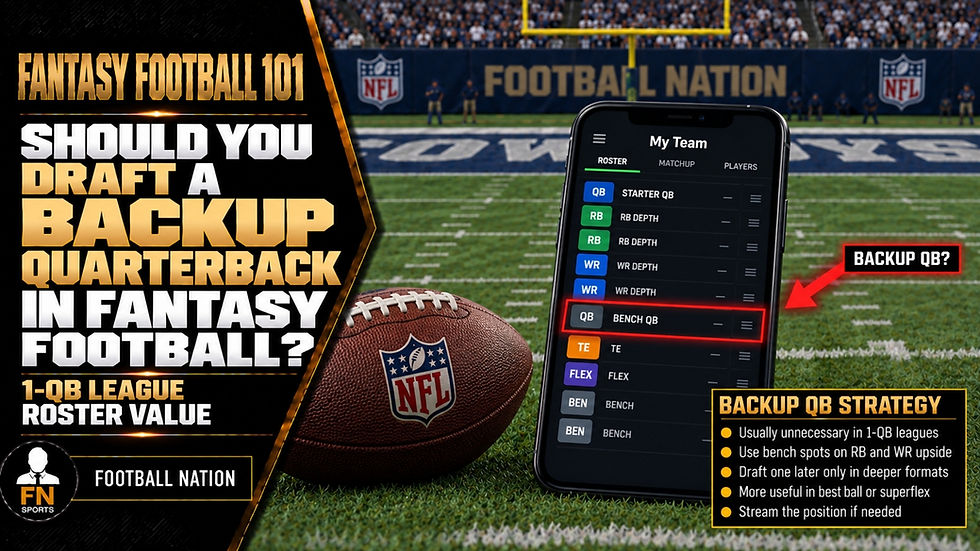
Most managers in a normal one-quarterback league should draft only one QB if playable alternatives will remain on waivers. Use the bench spot on a running back or wide receiver who can gain value. Draft a backup quarterback when your format starts two QBs, the waiver pool will be thin, your starter carries unusual availability risk or the second QB falls far enough to become clear value.
The decision is not about whether QB2 provides insurance. It does. The real question is whether that insurance is worth more than the upside you surrender at another position.
Why one quarterback is usually enough in a one-QB league
A typical one-QB league creates limited weekly demand: every team starts one passer, while multiple running backs and receivers fill the lineup. That makes the opportunity cost of a bench spot important. A backup QB can replace only your starter; an upside RB or WR can become a starter, a flex option or trade value after one depth-chart change.
That is the core of good fantasy football roster construction. Bench players should either protect something difficult to replace or offer a realistic path to a larger role. A second quarterback who will sit for nearly the entire season may do neither.
Yahoo's current roster and lineup guide shows that available players can be filtered and added to a roster. That makes waiver depth part of the draft decision: if several acceptable quarterbacks are likely to remain available, you can replace an injured starter without paying for insurance in August.
When drafting a backup quarterback makes sense
Your league creates extra QB demand
In superflex or two-QB leagues, quarterbacks are not optional bench insurance. They are lineup inventory. More passers start each week, so usable replacements disappear quickly and managers need enough depth to survive bye weeks and injuries.
Best ball also changes the calculation. Yahoo's Best Ball guide says managers make no adds, drops or lineup decisions after the draft. Without waivers, multiple quarterbacks are needed to cover weekly scoring and availability.
The waiver pool will be shallow
Count the teams and note roster limits before assuming you can stream. If managers routinely draft two or three QBs, the free-agent pool may not contain a starter you trust. In that room, a late backup can be rational even in a one-QB format. If the league is smaller and most managers roster one, streaming becomes easier.
Your starter has unusual risk
A backup becomes more useful when the starter is returning from a significant injury, has uncertain Week 1 availability or plays in an offense with a short evaluation window. Do not invent risk simply because every NFL player can get hurt. The premium should reflect a specific concern and the quality of the replacement.
The value falls to you
Your late-round QB plan should include price limits. If a quarterback you rank well above the remaining tier falls several rounds, taking QB2 can create trade leverage or matchup flexibility. Do not reach just to complete a depth chart.
League or roster condition | Default plan | Reason |
|---|---|---|
One-QB, usable waivers | Draft one QB | Preserve RB/WR upside |
One-QB, shallow waivers | Consider QB2 | Replacement cost is higher |
Superflex or two-QB | Draft multiple QBs | Quarterbacks fill more starters |
Best ball | Draft multiple QBs | No in-season roster repairs |
The strongest argument against QB2: bench spots compound
A running back or receiver selected late can gain touches, targets and market value without entering your lineup immediately. That is why a bench stash often has more paths to help than a backup QB. Yahoo also confirms that commissioners control non-active bench positions; the fewer spots your league uses, the more expensive every reserve becomes.
Yahoo's lineup guide notes that benched players do not contribute to the weekly score. The point is simple: QB2 helps only when promoted or traded. A position player can earn that promotion through an expanding role, so the upside comparison matters.
How to make the decision on draft day
First, confirm the starting format and position limits. Second, count how many managers already have two quarterbacks. Third, compare the best available QB with the remaining RB and WR tiers. Finally, check your starter's bye week; you do not need to solve that week immediately if the waiver pool is deep. Our bye-week strategy guide explains why drafting around every conflict can cost more talent than it saves.
Backup quarterback FAQ
Should I draft my starter's real-life backup?
Usually no. NFL backups rarely match the fantasy role or production of the starter. Draft the best fantasy replacement, not the same uniform.
Should my two quarterbacks have different bye weeks?
Prefer it, but do not pass on major value solely because the bye weeks match. You can trade or use waivers before that week.
When should I draft QB2?
After your core starters and priority upside targets, unless superflex or two-QB rules make the position scarce much earlier.
What is the next checkpoint?
Recheck position limits and the waiver pool after the draft. Before Week 1, compare your QB2 with newly available RB and WR stashes and keep the spot that offers more value.
Football Nation takeaway
In a one-QB league with usable waivers, draft one quarterback and preserve the bench spot. Add QB2 only when format, waiver scarcity, starter risk or a real draft-day discount makes the insurance worth its opportunity cost. The goal is not perfect coverage; it is the strongest total roster.


Comments