


Treylon Burks' Foot Injury Puts Washington's Explosive Pass Layer on Trial
Treylon Burks turned one opportunity into Washington's longest reception of the season on Sunday night. Three days later, his foot put the explosive layer of the Commanders' passing game under review. Burks did not participate in Wednesday's practice, according to the team's first Week 9 injury report. That designation does not decide his availability against the Los Angeles Rams, but it does require Washington to prepare for more than one version of its receiver rotation.
Burks caught three passes for 81 yards against Philadelphia, including a 53-yard gain. Through Week 8, he has 12 receptions for 233 yards and two touchdowns. His 19.4 yards per catch is the highest average among Washington receivers with at least five catches. The sample is small, and that is precisely why the role matters: Burks has supplied disproportionate field position from limited volume. Replacing his name on the lineup card would be easy. Replacing the stress he places on coverage would not.
Why Burks changes the shape of the passing game
Washington has thrown for 1,502 yards and converted 30 of 94 third downs. Jayden Daniels has 976 passing yards, six touchdowns and no interceptions, while the team owns a plus seven turnover margin. That profile rewards a controlled offense, but it still needs an explosive outlet. Without a credible deep or boundary threat, safeties can tighten toward Stefon Diggs, Antonio Williams and the intermediate middle. The answer is not to chase a long ball on every series. It is to preserve enough vertical access that the defense cannot compress the rest of the route structure.
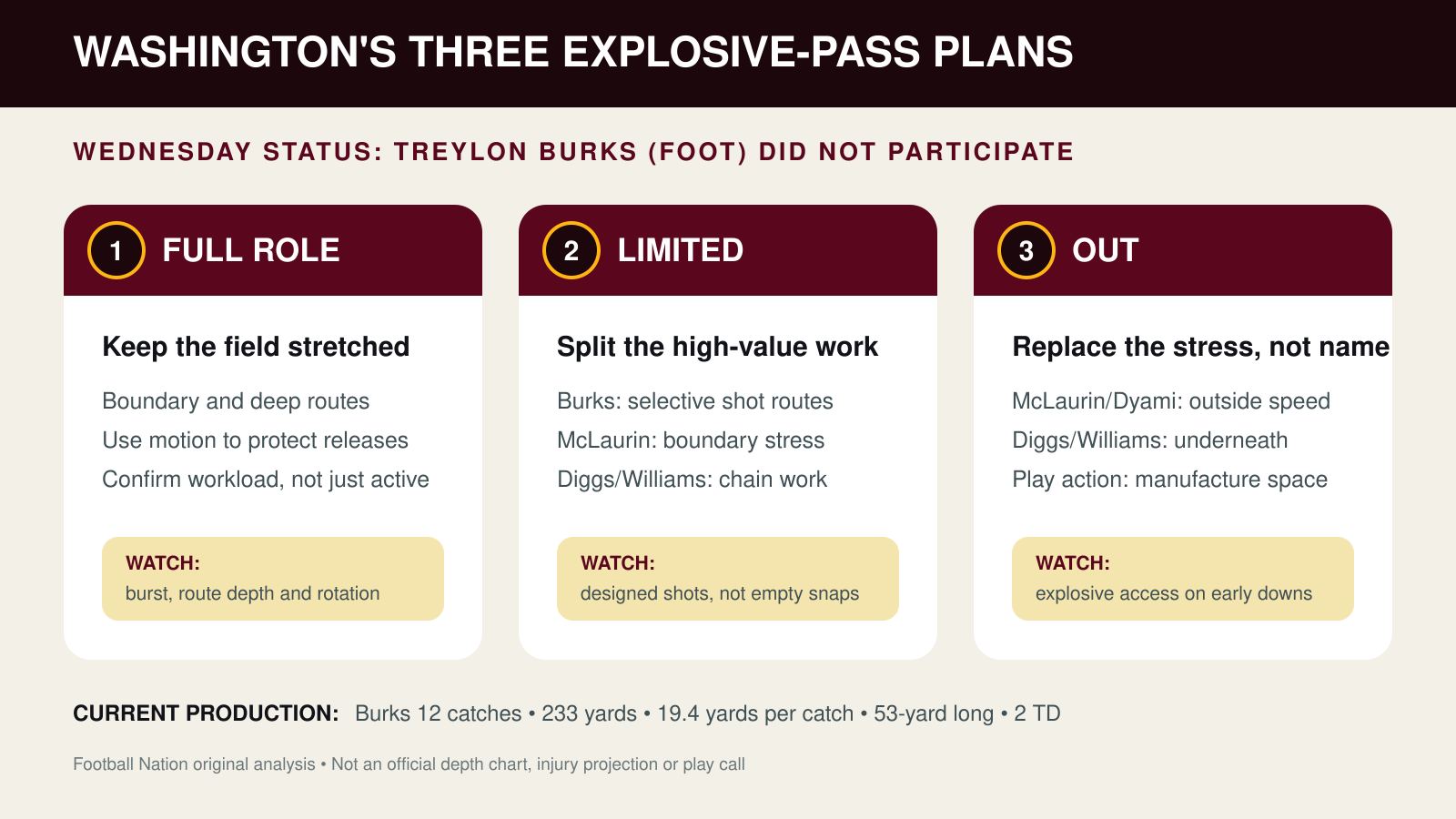
Plan one: Burks has his normal role
If Burks practices fully and is cleared for a normal workload, Washington should keep his job recognizable. Boundary releases, deep crossers and selected go routes let him attack space without requiring a high target count. Motion can help him avoid static press coverage and give Daniels a cleaner picture before the snap. Even in the best case, active status is not the only checkpoint. Route depth, burst and rotation frequency will show whether the foot allows Burks to play at the speed that makes his role valuable.
Plan two: Burks plays, but his workload is managed
A limited Burks should receive high-value work rather than empty snaps. Washington can select a small package of shot routes and play action concepts while Terry McLaurin carries more boundary responsibility. Diggs and Williams can continue handling chain-moving routes, option work and quick answers. The point is not to make Burks a decoy for sixty minutes. It is to use his available burst where it can change coverage, then distribute routine volume to healthier receivers.
The official Commanders X post below links to Wednesday's injury report. It is evidence of the current practice status, not a prediction of Sunday's inactive list.
Plan three: Washington plays without Burks
If Burks cannot play, Washington should replace the stress rather than ask one receiver to copy the entire role. McLaurin is averaging 15.3 yards per catch and can handle outside work. Dyami Brown has a 48-yard reception this season and can supply selected speed routes. Diggs leads the team with 27 catches and five receiving touchdowns, while Williams leads the team with 259 receiving yards. That group can divide the field by skill: outside speed from McLaurin and Brown, underneath stability from Diggs and Williams, and play action to manufacture space.
The tradeoff is clarity for the defense. No other Washington receiver is averaging Burks' 19.4 yards per catch, so the Rams could squeeze intermediate windows until someone proves the top of the coverage is vulnerable. Washington should answer with early-down motion, max-protection shots and formations that force defenders to declare leverage. A deep pass does not have to be completed to create value, but it must be credible.
Fantasy consequence
For fantasy managers, Burks is a practice-report decision. If he returns without a workload warning, his documented big-play profile makes him a volatile standard-scoring option with a lower PPR floor. If he is active but managed, the upside remains but the route count becomes the risk. If he is out, McLaurin gains the clearest path to additional outside work, while Diggs and Williams become stronger volume candidates. Brown would be a deeper explosive-play option. These are role-based observations for standard and PPR formats, not a target or score projection.
The strongest counterargument and next checkpoint
The strongest counterargument is that one Wednesday absence can be precautionary, especially after a player has carried a physically demanding vertical role. That is fair. It is also why the article presents contingency plans instead of declaring Burks unavailable. Thursday's and Friday's official participation reports are the next checkpoints, followed by Sunday's inactive list. If Burks progresses, the question shifts from availability to workload. If he does not, Washington must show how it will keep the field from shrinking.
Sources, checks and rights record
Material facts were checked against the Washington Commanders' official Week 9 injury report, official 2026 team statistics and official Week 8 stats and snaps at 4:19 a.m. Central on Nov. 5, 2026. Comparison period: 2026 regular season through Week 8. The cover and teaching graphic are original Football Nation designs created Nov. 5 from those facts; they use no documentary player likeness. The X evidence is the official Commanders status opened at its exact public URL.

Comments