What Is a 3-Technique in Football? Defensive Tackle Alignment Explained
- Football Nation
- 4 days ago
- 5 min read
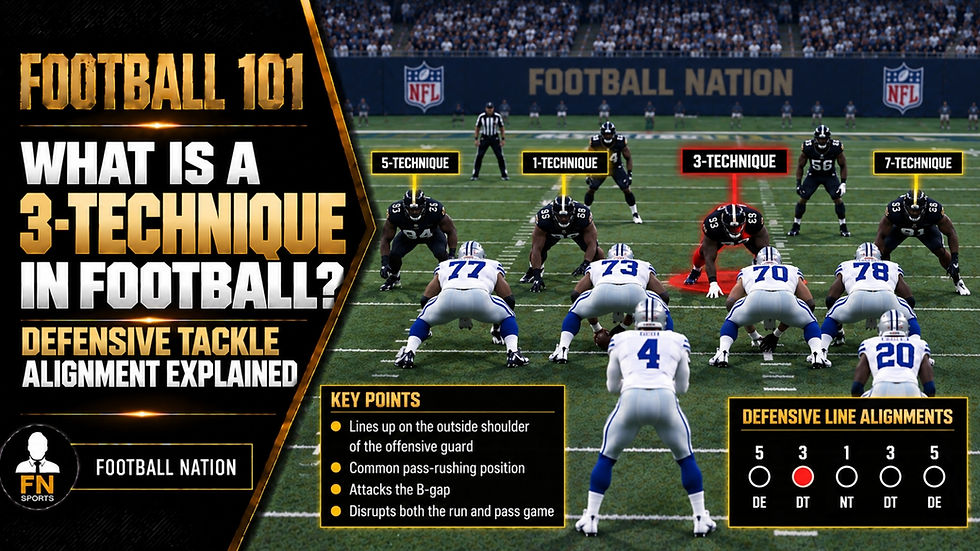
A 3-technique is a defensive lineman aligned on the outside shoulder of an offensive guard. He usually has immediate access to the B-gap between that guard and the tackle. The name describes where the defender starts—not his jersey number, body type or entire job description.
The alignment matters because it places a quick interior defender on one edge of the guard instead of directly over him. From that outside shade, the defender can penetrate the B-gap, squeeze a run lane, force the guard to turn his shoulders or rush the passer through the shortest part of the pocket. That is why the 3-technique is often an attacking defensive-tackle role.
Where the 3-technique lines up
Find the offensive guard, then look at his outside shoulder—the shoulder closer to the offensive tackle. A defender shaded there is in a 3-technique. If he is aligned on the right guard’s outside shoulder, he is positioned between the right guard and right tackle. If he is on the left guard’s outside shoulder, the picture is mirrored.
The nearby gap is the B-gap. The A-gaps sit between the center and guards; the B-gaps sit between the guards and tackles. Coaches can call movements that change the defender’s destination after the snap, but the technique number still identifies the pre-snap landmark.

How defensive line technique numbers work
The common numbering system uses offensive linemen as landmarks. A 0-technique is head-up on the center. A 1-technique shades a shoulder of the center. A 2-technique is head-up on a guard, while the 3-technique shades the guard’s outside shoulder. A 4-technique is head-up on a tackle, a 4i is on the tackle’s inside shoulder and a 5-technique is on the tackle’s outside shoulder.
The pattern helps viewers decode a front quickly: even numbers are generally head-up alignments, while odd numbers are usually shoulder shades. Terminology can vary slightly by coaching system, and a call can add a movement or gap responsibility. The number is the starting address, not a complete playbook.
Why defenses want a 3-technique
The offense can help a guard more easily when a defender is head-up or shaded toward the center. A 3-technique starts farther from that center help. If the guard steps inside, the defender can threaten the B-gap. If the tackle has to account for an edge rusher, the 3-technique may earn a true one-on-one inside.
That spacing is important in a Bear front, where defenders cover interior offensive linemen and make clean combination blocks difficult. Even in lighter fronts, the 3-technique can be the piece that forces the blocking scheme to declare which lineman will help and which defender will be left alone.
The defender does not have to charge straight ahead on every snap. A called defensive line slant can send him across a blocker’s face into a different gap. The pre-snap alignment creates leverage; the post-snap call decides how the defense wants to use it.
What the 3-technique does against the run
Against inside zone, the 3-technique can disrupt the combination between guard and tackle. If he penetrates before the blockers establish hip-to-hip control, the running back may have to cut early. If he anchors and keeps the guard from climbing, he can also protect the linebacker behind him.
Against Duo, the offense wants vertical double teams and a downhill read. The 3-technique tries to dent that surface, split the double team or occupy two blockers long enough for a linebacker to fit cleanly. Winning does not always mean making the tackle; forcing the ball away from its intended track can be enough.
Gap schemes create different problems. On Power or Counter, the 3-technique may face a down block, a double team or a puller arriving through the B-gap. He must read the block, stay square and avoid creating a vertical seam. Penetration is useful only when it does not open the lane the offense wants.
What changes on passing downs
The 3-technique’s pass-rush value comes from interior access. An edge rusher can run past the quarterback’s launch point; an interior rusher can collapse the pocket directly into it. A quick first step forces the guard to set immediately, and an outside rush can make the guard open his hips before the defender counters back inside.
Defenses also pair the 3-technique with twists and games. He may penetrate to occupy the guard and tackle while a teammate loops behind him, or he may loop after another lineman crashes first. The alignment makes those exchanges harder to sort because the guard and tackle already have threats on adjacent edges.
An official NFL video in which Gerald McCoy defines the 3-technique defensive tackle reflects how closely the term is associated with disruptive interior play. An NFL discussion of Fletcher Cox similarly describes the 3-technique as lining up on the outside shoulder of the guard.
Over fronts, under fronts and strength calls
A defense can place the 3-technique to the strong side, weak side, field or boundary depending on its rules. In a traditional over front, the 3-technique is commonly set toward the strength. In an under front, the front shifts the other way. The exact strength declaration can come from the tight end, passing formation, back alignment or game plan.
That is why the same defensive tackle may appear over the left guard on one snap and the right guard on the next. An NFL feature on Seattle’s fronts illustrates how defenses combine a 1-technique and 3-technique within over and under structures. The label travels with the alignment, not with one permanent side of the formation.
The biggest misconception
The biggest misconception is that “3-technique” is a fixed roster position. A depth chart may simply list defensive tackle, yet that player can align as a 1-technique on one call and a 3-technique on another. Some defenses favor a penetrating specialist at 3-technique; others rotate several linemen through the shade.
It is also wrong to assume that every 3-technique shoots the B-gap without reading the play. The front, coverage and run-fit plan can ask him to penetrate, squeeze, wrong-arm a puller, occupy a double team or exchange gaps with a linebacker. Understanding the Sam, Mike and Will linebacker roles helps explain why a lineman’s movement and a linebacker’s fit must work together.
How to spot a 3-technique on film
Pause before the snap and locate both guards. If a defensive lineman’s helmet is outside a guard’s helmet, with his body shaded toward the tackle, you are likely looking at a 3-technique. Next, watch the first two steps: does he attack the B-gap, cross the guard’s face, anchor against a down block or set up a pass-rush game?
The next factual checkpoint is the offense’s response. Does the center slide toward him? Does the tackle squeeze down to help? Does the running back cut away? Those reactions reveal why the alignment was chosen even when the 3-technique does not record a tackle or sack.
Football Nation takeaway
A 3-technique is best understood as an address: the outside shoulder of the guard, next to the B-gap. That address gives the defense leverage to disrupt interior runs, isolate a guard in pass protection and build line movements with the tackle or edge defender. Do not judge the role only by the box score. Watch how the guard sets, where the running lane bends and whether the pocket collapses from inside. Once you can locate the outside shade, the structure of the entire defensive front becomes easier to read.


Comments