What Is a Bear Front in Football? Defensive Alignment Explained
- Football Nation
- 1 day ago
- 4 min read
A Bear front is a defensive alignment that covers the center and both guards, usually with five defenders on or near the line of scrimmage. The classic picture places a nose tackle head-up on the center, two interior defenders over the guards and edge defenders outside the tackles. Its purpose is to crowd the interior, eliminate easy double teams and force the offense to solve five immediate threats across the front.
The direct answer: Bear is a front, not a coverage. It tells you how the defense aligns against the offensive line, but it does not automatically reveal whether the secondary is playing man or zone. Personnel and gap rules also vary. Some teams use five defensive linemen; others build the same surface with stand-up linebackers or hybrid edge players.
What makes a front a Bear front
The most useful identifying feature is the covered interior. In a normal four-man front, at least one interior offensive lineman is often uncovered and can help a teammate before climbing to a linebacker. Bear removes that comfort. When the center, left guard and right guard each have a defender aligned directly over them or on a shoulder, all three must account for first-level threats immediately.
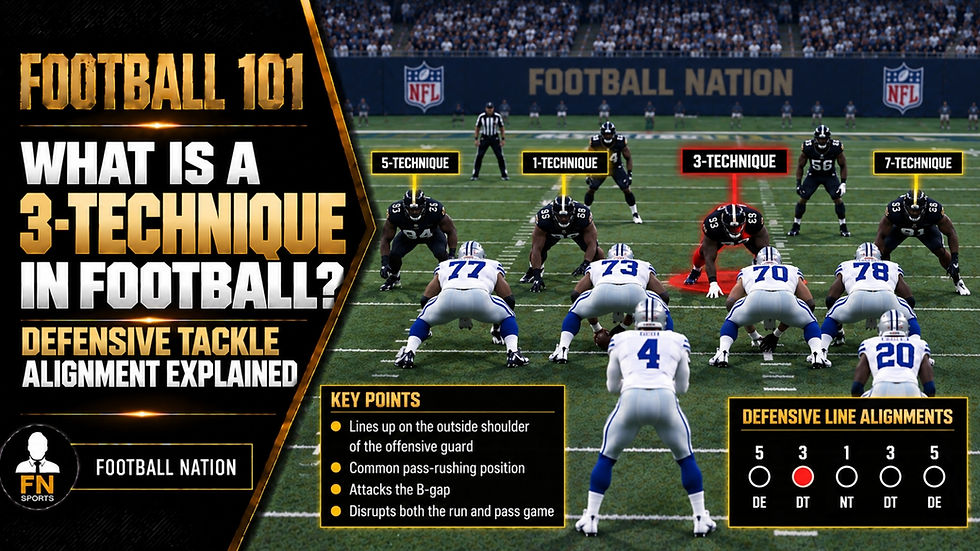
A common teaching picture uses a zero-technique nose directly over the center and two 3-techniques on the outside shoulders of the guards. The edge players complete the five-man surface. Exact shades change with the formation and call, so the label should describe the structure rather than one frozen diagram.

Why Bear fronts are difficult to run against
Interior runs depend on angles, movement and combination blocks. Against Inside Zone, an uncovered lineman normally has a favorable path to help on a defensive tackle and then climb to the second level. Bear covers the helpers. The offense must create movement one-on-one or use a more complicated exchange to reach a linebacker.
The same structure challenges Duo, a scheme built around vertical double teams, and Power O, which needs a clean path for the pulling guard. When three defenders occupy the interior surface, the puller may find traffic before reaching the intended linebacker. The defense is trying to make every inside gap feel occupied before the ball is handed off.
Bear front versus the 46 defense
Bear is closely connected to Buddy Ryan's 46 defense, but the terms are not perfectly interchangeable. The historic 46 was an entire defensive system with a specific personnel package, pressure identity and secondary structure. The Bear front is the alignment idea that survived: cover the three interior offensive linemen and create a heavy surface.
An NFL.com discussion of the Bear look described a defense covering all three inside offensive linemen, using what could become a five-man defensive line and declaring that the offense would not run easily up the middle. That is the visual viewers should remember, even when a modern coordinator pairs the front with different coverages and pressure rules. See the NFL Bear-front analysis.
Bear front versus the modern Tite front
The Tite front is a modern relative, not a perfect synonym. Its common structure is 4i-0-4i: two defensive ends aligned on the inside shoulders of the tackles with a nose over the center. That alignment controls the interior from B-gap to B-gap while keeping more defenders available for spread formations, option football and RPOs.
USA Football describes Tite as a modern version of the Bear idea used to defend spread offenses. The important difference is location. A traditional Bear picture commonly puts the interior defenders over the guards; Tite moves them to 4i alignments inside the tackles. Both aim to close interior running lanes, but they create different blocking angles and linebacker fits. The USA Football Tite-front guide explains the 4i-0-4i structure.
How offenses attack a Bear front
Offenses rarely keep running straight into the extra bodies without an adjustment. They can widen the formation, throw quick screens, use play-action or make an edge defender choose between the quarterback and running back. Perimeter schemes such as Pin-and-Pull can move blockers away from the crowded interior and force bigger defenders to pursue laterally.
Trap and wham concepts use the defense's aggression against it. A lineman can leave an interior defender temporarily unblocked, then strike him from an unexpected angle with a pulling lineman, tight end or fullback. Football Nation's Trap play guide explains why inviting penetration can create a better blocking angle. Quick passing is another answer because a five-man surface can leave fewer bodies available underneath if the defense also sends pressure.
What the defense still has to solve
A heavy front does not guarantee a successful run defense. The edge players must maintain leverage, the interior defenders must control their assigned gaps and the linebackers must fit off the movement in front of them. If every defender charges inside, the ball can bounce to open space. If the front becomes too wide, an interior crease can reappear.
Movement also changes the picture. A defensive line slant can exchange gaps after the snap, but every second-level defender must understand the new fit. The front can also disguise a zone blitz, dropping one apparent rusher while bringing pressure from another location. Alignment creates the problem; assignment and execution still determine whether the defense solves the play.
The biggest misconception
The biggest misconception is that Bear always means five defensive linemen and an all-out blitz. A linebacker can walk onto the line and create the fifth surface player. A safety can enter the box. The defense can rush four, rush five or move players after the snap. The front only tells you where the immediate threats are aligned.
It is also misleading to call every tight odd front Bear. If the guards are uncovered and the ends are in 4i techniques, the more precise label may be Tite. Terminology differs between staffs, so viewers should describe what they can verify: which offensive linemen are covered, how many defenders are on the surface and where the linebackers fit after the snap.
Football Nation takeaway
To recognize a Bear front, ignore the secondary and count the interior matchups. Is there a defender on the center? Are both guards covered? Are edge players outside the tackles, creating a five-man surface? If so, expect the offense to lose easy combination blocks and search for answers on the perimeter, through play-action or with trap-style angles. Bear is built to make the offense prove it can win somewhere other than straight through the middle.


Comments