


What Is a Hump Move? How Pass Rushers Turn Power Into an Inside Win
Information cutoff: November 4, 2026 at 5:11 PM Central. This lesson explains a coaching technique, not a guaranteed result. Terminology can vary by team, but the leverage problem is consistent.
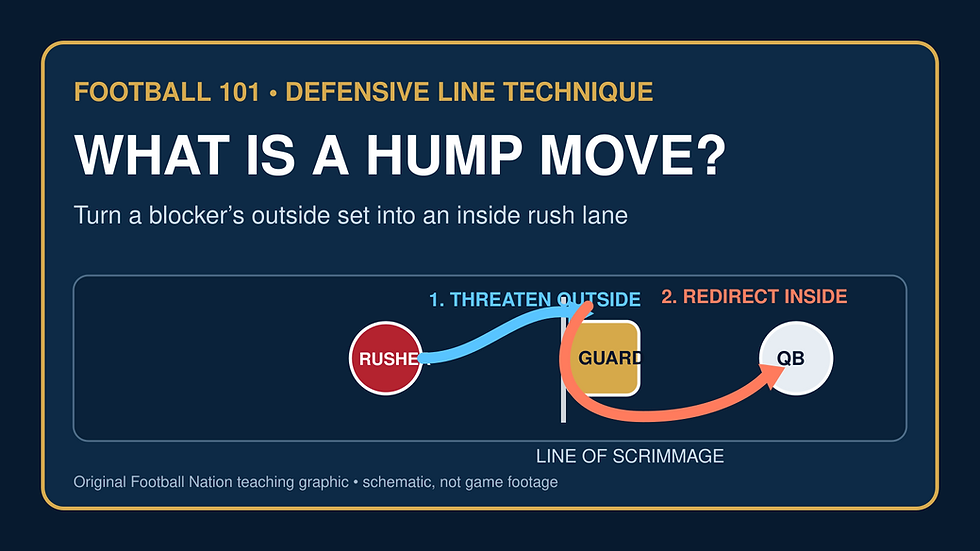
A hump move is a power counter. The pass rusher first convinces the blocker that the rush is going toward an outside edge, then uses leverage and the inside arm to lift and redirect the blocker across his own frame. That creates an inside lane to the quarterback. The move became closely associated with Hall of Fame defensive lineman Reggie White, but the important lesson is not imitation. It is understanding how speed, force and timing work together.
The hump move in plain language
Imagine a guard setting with his shoulders square. If the rusher drives straight through the middle, the blocker can absorb the force with a balanced base. The rusher changes that picture by attacking the blocker’s outside hip. The blocker widens, turns and shifts weight toward the threat. At that instant, the rusher plants, keeps the feet alive and uses the inside arm to send the blocker farther in the direction he already chose. The rusher is not merely pushing a large player sideways. He is adding force to the blocker’s momentum.
That is why the move is different from a basic bull rush. A bull rush tries to collapse the blocker backward. The hump begins with an edge threat and becomes an inside counter. It is also different from a swim move, which emphasizes clearing over the blocker’s arm. The hump wins through leverage, torque and violent redirection.
Four moments to watch

First, the rusher must sell the outside threat. A lazy angle gives the blocker no reason to open. Second, the rusher reads the set rather than deciding blindly. The move is available when the blocker widens or turns the shoulders. Third, the inside arm strikes and lifts while the hips and feet continue through contact. Fourth, the rusher clears the blocker and closes under control. Reaching the quarterback is not enough if the finish creates a roughing foul or allows an easy escape lane.
Worked example: Christian Barmore against Pittsburgh
The Patriots provided a clean 2026 example against the Steelers. On a second and long snap, Christian Barmore was isolated against right guard Spencer Anderson. Patriots.com reported that Barmore used a hump move to win the one on one rush, then attacked Aaron Rodgers’s throwing hand. The ball came loose and Elijah Ponder returned it for a touchdown. The result was dramatic, but the teaching sequence came first: Barmore threatened with power, made the guard commit, redirected inside, cleared the block and finished through the ball.
Watch the official Patriots clip below for those checkpoints. Start with the guard instead of the ball. Notice when his shoulders turn, when Barmore’s inside arm takes control, and how quickly the rusher arrives once the inside lane opens.
A contrasting example: when the move should stay in the toolbox
Now change the blocker’s response. Suppose the guard stays square, keeps the inside hand ready and gives ground without opening the hips. The inside lane never appears. If the rusher forces the hump anyway, the guard can sit on the redirect and wash the rush past the pocket. The better answer may be to keep converting speed to power, use a long arm, or work back outside on the next step. A pass rush move is a response to the blocker, not a trick that succeeds on command.
How an offensive lineman counters it
The blocker wants a patient set, a firm inside half and hands that do not drift outside the frame. Square shoulders reduce the rusher’s leverage. Independent hands also matter. If the outside hand can test the rush without the inside hand leaving home, the blocker is less vulnerable to the redirect. Help from the center can change the picture too, but protection rules may leave the guard alone when the center is occupied by another interior threat.
For viewers, the fastest clue is the blocker’s chest. When the numbers turn toward the sideline, the rusher has a surface to redirect. When the chest stays square and the feet remain underneath the hips, the blocker still owns both lanes.
Football consequence
An inside win shortens the path to the quarterback because the rusher no longer has to run the arc. It can also disrupt the quarterback’s ability to step into a throw. Even without a sack, that compression can force an early release or move the quarterback into another rusher. The offense may answer by sliding the center toward the dangerous interior defender, keeping a back in protection or changing the launch point. Each answer removes a resource from somewhere else.
Fantasy consequence
In standard fantasy formats, the move itself earns no point. The consequence appears through sacks, forced fumbles, defensive touchdowns and disrupted passing volume. In individual defensive player leagues, scoring rules vary, so managers should confirm whether quarterback hits, tackles for loss and forced fumbles score separately. For offensive players, repeated interior pressure can reduce deep attempts and make short targets more valuable, but one highlight is not enough to project a lasting fantasy trend.
Strongest counterargument and uncertainty
The strongest counterargument is that the name can overstate certainty. Coaches and analysts may label the same rep as a hump, a club counter or a power to inside move depending on the hand placement and the teaching system. Broadcast angles can also hide the exact strike. The useful question is not whether every observer uses the same label. It is whether the rusher created an outside commitment, redirected the blocker and won the inside lane.
Rules checkpoint: pass or fumble
The finish can create a close officiating decision. Under the 2026 NFL Rulebook, Rule 8, Section 1, Article 1, intentional forward movement of the passer’s hand starts a forward pass. If contact knocks the ball loose before that forward movement begins, the play is treated as a fumble under Rule 8, Section 7. That line matters because a strip sack can become a live turnover, while an incomplete forward pass ends the play. This is an NFL rule explanation. College administration and replay standards should be checked separately.
What to watch next
On the next interior pass rush, watch the first two steps before following the quarterback. Ask three questions. Did the rusher threaten a real outside lane? Did the blocker turn the shoulders or widen the base? Did the rusher keep moving through the redirect? If all three happen, the inside win is earned. If the blocker stays square, look for the rusher to continue power or choose a different counter.
Quick FAQ
Is a hump move only for huge defenders? No. Mass helps, but timing, pad level, hand placement and footwork create the leverage. A lighter rusher can use the move if the blocker commits hard enough.
Is every inside counter a hump move? No. A spin, swim, club and cross chop can all win inside through different mechanics. The hump is identified by the power redirect across the blocker’s frame.
Does a successful hump always produce a sack? No. A quick throw can beat the rush, the quarterback can escape, or another blocker can help. Pressure that changes the throw can still be a useful defensive win.
Sources and check times
Patriots.com game observations and technique description, checked November 4, 2026 at 5:11 PM Central: https://www.patriots.com/news/game-observations-8-takeaways-from-the-patriots-win-over-the-steelers-in-week-2
New England Patriots official X video, checked as a working native embed November 4, 2026 at 5:11 PM Central: https://x.com/Patriots/status/2101754135259369972
NFL Throwback on Reggie White’s signature hump move, checked November 4, 2026 at 5:11 PM Central: https://www.nfl.com/videos/nfl-throwback-former-nfl-defensive-end-reggie-white-s-signature-hump-move-434211
NFL Next Gen Stats pressure definitions, checked November 4, 2026 at 5:11 PM Central: https://www.nfl.com/news/next-gen-stats-introduction-to-pressure-probability
Official 2026 NFL Rulebook, checked November 4, 2026 at 5:11 PM Central: https://operations.nfl.com/rules-officiating/2026-nfl-rulebook
Related Football Nation lessons: Twist Stunts, Reach Blocks and Counter Trey are attached below as related reading for the trench play curriculum.


Comments