


What Is a Reach Block? How Offensive Linemen Win Play Side Leverage
Information cutoff: November 4, 2026 at 4:06 AM CST. This lesson explains a blocking technique, not a prediction about one team or player.
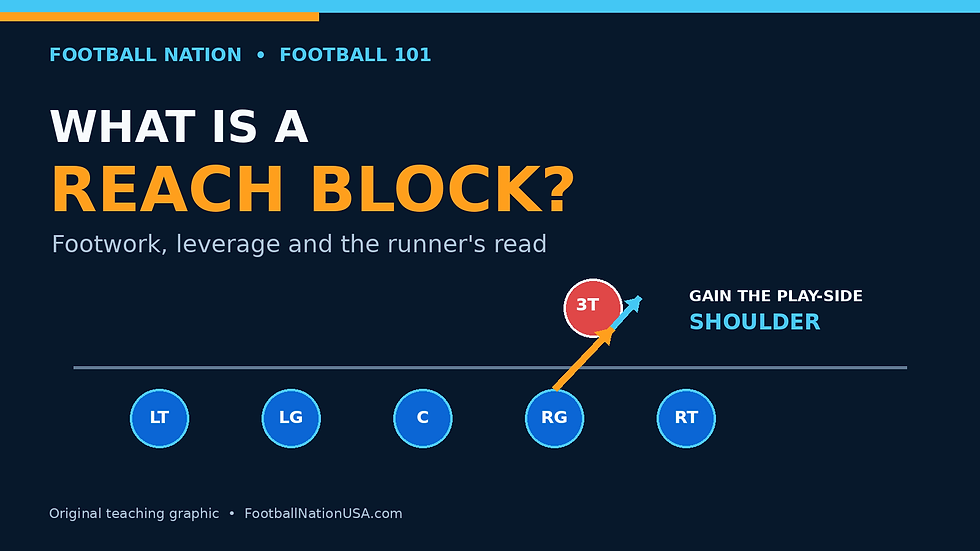
A reach block asks an offensive lineman to win leverage that the defender owns before the snap. Instead of driving straight ahead, the blocker steps toward the play side, crosses enough of the defender's face to control the near shoulder, and keeps working his feet so the defender cannot beat the run to the edge. The name describes the assignment, not an arm extension. The blocker must move his whole body into useful position.
A reach block in plain English
Picture a right guard with a defensive tackle shaded on the guard's outside shoulder. The offense wants to run right. The defender begins closer to the intended path, so a straight drive block would preserve the defender's leverage. The guard must gain ground toward that outside shoulder, bring the second foot through, and place the near hip between the defender and the runner's track. If the guard wins that race, the defender is sealed inside and the back can press the edge.
A successful reach block does not always end with the defender flat on the ground. Control is the standard. If the blocker keeps the defender from crossing the runner's path and gives the back a clean read, the block has done its job.
Why it matters when you watch an NFL game
Reach blocks are central to zone runs because zone schemes create lanes through coordinated movement rather than a predetermined hole. One lineman may reach a shaded defender while the next lineman helps briefly and then climbs to a linebacker. The back presses a landmark, studies the defenders' leverage, and chooses whether to continue outside, plant vertically, or cut behind the flow.
That sequence also explains why a runner can look patient on one play and decisive on the next. The back is not waiting without purpose. The back is forcing defenders to declare where they will fit, then using the leverage created by the line.

Worked example: right guard against a 3 technique
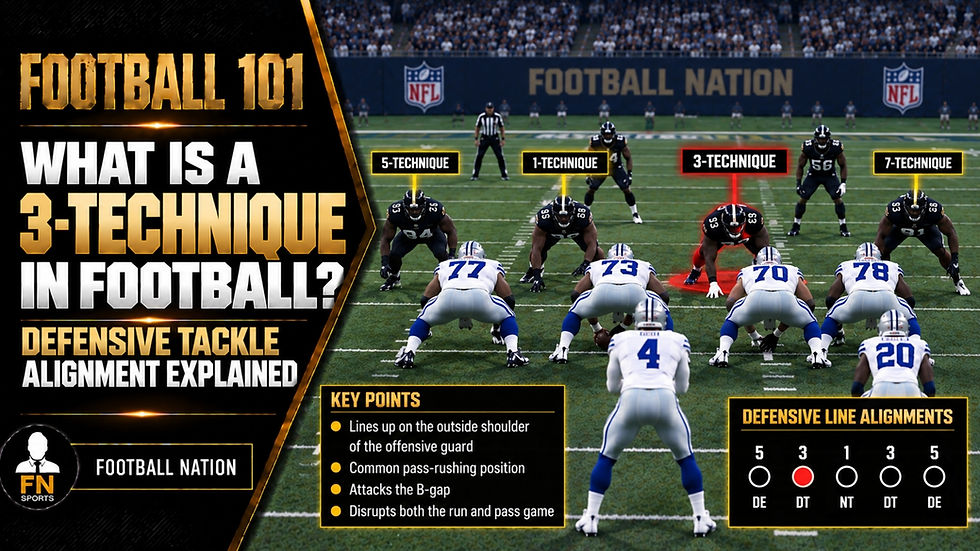
The offense aligns in a normal five man line and calls outside zone to the right. The defensive tackle is a 3 technique, aligned on the outside shoulder of the right guard. At the snap, the guard takes a short angle step toward the defender's near shoulder. The second step must arrive quickly enough to keep a wide base. The guard strikes with the hands inside, keeps the chest up, and runs the feet.
If the guard gets the helmet and near hip across the defender, the defender is sealed toward the middle. The running back presses the outside track and can stay wide. If the defender fights hard to the sideline, the guard does not need to force a hook at any cost. The guard can keep driving the defender outward, which creates a vertical crease inside. The back reads the same leverage and cuts through that crease.
For the alignment behind this example, see Football Nation's lesson on the 3 technique defensive tackle. For the runner's decision process, see inside zone blocking.
Contrasting example: the defender crosses the blocker's face
Now imagine the same call, but the defender spikes hard into the inside gap at the snap. The guard may not be able to place the body fully across the defender. Chasing the defender sideways can make the problem worse because it opens penetration and narrows the back's path. The better response is to stay square, keep contact on the defender's play side half, and prevent immediate penetration.
The runner sees the defender cross inside and can continue outside. The visual result is different from the first example, but the offense may still be correct. This is why reach blocking should be judged with the runner's track and the entire front in view, not by whether one blocker visibly turns one defender.
Three technique landmarks to watch
First two steps: the blocker gains width without crossing the feet or standing upright.
Near shoulder and near hip: the blocker works the body across the defender instead of reaching with the arms alone.
Active finish: the feet keep moving so the defender cannot shed late and enter the runner's lane.
Common misconceptions
First, a reach block is not automatically holding. Legal hand placement and body position still matter. A blocker who loses leverage and grabs outside the defender's frame risks a flag, but good lateral movement and inside hands are ordinary legal blocking.
Second, a reach block is not the same as a pull. A pulling lineman leaves the original spot and travels to another gap or level. A reaching lineman usually attacks a defender aligned near the original position and tries to win that defender's play side half.
Third, every coaching staff does not teach identical footwork. Some emphasize a short lead step, others a bucket step or a different aiming point. The shared objective is leverage. The precise technique changes with the defender's shade, the runner's track, the adjacent lineman's help, and the speed of the front.
A real film example to watch
Jonas Shaffer's film post identifies three John Simpson blocks from Baltimore's 2023 preseason tape. The third clip is the useful teaching point here: Simpson gets enough of the reach block to help spring Justice Hill. Watch the defender's leverage, Simpson's path, and the lane that appears for the runner. The block is valuable because it changes the defender's access to the ball, not because it produces a dramatic finish.
Football and fantasy consequences
For the offense, reliable reach blocking expands the menu. The coordinator can attack wider fronts without asking the running back to manufacture every yard. It also makes play action and boot concepts more believable because linebackers must respect the same initial flow.
For fantasy football, the lesson is not to chase one highlight block. Repeated success matters. A line that consistently controls shaded defenders can create cleaner first reads, more yards before contact, and more sustainable rushing volume. The strongest counterargument is that a running back's result still depends on the full five man unit, tight end support, defensive movement, and the back's own decision. One impressive reach block does not prove a permanent scheme advantage.
Quick FAQ
Does the blocker always have to hook the defender inside?
No. If the defender runs hard outside, the blocker can use that movement and widen the lane. The runner then cuts inside. The play is about controlling leverage, not forcing one finish.
Is a reach block only for outside zone?
No. It is common in zone football, especially when the runner's path stresses the edge, but offenses can use the technique in other run designs whenever a blocker must gain play side position on a shaded defender.
What should a viewer watch first?
Watch the blocker's first two steps and hips, then shift your eyes to the runner. If the blocker keeps a balanced base and the runner has a clean two way read, the reach assignment is likely working.
Sources and next checkpoint
Sources checked November 4, 2026 at 4:06 AM CST: the Minnesota Vikings film breakdown of Caleb Tiernan, NFL Play Football coaching guidance, PFF's reach block grading explainer, and the Baltimore Ravens article preserving the Shaffer film post. The next checkpoint is new official line film that shows the same assignment against a different front, which may change the recommended aiming point but not the leverage principle.
Takeaway
A reach block is a race for play side leverage. The lineman uses footwork, body position, and continued movement to keep a shaded defender out of the runner's path. When you watch the first two steps, the near hip, and the back's read together, a crowded run play becomes much easier to understand.

Comments