What Is a Safety in Football? NFL Two-Point Score Explained
- Football Nation
- 5 days ago
- 5 min read
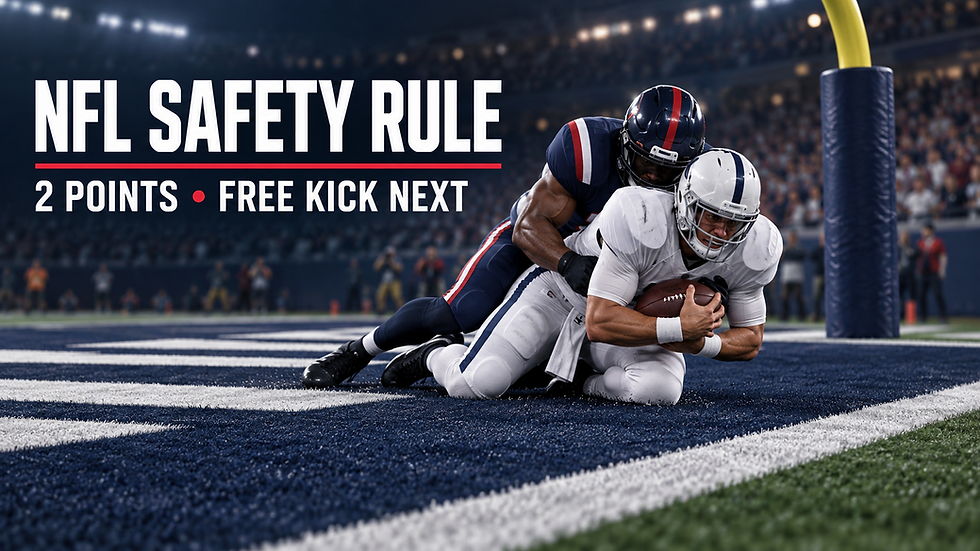
A safety in football is worth two points. In the NFL, it usually occurs when the offense is responsible for the ball becoming dead in its own end zone, when the ball goes out of bounds behind that offense’s goal line, or when an offensive foul is enforced there. The defense gets two points, and the team that conceded the safety must give the ball back with a free kick.
The direct test is simple: locate the ball or enforcement spot, then identify which team caused it to be there. Merely seeing the ball in an end zone is not enough. That responsibility question—called impetus in the rulebook—is what separates a safety from a touchback.
The word safety also names a defensive back position. This guide covers the score. The NFL Football Operations glossary lists the position and scoring play as separate meanings.
What counts as a safety in the NFL?
Rule 11, Section 5 of the official 2026 NFL Rulebook establishes the core rule. A safety can result when the offense commits a foul behind its own goal line and the penalty is accepted there. It can also result when a team supplies the impetus that sends the ball behind its own goal line and the ball becomes dead in that team’s possession or goes out of bounds.
In everyday language, a quarterback tackled with the ball in his own end zone is the clearest example. The offense carried the ball backward, the ball became dead behind its goal line, and the defense earns two points.
Four common ways a safety happens
A quarterback or runner is tackled, goes down, or steps out of bounds while possessing the ball in the offense’s own end zone.
An offensive fumble or backward pass rolls through the back or side of the offense’s own end zone.
The offense commits an accepted foul in its own end zone, such as holding or intentional grounding enforced there.
A bad snap or loose ball remains attributable to the offense and becomes dead behind its goal line.
Loose-ball rulings are easier to follow after learning the league’s recovery rules. Football Nation’s fumble explainer covers possession, recoveries, and why the location of a dead ball matters.
Why impetus decides safety versus touchback
Impetus is the action that sends a loose ball across a goal line. A carry, fumble, backward pass, snap, muff, bat, or kick can supply it. Officials do not simply blame the last player who touched the ball; they trace the action that actually put it into the end zone.
If an offensive player fumbles in the field of play and the ball rolls through the back of that offense’s end zone, the offense supplied the impetus: safety. If an opponent supplies the impetus that sends the ball into the other team’s end zone and the ball becomes dead there, the result is generally a touchback: no points, with possession awarded under the applicable touchback rule.

The diagram’s question—who sent the ball there?—is the fastest useful shortcut. It is not a substitute for every exception, but it correctly frames the ruling. A defender’s mere touch does not always create new impetus, especially on blocked kicks or loose-ball scrambles.
Safety or touchback: the practical difference
A safety awards two points to the opponent and is followed by a free kick from the team that allowed the score. A touchback awards no points and places the ball for the team receiving possession under the rule that created the touchback.
Direction gives viewers a clue. When the offense retreats or sends its own loose ball behind its goal line, think safety. When the opponent sends the ball into that end zone and the defending or receiving team legally ends the play there, think touchback. Football Nation’s guide to a muffed punt versus a fumble shows why possession and responsibility must be separated on kicks.
Can a penalty create a safety?
Yes. An offensive foul enforced behind the offense’s goal line can produce a safety. Intentional grounding from the end zone is the familiar quarterback example; accepted holding in the end zone is another. The flag alone does not create the score—the enforcement spot does. See Football Nation’s Penalties Explained for the broader enforcement framework.
An ordinary incomplete forward pass is not a safety merely because it lands in the offense’s end zone. If the pass is legal and incomplete, the ball returns to the previous spot. Intentional grounding is different because the foul carries enforcement that can place the result behind the goal line.
What happens after a safety?
The team that conceded the safety puts the ball back in play with a free kick from its own 20-yard line. The scoring team is positioned to receive, so the damage is greater than two points alone: the opponent usually gets the next possession and a chance to convert favorable field position into another score.
A safety kick follows free-kick procedures rather than starting with a normal snap. Football Nation’s 2026 kickoff rules explainer details the current alignment framework, while the rulebook separately identifies the 20-yard line as the restraining line for a safety kick.
Why offenses change strategy near their own goal line
Backed-up offenses have almost no margin for error. The quarterback has less space to retreat, the punter may operate close to the end line, and an accepted foul can turn into points. Coaches often favor a quick throw or a secure run to create operating room before attempting a longer-developing play.
Punting is also harder when the punter has limited depth. Football Nation’s punt rules and strategy guide explains the tradeoff between hang time, distance, protection, and field position.
Can a team intentionally take a safety?
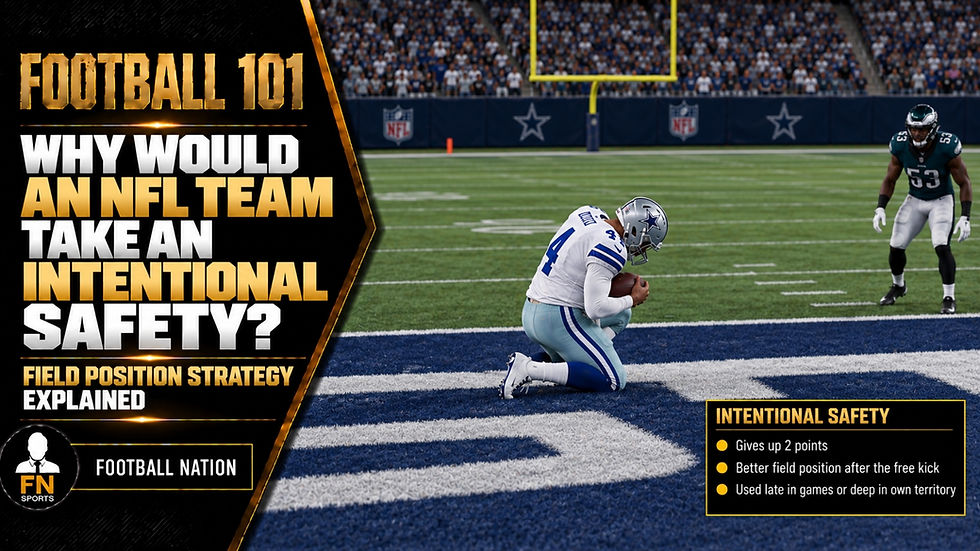
Yes. A team may intentionally concede two points when that is less dangerous than a blocked punt, turnover, or return touchdown. A punter can use available space and time before ending the play, provided the action is legal. The choice is rare because the opponent receives points and the following free kick; it usually requires a very specific score-and-clock situation.
The strongest misconception
The misconception is that any dead ball in an end zone is a safety. It is not. Officials must know which goal line is involved, who possessed the ball, what supplied the impetus, whether a foul changes enforcement, and whether an exception applies. The momentum exception can protect a defender whose original momentum after an interception or recovery carries the player into the end zone; when it applies, the ball is returned to the possession spot rather than automatically becoming a safety.
Football Nation takeaway
Start with responsibility, not location. If the offense supplies the action that sends the ball behind its own goal line and the ball becomes dead there—or if an offensive foul is enforced there—the defense usually gets two points. If the opponent supplied the impetus, think touchback. Then check for a foul, kick rule, or momentum exception before finalizing the call.


Comments