Why Would an NFL Team Take an Intentional Safety?
- Football Nation
- 2 days ago
- 5 min read
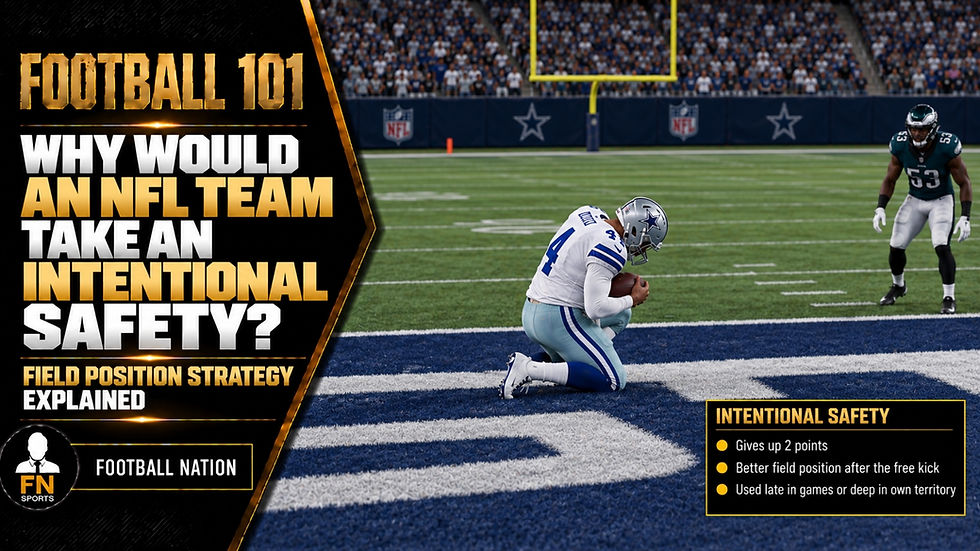
An NFL team takes an intentional safety when conceding two points creates a better chance to win than attempting a normal play or punt from its own end zone. The team can use the live play to drain valuable seconds, avoid a blocked punt or dangerous return, and then make a free kick from its 20-yard line. The opponent gets two points and the ball, so the tactic only makes sense in a narrow score-and-clock situation.
The clearest example is a team protecting a late lead with only a few seconds remaining. A punter receives the snap, retreats through the end zone while avoiding defenders, burns as much legal time as possible and then steps out or downs the ball. The safety ends the play, and the remaining clock may leave the opponent with only a return or one final snap.
What is an intentional safety?
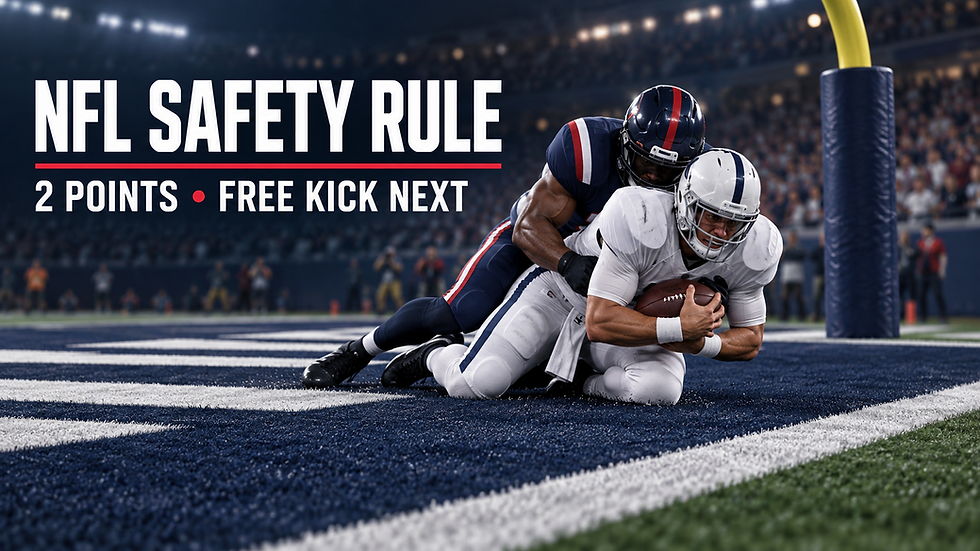
A safety normally occurs when the team responsible for the ball causes it to become dead in its own end zone. The defense receives two points. Afterward, the team that conceded the safety puts the ball in play with a safety kick. The result is identical on the scoreboard whether the safety was forced or chosen; “intentional” describes strategy, not a separate scoring rule.
Rule 11 and the free-kick provisions of the 2026 NFL Rulebook establish the two-point score and the restart. After a safety, the ball is kicked from the scoring team’s 20-yard line. The kicking team may use the safety-kick options permitted by rule, which is why viewers often see a punt-style free kick rather than a normal scrimmage punt.
NFL Football Operations’ terminology guide helps distinguish the score from a touchback. A touchback does not award points; a safety does. The key question is which team supplied the force that put the ball into its own end zone and made it dead there.
Choice | Score effect | Possession and field-position effect |
|---|---|---|
Normal fourth-down punt | No points conceded | Opponent receives the punt; coverage result determines starting field position |
Intentional safety | Opponent gains 2 points | Scoring team must make a free kick from its 20-yard line |
Run ordinary offensive play | No automatic score | Risk of turnover, sack, blocked play or clock stoppage near own goal line |
Use timeout | No score; clock stops | Preserves possession decision but spends one limited timeout |
Source: 2026 NFL Rulebook scoring, safety-kick and timing provisions. Strategic value depends on the exact score, remaining time, timeout inventory and return risk.

Why give the opponent two points?
Because points are only one game resource. Time, possession and field position also matter. If a team leads by more than two points and the opponent has almost no time left, losing two points can be less dangerous than attempting a cramped punt that might be blocked or returned from close range. The safety converts an unpredictable goal-line play into a controlled clock drain and a planned free kick.
The math is contextual. A team leading by three that concedes two still leads by one. A team leading by four still leads by two. But a team leading by two would tie the game, and a one-point lead would become a deficit. Coaches must calculate the score after the safety—not merely before it—then consider what the opponent can realistically do with the remaining time.
How does the play burn time?
The game clock runs during the live play under the normal timing rules. Rather than immediately stepping out, the punter can retreat or move laterally in the end zone while protecting the ball. He cannot commit fouls or assume defenders must stop pursuing; the play remains live until he is down, goes out of bounds or otherwise makes the ball dead.
The offense must first complete a legal snap before the play clock expires. The punter’s task is to consume game-clock seconds without allowing a strip, touchdown or penalty that creates a worse result. The final checkpoint is the whistle: only then is the time drain complete and the safety recorded.
Why not simply punt normally?
A normal scrimmage punt can produce better field position without conceding points. But when the snap originates near the goal line, the punter has little operating room. A high snap, protection leak or blocked kick can hand the opponent a touchdown opportunity. An intentional safety accepts a known two-point cost to reduce those volatile outcomes.
A team with more space can use a directional or coffin-corner punt to suppress a return. The intentional safety is the extreme version of field-position management: it moves the restart away from the goal line and lets the kicking team organize a full free-kick coverage play.
What happens after the safety?
The team that conceded the score makes a free kick from its 20-yard line. The opponent remains entitled to receive. That is why the tactic does not “end the game” automatically. The receiving team may return the kick, and if time remains it can run additional plays. Coverage quality still matters.
The free kick also differs from an ordinary fourth-down punt because it follows a score and uses free-kick administration. Coaches select the kick type and placement that best balances distance, hang time and return exposure under the current rules.
When is an intentional safety a bad idea?
It is usually wrong when the two points change the leader, tie the game, bring the opponent within an easy scoring margin, or leave enough time for a meaningful possession. It is also unnecessary when a normal kneel, punt or clock-stopping tactic can secure the result without giving away points.
Timeouts and the two-minute warning change the calculation. An opponent that can stop the clock may prevent the offense from draining enough time before the safety. Conversely, a team may first use ordinary plays, then choose the safety only when the remaining seconds make the trade favorable.
The biggest misconception
An intentional safety is not the same as surrendering. It is a controlled exchange: two points and future possession for time, protection and a more manageable kick. But it is never risk-free. The ball is live, defenders can score, penalties can alter enforcement, and the receiving team still gets a return opportunity.
It also is not the same as a quarterback spike to stop the clock. A spike sacrifices a down to preserve time for the offense. An intentional safety tries to eliminate time while deliberately giving the opponent points and possession.
Frequently asked questions
How many points is an intentional safety?
Two points, awarded to the opposing team—the same as any other NFL safety.
Who gets the ball after an intentional safety?
The team that scored the safety receives the ensuing safety kick.
Where is the free kick after a safety?
The team that conceded the safety kicks from its 20-yard line under the NFL safety-kick rule.
Can a punter run around in the end zone to waste time?
Yes while the play remains live, but defenders may pursue and the punter must avoid turnovers and fouls.
When should a team take an intentional safety?
Only when the exact score, remaining time and field-position risk make conceding two points safer than running a normal play or punt.
Football Nation takeaway
When you see a punter retreat through his own end zone, check four things: the current lead, what the lead becomes after two points, the opponent’s timeouts and the seconds remaining. If the team can stay ahead and leave almost no usable time, the safety may be the smartest available play. It is a deliberate trade of points for clock and field-position control.


Comments