top of page

What Is Cover 2 in Football? Tampa 2 Defense Explained

Cover 2 is a zone coverage that divides the deep part of the field between two safeties and assigns five defenders to underneath zones. The basic picture is “two deep, five under”: each safety owns one deep half, the cornerbacks protect the flats, and three linebackers work the hook-and-curl areas. The defense normally rushes four.

That simple structure explains the name, but not the whole call. Cover 2 succeeds when defenders reroute receivers, pass routes between zones and force the quarterback to hold the ball. It becomes vulnerable when the offense stretches one zone defender with two routes or attacks the space between a cornerback and a safety.

Why Cover 2 still matters

The modern NFL has increasingly leaned on split-safety structures to limit explosive passes. According to NFL.com’s analysis of the 2025 season, defenses used a two-high coverage family on 42.0% of pass plays. Cover 2 itself appeared on 13.9%, slightly above its 13.2% average from 2018 through 2024.

That does not mean every defense is playing old-fashioned spot-drop zone. Coordinators mix Cover 2 with match rules, simulated pressures and disguises. They can align in a two-high shell before the snap and rotate to a different coverage after it. For the complete foundation, start with Football Nation’s guide to zone coverage.

Coverage family

2025 share of pass plays

2018–2024 average

All two-high coverages

42.0%

Not stated

Cover 2

13.9%

13.2%

Cover 4

17.2%

13.9%

Cover 6

9.2%

Not stated

Source: NFL.com, using Next Gen Stats coverage classifications. “Two-high” is a family of coverages, not a single play call.

What every defender does in Cover 2

Football Nation teaching diagram comparing standard Cover 2 with Tampa 2 and showing the middle linebacker carrying the deep seam.
Standard Cover 2 splits the deep field between two safeties and protects five underneath zones. In Tampa 2, the middle linebacker carries the deep middle. Original Football Nation teaching diagram. Rights: Football Nation.

Safeties: split the deep field

The free safety and strong safety each protect a deep half. They read the quarterback, keep receivers in front and overlap vertical routes that enter their territory. Because each safety has so much width to cover, speed, angle and route recognition matter. A late step toward the middle can open the sideline; a safety who widens too quickly can expose a seam.

Cornerbacks: control the flats

Cover 2 corners usually play with outside leverage and vision on the quarterback. They reroute outside receivers, sink underneath deep sideline routes and react forward to throws in the flat. This is often called a “cloud” technique. It differs from press coverage, where a defender’s primary goal is to disrupt a receiver at the line and may be tied to man coverage.

A corner cannot simply chase the first short route. If he drives too hard on a running back or quick out, the offense can throw behind him and in front of the safety—the classic Cover 2 hole shot.

Linebackers: close the hook-and-curl windows

The outside linebackers widen beneath curls, outs and intermediate sideline routes. The middle linebacker protects the inside hook area and must feel crossing routes behind him. All three need disciplined spacing because quarterbacks are trying to move one defender and throw into the space he vacates.

Subpackages change the personnel, not the coverage’s basic geometry. A defense may play Cover 2 from nickel personnel or use dime personnel in obvious passing situations.

How Tampa 2 changes the middle

Tampa 2 begins from the same two-safety structure, but the middle linebacker runs deeper down the middle—often described as “running the pole.” Instead of settling in a shallow hook zone, he carries vertical threats and helps close the space between the safeties. The final coverage can resemble three deep defenders with four underneath.

That adjustment became closely associated with Tony Dungy and Monte Kiffin’s Tampa Bay defenses. The Pittsburgh Steelers’ official Cover 2 history explains those Tampa roots, while an NFL.com coaching analysis identifies the middle linebacker’s deep drop as the defining change.

Tampa 2 asks a lot of that linebacker. He needs enough speed to carry a seam, enough awareness to find routes crossing behind him and enough toughness to still fit the run. If he cannot gain depth quickly, the quarterback gets an easy throw down the hash.

How offenses attack Cover 2

The coverage has four familiar stress points:

1. The hole shot: A vertical route outside stretches the safety while a short route holds the corner. The quarterback throws into the sideline window between them.

2. The middle seam: Standard Cover 2 can leave space between the safeties. A fast tight end or slot receiver threatens that void, especially if the middle linebacker stays shallow.

3. Four verticals: Four deep routes force two safeties to sort more threats than they can cover alone. Match rules and underneath reroutes are the defense’s answer.

4. High-low combinations: Concepts such as Smash pair a short corner route with a deeper corner route, making one defender wrong whichever way he reacts. Football Nation’s route-tree guide helps identify the routes creating those conflicts.

Offenses can also test the run box. Two deep safeties mean fewer immediate defenders near the line of scrimmage, so a patient offense may accept steady rushing gains until the defense rotates a safety down.

The biggest misconception

Two safeties aligned deep before the snap do not automatically mean Cover 2. That alignment is a shell. At the snap, a defense can remain in Cover 2, rotate one safety toward the middle for Cover 3, play quarters, or combine coverages by side. The quarterback must confirm the corners’ technique, the linebackers’ drops and the safeties’ movement.

Cover 2 is also not automatically “soft.” A well-coached version can be physical: corners reroute receivers, linebackers collide with seams and the front four creates pressure without a blitz. The tradeoff is spatial. Seven defenders can close passing lanes, but every zone has a boundary and coordinated route combinations are designed to stretch those boundaries. Compare that spacing responsibility with Football Nation’s explanation of man coverage.

How to recognize Cover 2 on television

Watch the play after the snap, not just the alignment.

• Both safeties widen into separate deep halves.

• The outside corners squat in the flats with eyes toward the quarterback.

• Three underneath defenders spread across hook-and-curl landmarks.

• Four rushers attack while seven defenders form the coverage shell.

• In Tampa 2, the middle linebacker turns and gains unusual depth between the safeties.

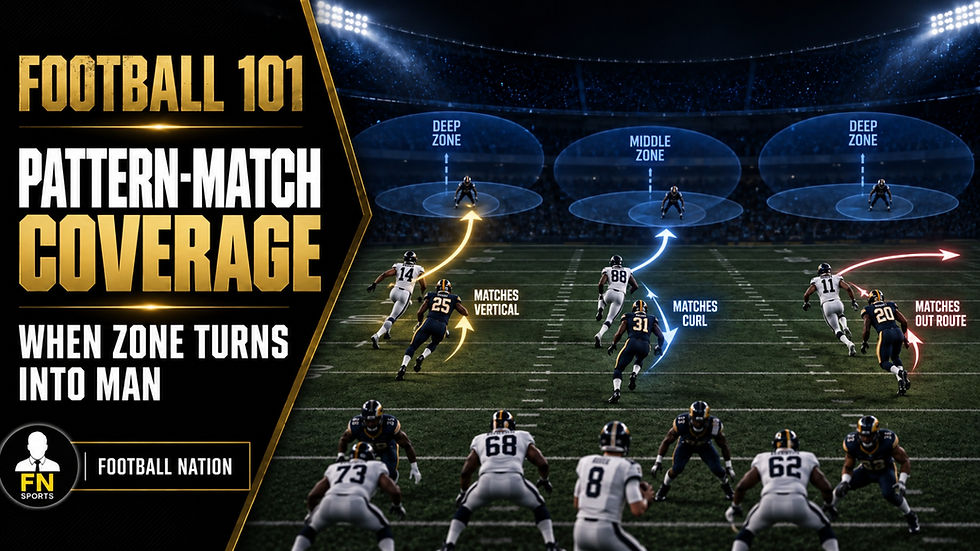
No single cue is conclusive, because match coverages can resemble man defense once routes enter zones. The full picture—two split safeties, flat defenders underneath and the middle linebacker’s depth—is the reliable read.

Football Nation takeaway

Cover 2 is best understood as a spacing system: two safeties cap the deep halves, five defenders protect underneath, and the pass rush tries to make the quarterback decide before a route can stretch a zone. Tampa 2 changes one central assignment by sending the middle linebacker deeper, protecting the seam at the cost of asking that player to cover more ground.

When you see two high safeties, do not name the coverage yet. Wait for the corners to settle into the flats and track the middle linebacker. Those two reactions reveal whether the defense is actually playing Cover 2—and whether it has become Tampa 2.

Cover 2 FAQ

Is Cover 2 man or zone coverage?

Traditional Cover 2 is zone coverage. Two safeties split the deep field and five defenders protect underneath zones, though modern match rules can make individual assignments look like man coverage.

What is the weakness of Cover 2?

The most common weak spots are the sideline window between the corner and safety, the deep middle between the safeties, and the run box created by keeping two safeties deep.

What is the difference between Cover 2 and Tampa 2?

In Tampa 2, the middle linebacker drops much deeper to carry vertical routes and help protect the middle between the safeties. Standard Cover 2 usually keeps that linebacker in a shallower hook zone.

Comments


bottom of page