What Is Pattern-Match Coverage in Football? Zone-Match Defense Explained
- Football Nation
- 1 day ago
- 6 min read
Pattern-match coverage is a pass defense that begins with zone spacing but changes responsibilities according to the receivers’ routes. Defenders do not simply guard grass, and they do not choose one receiver before the snap. They read the route distribution, then carry, exchange or pass off receivers using the call’s rules.
The direct answer: match coverage is the middle ground between spot-drop zone and pure man-to-man. A vertical route may be matched like man coverage. A shallow route may be passed to an underneath defender while the original coverage player returns to his zone leverage. That flexibility helps defenses close the open windows that static zone coverage can leave behind.
How pattern-match coverage works
Before the snap, defenders align from a zone shell such as quarters or Cover 3. They identify the eligible receivers from outside to inside: No. 1 is the widest receiver, No. 2 is the next receiver inside and No. 3 is the third. The numbering can change after motion or a formation shift, so communication is part of the coverage.
After the snap, each defender reads one or more receivers. The rule might tell a corner to carry No. 1 if he runs vertically, a nickel to match No. 2 beyond a certain depth, or a linebacker to take the first receiver entering his area from inside. Short routes can trigger an exchange call that sends one defender back to his landmark while another takes the receiver.
Those examples explain the framework, not one universal playbook. Some teams call a route vertical after five yards; others use a different depth. Some safeties read No. 2 first, while other systems make the corner’s release the starting point. The coverage name matters less than the shared idea: route releases activate the assignments.
Why defenses use match rules
Traditional spot-drop zone asks defenders to reach landmarks, keep their eyes on the quarterback and react to throws. That can protect defenders from difficult one-on-one matchups, but offenses know where the soft spaces will appear. Floods, seams and layered routes can place two receivers near one zone defender.
Pure man coverage removes many of those empty windows, but it creates different problems. Defenders must chase across the formation, navigate traffic and survive every individual matchup. Pattern match lets a defense keep the structure and vision of zone while becoming tighter once the offense declares its routes.
That is why a general guide to defensive coverages can describe zone and man as separate families, yet modern calls often blend them. The pre-snap shell tells only part of the story. The receivers’ stems determine what the defenders become after the snap.
What the teaching diagram shows
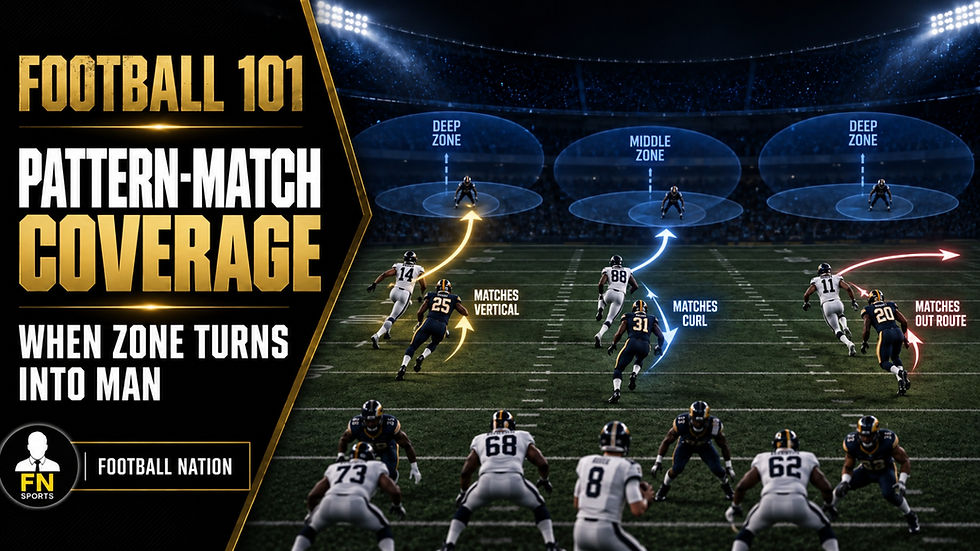
The left panel shows two vertical releases. No. 1 pushes upfield, so the corner carries him. No. 2 also releases vertically, so the nickel or safety matches him according to the call. The defenders started with zone leverage, but the route distribution turns both assignments into tight coverage.
The right panel shows No. 2 breaking shallow inside. Instead of chasing him across the field, the curl-flat defender can call an exchange, pass the route to a hook defender and regain outside leverage. That keeps the defense from creating a hole when one player follows a short route away from his original area.

The key words: carry, pass and cut
Carry means a defender stays with a receiver beyond the route depth defined by the coverage. The assignment begins to look like man coverage, although the defender may still play with help from a safety or another leverage player.
Pass or exchange means the defender transfers the receiver to a teammate. The communication must arrive early enough for the new defender to adjust. A late exchange creates the exact open window the coverage was designed to eliminate.
Cut means an underneath defender attacks a route crossing into his area, often from inside out. The original defender can then replace the space that was vacated. Terminology differs, but all three actions solve the same problem: matching routes without asking every defender to follow every receiver everywhere.
Pattern match in Cover 3 and quarters
A Cover 3 defense can use match rules to protect its seams. The curl-flat or seam defender may carry No. 2 when he releases vertically instead of stopping in a short zone and leaving a deep safety to defend two routes. Nick Saban’s well-known Rip/Liz system is one example of match Cover 3. USA Football’s breakdown shows how the safety or Star can match the slot’s vertical release and how an under call can convert the response toward a more traditional zone drop.
Quarters coverage also relies heavily on route distribution. Safeties and corners often read the releases of No. 1 and No. 2, then sort verticals, outs and inside breaks. Although quarters starts with four deep defenders, it does not always finish as four players standing in equal slices of the field.
A Cover 2 defense can incorporate match principles too. A corner may sink with a vertical route, a safety may overlap from the top and an underneath defender may carry the slot. The shell provides the starting geometry; the rules determine the final matchup.
How offenses attack match coverage
Offenses try to create releases that make two defenders claim one receiver or make both defenders pass him off. Bunch and stack formations compress the routes, forcing the defense to communicate through traffic. Rub concepts can delay a defender long enough for a receiver to separate even when the coverage rule is correct.
Pre-snap motion can change the receiver numbering just before the snap. A defender who thought he was reading No. 2 may suddenly be responsible for a new No. 3. The defense must reset the strength, repeat its calls and preserve leverage without revealing too much.
Crossing concepts create another stress. The mesh concept sends receivers through the middle at shallow depth, exactly where defenders must decide whether to carry or exchange. If the calls are late, the offense gets a clean completion with room to run.
The strongest misconception
The biggest mistake is calling match coverage man-to-man because defenders are running with receivers. The post-snap technique can look like man, but the assignment was created by a zone-based rule. The defender might have matched a completely different receiver if the route distribution had changed.
The opposite mistake is calling it ordinary zone because the defense showed a familiar shell. If a nickel carries the slot 25 yards downfield, he is no longer protecting a fixed short zone. The route has converted his responsibility.
There is also no single pattern-match coverage. Coaches build different rules for formations, personnel and field position. Two defenses can both call quarters and give the safety different answers against the same slot release. Any explanation that presents one diagram as the universal rule is incomplete.
How to recognize match coverage on television
Start with the pre-snap shell. Note whether one or two safeties are deep, then identify No. 1 and No. 2 on one side. At the snap, watch the slot defender rather than the quarterback. If he carries a vertical route far beyond a normal short-zone landmark, match rules may be active.
Next, watch shallow routes. If one defender points, communicates or stops chasing while another picks up the receiver, you are seeing an exchange. Finally, compare both sides of the formation. Pattern match can create different-looking techniques on the same play because the routes were different.
Do not treat one replay as proof of the exact call. Pressure, a coverage bust or a defender freelancing can imitate match behavior. The best clue is repeated route-based communication across several snaps.
Football Nation takeaway
Pattern-match coverage solves a modern passing-game problem: static zones leave predictable windows, while pure man coverage asks defenders to win every matchup. Match rules let a defense keep zone structure before the snap and tighten into route-specific coverage after it.
The simple viewing key is vertical equals carry, short equals exchange—but remember that the exact rules vary. Watch the receivers declare their routes, then watch the defenders change jobs. That transformation from zone spacing to route-based matching is the concept.


Comments