top of page

Route Stems: How Receivers Manipulate Defensive Leverage

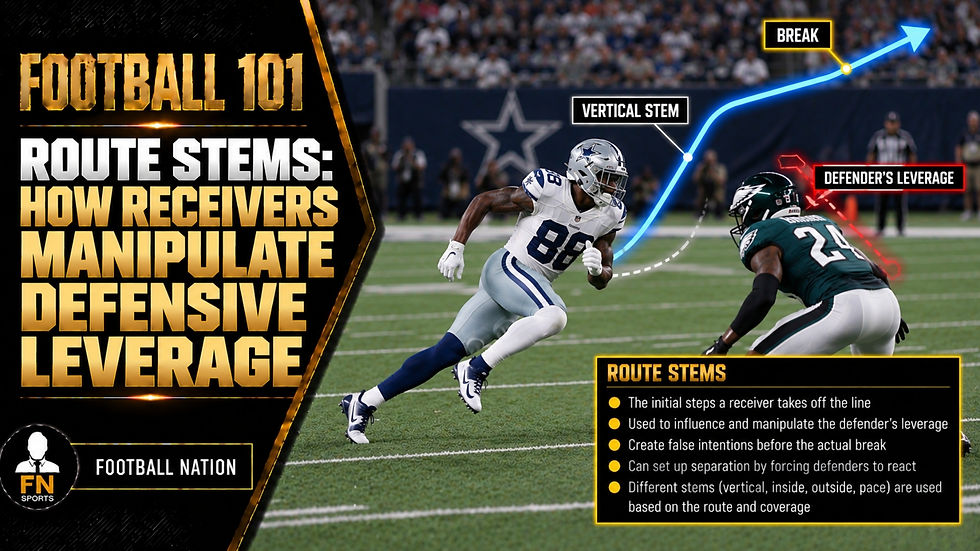
A route stem is the path a receiver takes from his release until he reaches the top of the route and makes his main break. It is the setup before the cut. A good stem threatens the defender's leverage, preserves more than one possible route and gets the receiver to the correct depth at the correct time.


The stem is not a separate route. It is one phase of the route. Two receivers can run the same comeback, post or out but create very different separation because one stem forces the cornerback to turn, widen or protect space that the route will eventually leave.

Where the stem fits in a route


Most routes can be understood in four parts: release, stem, break and finish. The release defeats or avoids the defender at the line. The stem carries the receiver toward the break point. The break changes direction. The finish includes accelerating away, presenting the quarterback a target and working through the catch.


A route tree names the destination and general shape. The stem explains how the receiver gets there. That difference matters because the quarterback is throwing to timing and space, while the defender is reacting to the story the receiver tells before the cut.


NFL.com's comparison of Eric Decker and Hakeem Nicks highlighted pace, tempo, releases and stems as tools for creating separation. That is the core idea: route running is not simply sprinting to a yard line and turning.

Football Nation diagram showing vertical, inside-attacking and outside-attacking route stems before the break.
The gold path is the stem; the red path is the break. A receiver can stay vertical, attack inside leverage or widen outside before changing direction. Original Football Nation teaching diagram.

Three basic ways a receiver can stem a route


1. Push vertically


A vertical stem drives straight at the defender and keeps both sides available. The corner cannot immediately commit inside or outside without risking the opposite break. That makes the vertical stem useful on routes that must look alike early, including curls, comebacks, posts and go routes.


A receiver should not drift merely because the play will eventually break inside. The post route becomes easier to defend when the receiver announces the inside cut too soon. Staying vertical can hold the corner's hips and protect the throwing lane.


2. Attack inside leverage


If a defender aligns inside, the receiver can press that leverage with the stem. The goal is not necessarily to run through the defender. It is to make the defender defend the inside threat. Once the defender squeezes or turns inward, an outside break can gain space.


This is especially useful when the offense wants to widen an underneath defender or create room toward the sideline. USA Football's breakdown of a Kyle Shanahan trips concept describes a receiver using a true vertical stem to influence defenders before an adjustment. The exact coaching language varies, but the leverage principle is consistent.


3. Attack outside leverage


The receiver can also lean or angle outside to widen the defender, then break back inside. The stem forces the corner to protect the sideline and can create a cleaner lane for a dig, slant or post. The move must remain believable; an exaggerated curve can ruin timing and compress space for another route.

How stems create separation without wasted motion


The best stem changes the defender's decision before it changes the receiver's direction. A receiver can use speed to threaten vertically, body position to attack a shoulder, eyes and head movement to sell a route, or tempo to make the defender stop and restart. NFL.com's slot-receiver comparison of Wes Welker and Victor Cruz noted how stems, releases and hesitation moves can create separation in tight space.


The receiver is trying to control leverage, not perform a dance routine. Every step should help him reach the designed depth on time. If the stem takes too long, the quarterback may finish the progression before the receiver gets open. If it is too direct, the defender can sit on the expected break.


Against press coverage, the release and stem work together. The release earns access to the field; the stem re-establishes the route after contact. Against off coverage, the receiver may have more room to threaten the defender's cushion before choosing the break angle.

Stem versus release, break and route depth


The release happens first and answers the immediate problem at the line of scrimmage. The stem follows and attacks the defender's position in space. The break is the decisive cut. Route depth is the landmark where the concept expects that cut to occur.


Those parts cannot be separated from timing. USA Football's Chiefs play-action analysis describes Travis Kelce working inside, then stemming vertically to the designed depth before breaking outside. The example shows why depth and leverage must be solved together rather than treated as independent instructions.


An option route adds another layer because the receiver may choose the break based on coverage. Even then, the stem must keep the legitimate options alive long enough for both receiver and quarterback to read the same defender.

How to recognize a good route stem on film


Watch the defender instead of only following the ball. Ask whether the receiver makes the defender change his hips, surrender cushion or move off his leverage. Then check whether the receiver reaches the break point on schedule and accelerates out without rounding the route.


Next, compare routes from the same formation. In trips formation or bunch formation, stems also create spacing for teammates. A receiver who drifts into another route can crowd the concept even if his own defender is beaten.


The cleanest clue is late information. If several routes look identical for their first few steps, the defense must wait longer to declare the answer. If the route reveals itself immediately, the defender can break before the receiver does.

The biggest misconception


A stem is not always straight upfield, and it is not automatically the first five or ten yards of every route. The shape and length depend on the concept, alignment, coverage and coaching rules. What makes it a stem is its job: carrying the receiver from the release toward the break while manipulating leverage and preserving timing.


It is also not proof that a receiver won. A technically sharp stem can still lead to a contested catch if the defender recovers, the protection changes the quarterback's clock or the ball arrives late. Technique improves the odds; it does not guarantee separation.

Route stem FAQ


Is the stem the same as the release?


No. The release is the receiver's initial move off the line. The stem is the path after the release and before the main break.


Does every route have a stem?


Most routes have some pre-break path, but very quick routes may make the release and stem feel almost continuous.


Why do receivers stem toward a defender?


Attacking leverage can force the defender to move or turn, creating space in the direction of the eventual break.


Can a bad stem affect another receiver?


Yes. Poor spacing can crowd a route combination, bring extra defenders to the target area or distort the quarterback's read.


What should fans watch at the top of the route?


Look for whether the defender's hips and weight were moved by the stem, then whether the receiver makes a sharp, balanced break and accelerates away.

Football Nation takeaway


The route stem is the setup that makes the break work. It carries the receiver to the right place, keeps multiple routes believable and attacks the defender's leverage without wasting time. When studying a receiver, do not start at the catch. Watch the path before the cut—that is often where the separation was actually created.

Comments


bottom of page