The Post Route: Break Point, Timing and Coverage Reads
- Football Nation
- 2 days ago
- 6 min read
A post route is a pass pattern in which a receiver pushes vertically, threatens the defender’s cushion and then breaks diagonally toward the middle of the field—traditionally toward the near goalpost. It is usually an intermediate-to-deep route designed to win inside leverage and create an explosive throw. The essential idea is simple: sell vertical first, make the defensive back turn or widen, then cross his face into the throwing window.
That direct definition matters because a post is not just “run toward the middle.” The route succeeds through the stem, leverage and timing before the break. If the receiver drifts inside too early, the defender can stay on top. If the quarterback waits to see the receiver fully open, the middle safety may close the window.
Why is it called a post route?
The name comes from the receiver’s path toward a goalpost after the vertical stem. Football terminology is not perfectly standardized, so exact depths and landmarks vary by offense. One playbook may ask for a break near 10 or 12 yards; another may build a deeper shot. The common feature is the angled inside break after a vertical threat.
On a conventional route tree, the post sits among the deeper inside-breaking patterns. Coaches may adjust it with a skinny post, glance, bang-eight or deep post tag, but those variations still depend on the same leverage battle.
How a receiver runs the route
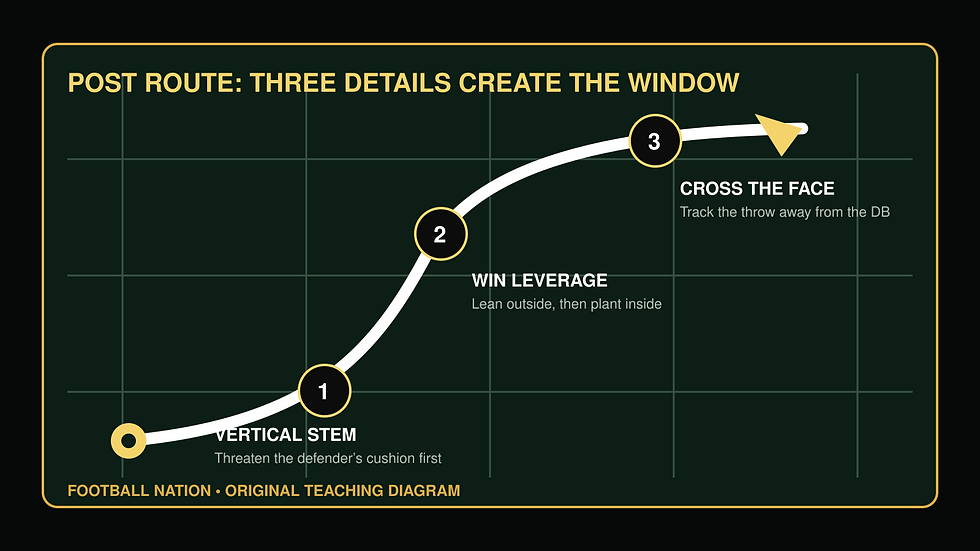
First, the receiver releases with enough urgency to threaten the defender vertically. The stem should look like a fade or go route long enough to force the corner to protect deep space. Against off coverage, that means eating the cushion without losing control. Against press coverage, it means clearing the defender’s hands and getting back on the intended line.
Second, the receiver creates leverage. A subtle outside lean can move a defender’s hips before the inside plant. The receiver does not need a dramatic fake; he needs the defender to commit just enough that the break crosses the defender’s face.
Third, the receiver accelerates through the break and tracks the ball without flattening the route unnecessarily. The quarterback generally throws to the space the receiver is entering, not to the receiver’s current location. The best completion often arrives just after the break, before the safety can drive downhill.

What the quarterback reads
The quarterback starts with the coverage shell, the leverage of the corner and the location of any middle-field safety. Against single-high coverage, a deep middle defender can squeeze the post, so the offense may use motion, play-action or another route to move him. Against two-high structures, the post can attack the space between safeties—but only if the receiver’s angle and the quarterback’s timing keep the ball away from help.
Protection also controls the route. A deep post takes time. If the pass rush forces an early throw, the quarterback needs a shorter answer in the progression. That is why the post is often paired with underneath routes rather than treated as an isolated all-or-nothing call.
How offenses create room for the post
A post route becomes more dangerous when the other routes manipulate help defenders. In the Dagger concept, a vertical route can clear space for an inside-breaking dig. A post can serve that clearing function or become the shot if the safety vacates. In a post-wheel pairing, the post pulls inside while a wheel route climbs outside, forcing defenders to exchange assignments without losing leverage.
The scissors concept combines a post with a corner route so the two paths cross downfield and stress quarters defenders. USA Football’s breakdown of the scissors concept shows why the combination can isolate a corner and safety. The Yankee play-action concept uses a deep post and an over route to attack defenders who react to the run fake.
A post is normally a called landmark route, not automatically an option route in which the receiver chooses among several breaks after reading coverage. Some offenses do add adjustments, but the quarterback and receiver must share the same rule. A receiver converting the route on his own can turn an open space into an interception.
Which coverages can the post attack?
Against Cover 1, the receiver may get a true one-on-one opportunity, but the post runs toward the free safety. The quarterback needs either elite timing or a way to hold that safety elsewhere. Against Cover 2, a well-timed post can split the safeties if the middle linebacker cannot carry enough depth. Against Cover 3, the middle-third safety is already positioned in the route’s path, so the offense often needs a formation or combination that moves him.
Quarters structures create a different problem. The route can attack a safety who triggers too quickly on another receiver, but it can also run directly into help if the defense communicates cleanly. That is part of why concepts such as Cover 6 require the quarterback to identify which side is playing quarters and which side is playing a Cover 2 technique before choosing the matchup.
A clear NFL example
An official NFL highlight shows Dak Prescott completing a 23-yard post route to Michael Gallup. Watch the sequence rather than only the catch: Gallup threatens vertically, gains inside position and presents a target as the ball arrives. The completion is a useful example of the route’s purpose—create a window downfield before help can erase it.
The route still operates within the passing rules. The 2026 NFL Rulebook governs eligible receivers, legal and illegal contact, and pass interference. A defender may initiate certain contact within five yards, but cannot simply restrict an eligible receiver farther downfield while the quarterback holds the ball. For the receiver, using a legal release is different from pushing off to create separation.
Post route vs. slant, dig and post-corner
A slant breaks inside quickly and at a sharper, flatter angle. A dig pushes vertically before breaking square across the field. A post breaks inside on a diagonal and continues gaining depth. A post-corner sells the post, then redirects back outside toward the corner. These labels describe the receiver’s path; the intended depth and exact steps still come from the play call.
The Smash concept helps illustrate the contrast: its corner route bends away from the middle, while a post bends toward it. Both can create explosive plays, but they attack different leverage and different help defenders.
Common misconceptions
The first misconception is that every post must be a bomb. A post can be thrown at several depths depending on the concept. The second is that an inside break is automatically open against man coverage. A defender with inside leverage can take away the route before it starts. The third is that the receiver should always run to the exact center of the field. The landmark is shaped by alignment, coverage and the called variation.
The most useful viewing cue is the receiver’s first several steps. If he threatens outside and vertical before cutting inside, note whether the defender turns his hips and whether the safety stays centered. Those two reactions usually explain why the throwing window opens—or why the quarterback moves to the next read.
Post route FAQ
How deep is a post route?
There is no universal depth. Many versions break in the intermediate range, while shot-play posts develop deeper. The playbook, formation and coverage determine the landmark.
What is a skinny post?
A skinny post uses a more vertical angle after the break. It can split safeties or preserve space from an inside defender while still attacking the middle.
Is a post route good against man coverage?
It can be, especially when the receiver wins inside leverage, but a free safety may still help. The offense often uses another route or play-action to occupy that defender.
What is the difference between a post and a dig?
A post continues diagonally upfield after the break. A dig turns more squarely across the field and usually runs flatter.
Why does timing matter so much?
The route bends toward central defenders. Throwing as the receiver breaks lets the ball reach the window before the safety closes; waiting for obvious separation often makes the throw late.
Football Nation takeaway
A post route is a vertical threat that breaks diagonally toward the middle and the goalpost. Judge it by three details: whether the receiver sells vertical, whether he wins leverage at the break and whether the quarterback releases the ball before the help defender arrives. The route is simple on a diagram, but its real value comes from timing and the other routes that create space around it.


Comments