top of page

What Is the Star Position in College Football? The Hybrid Role Explained

The Star position in college football is a scheme name, not one universal position. That is the most important thing to know before trying to define it.

With the 2026 college football season approaching, this is a useful depth-chart rule: translate the label into alignment and assignment before comparing players across teams. A Star on one roster can be recruited, coached, and evaluated very differently from a Star on another.

At one school, the Star may be a fifth defensive back who covers the slot. At another, the Star may be an outside linebacker who aligns to the wide side of the field. The name tells you less than the job description.

Football Nation diagram showing a Star defender aligned over the slot with arrows for coverage, run support and pressure.

Original Football Nation teaching graphic.

That is why Football Nation treats Star as a family of hybrid roles rather than one fixed spot on every depth chart.

What does Star mean in college football?

A Star is usually a defender chosen because he can handle space. Coaches may ask him to cover receivers, fit the run, blitz, or move with formations. The exact balance depends on the defense.

Alabama provides one well known example. Under Nick Saban, Shyheim Carter was described by Alabama Athletics as manning the Star position while playing in the secondary. In that structure, Star functioned much like the nickel defensive back in a defense that spent heavy time with five defensive backs.

Pitt has used the same word differently. Pat Narduzzi's defense has referred to Star and Money as outside linebacker positions, with Star generally working more to the field side and in space.

So if a broadcast says a player is the Star, do not assume he is automatically a corner, safety, or linebacker. Look at where he lines up and what the defense asks him to do.

Why coaches create a Star position

Modern offenses force defenses to defend wide formations without becoming soft against the run. A traditional linebacker may be strong enough for the box but uncomfortable covering a slot receiver. A small corner may cover well but struggle when an offense runs directly at him.

The Star gives a coordinator another answer.

A good Star often needs four traits:

  1. Enough speed to play in space.

  2. Enough strength to handle perimeter blocks.

  3. Enough awareness to recognize run and pass quickly.

  4. Enough versatility to cover, blitz, and tackle.

That overlaps with the ideas in Football Nation's guide to nickel defense. The difference is that nickel describes personnel, while Star is a coaching label for one player's role.

Star as a nickel defender

In many modern systems, Star is closest to a nickel or slot defender. He may align over the inside receiver, play man coverage, match routes in zone, force runs back toward help, and blitz from the edge.

That can make the Star look like a corner on one snap and a linebacker on the next.

If you are learning coverage, Football Nation's explainers on man coverage and zone coverage show why the same player can have very different assignments without changing his position name.

Star as a linebacker

Pitt's use of Star is a reminder that the label can move farther into the front seven. In that system, Star and Money have been described as outside linebacker spots, with alignment connected to the field and boundary.

That version of Star may still cover a back or receiver, but he also has more traditional linebacker work against the run.

This is similar to why college defenses use names such as Sting, Wolf, Rover, and Money. The name helps coaches organize responsibilities inside their own system.

Star vs nickel back

They can be nearly the same job, but they are not automatically synonyms.

A nickel back simply means the fifth defensive back in nickel personnel. A Star is a named role. One defense may use its Star as the nickel. Another may keep the Star in a linebacker room.

When comparing them, ask:

  • Is the player listed as a defensive back or linebacker?

  • Does he cover the slot?

  • Does he fit inside runs or mostly play on the perimeter?

  • Does he leave the field when the defense changes personnel?

Those answers reveal more than the nickname.

Star vs Husky

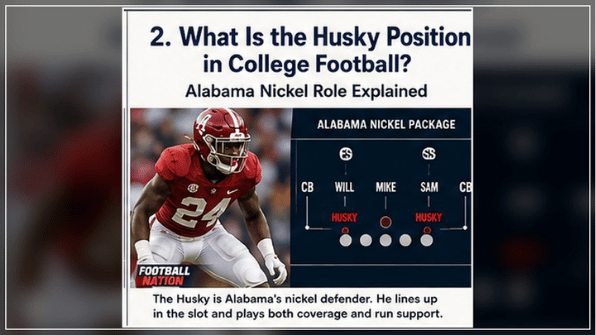
Alabama's current defense under Kane Wommack calls its nickel hybrid the Husky, not Star. The responsibilities still overlap. The Husky must play man coverage, zone coverage, run support, and edge pressure.

That is a perfect example of why position names change when coaching staffs change. The player archetype can survive even when the vocabulary does not.

What to watch on television

When you hear Star, find the player before the snap.

If he is over the slot, expect coverage, perimeter run support, or a blitz. If he is closer to the box, he may be playing an outside linebacker version of the role.

Then watch what happens when the offense motions a receiver. A true hybrid often has to communicate, trade assignments, or travel with the formation. Football Nation's guide to pre snap motion explains why that movement is such a useful test for a defense.

The strongest misconception about Star

The biggest mistake is treating Star as a nationally standardized depth-chart position. It is not an official personnel category with one body type or one assignment sheet. Even two defenses that put the Star over the slot may teach different leverage, run-fit, and pressure rules.

For viewers and recruits, the practical question is not ‘Is he a Star?’ but ‘What does this staff ask its Star to do?’ Check whether he stays on the field against heavier personnel, follows the slot in motion, inserts into the box, or becomes part of the pressure package. Those clues identify the real job.

Football Nation takeaway

The Star position is not one universal college football position. It is a scheme specific name usually given to a versatile defender who must handle space.

At Alabama under Nick Saban, Star was closely associated with the nickel defensive back. At Pitt, Star has been used as an outside linebacker label. The safest definition is simple: the Star is a hybrid role whose exact job must be learned from the defense using the name.

Sources

Recent Posts

See All

Comments


bottom of page