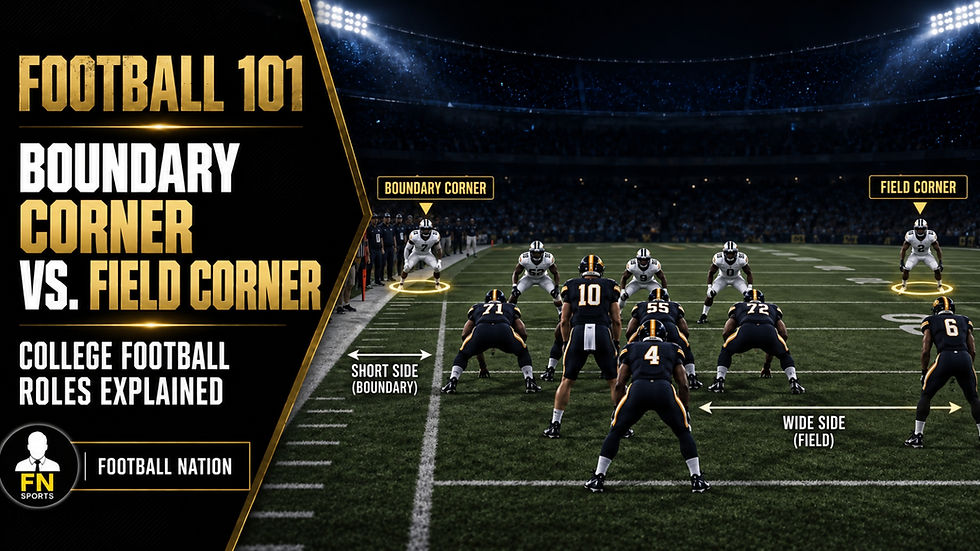
Boundary Corner vs. Field Corner: College Football Roles Explained
- Football Nation
- 6 days ago
- 5 min read
The boundary corner plays on the short side of the field, while the field corner plays on the wide side. They are both cornerbacks, but the amount of grass, available sideline help, run-support angle and likely receiver distribution can make the two jobs feel different—especially in college football, where the hashes are wider than in the NFL.

Original Football Nation teaching graphic created with AI assistance and reviewed for field/boundary alignment accuracy.
Boundary corner vs. field corner at a glance
Boundary corner: aligns between the ball and the nearer sideline. He has less horizontal space outside him but may face an isolated receiver, more press-man work, crack-replace responsibility, run support and short-side pressure calls.
Field corner: aligns between the ball and the farther sideline. He has more horizontal grass to defend, often sees multi-receiver formations and may need greater recovery speed and open-field tackling range.
These are tendencies, not universal rules. A coordinator can leave corners on fixed left and right sides, match the best corner to a receiver, or change the assignment by formation.
Why college hash marks make the difference bigger
A football field is 160 feet wide. The official 2026 NFL rulebook places professional hash marks 70 feet 9 inches from each sideline and identifies the college location as 60 feet. When the ball sits on a hash, that creates the following approximate short-side and wide-side space:
Level | Hash to near sideline | Hash to far sideline | Wide-minus-short difference |
|---|---|---|---|
College | 60 ft | 100 ft | 40 ft |
NFL | 70 ft 9 in | 89 ft 3 in | 18 ft 6 in |
Source: 2026 NFL Rulebook, Rule 1 field markings. Far-side distances are the 160-foot field width minus the published near-sideline distance.
The college imbalance is 40 feet, more than double the NFL's 18 feet 6 inches. That is why field and boundary language is especially useful in college: a defender can have dramatically different grass and route spacing depending on which side he occupies.
What is a boundary corner?
The boundary corner aligns to the compressed side. The sideline can help squeeze a receiver's release and reduce the room for an out-breaking route, but the assignment is not automatically easier. Spread offenses often put their best receiver alone on the back side of a three-receiver formation. If that receiver is in the boundary, the corner may receive less safety help because the defense is using numbers toward the passing strength.
That makes the role valuable for a physical corner who can disrupt releases, tackle and survive isolated coverage. The boundary corner may also fit the run sooner because the edge is closer. Coordinators can use him on a corner blitz or ask him to replace a force defender without opening as much horizontal space.
If the defense plays man coverage, the sideline becomes a useful landmark—but the corner still must control the receiver. Football Nation's man coverage guide explains why leverage and help location matter more than simply being close to the boundary.
What is a field corner?
The field corner aligns to the wide side. He cannot assume the sideline will erase a route quickly because the receiver has more room to release, stem and break. The field side also commonly holds two or three eligible receivers, forcing the corner to understand route combinations and how his assignment connects to the nickel defender and safety.
Speed helps, but the job is not just a forty-yard dash. A field corner needs disciplined eyes, route recognition and the ability to tackle in space. In zone coverage he may have to pass one route inside while staying on top of another. Football Nation's zone coverage explainer shows how defenders protect areas while matching threats that enter them.
Where does the defense put its best corner?
There is no automatic answer. Older descriptions often placed the most athletic cover player to the field because he had more space to defend. Modern spread offenses can reverse that logic by isolating a No. 1 receiver into the boundary. An NFL.com scouting analysis of Florida cornerbacks Loucheiz Purifoy and Marcus Roberson noted how college defenses used the boundary to create those one-on-one tests.
The opponent matters. Against a team that always keeps its top receiver in one spot, the defense may let its best corner travel. Against a formation-heavy offense, the coordinator may prioritize communication and keep each corner in a field or boundary role. A corner who can do both gives the defense more freedom.
The biggest misconception: boundary does not mean easy
The short side offers less grass, but it can also reduce help. A boundary corner may be asked to play press coverage alone against the offense's best receiver, defeat stalk blocks and become a primary run defender. One bad leverage decision can still create a vertical throw, back-shoulder completion or explosive cutback.
The field corner's challenge is different rather than automatically harder. He manages width, combinations and space. The boundary corner manages isolation, physicality and a quicker run-pass conflict. Personnel and the coverage call decide which assignment is more demanding on a given snap.
How coverage can change the labels after the snap
Field and boundary describe the pre-snap side, not necessarily the final coverage. In Cover 3, both outside corners can drop to deep thirds while a safety controls the middle. In quarters, a safety may match a vertical route and leave the corner to handle a different threat. A pressure call can send the boundary corner and rotate a safety over his vacated area.
Nickel personnel adds another relationship. The field corner may play outside a slot defender, while the boundary side has only one wide receiver. Football Nation's nickel defense guide explains why the fifth defensive back often becomes central to wide-side spacing.
Does a corner stay on one side all game?
Not necessarily. Some teams make the corner run across the formation whenever the ball changes hashes so he remains the boundary or field defender. Others keep corners on the left and right and let the responsibilities change. A third option is matchup coverage, where one corner follows a specific receiver.
Motion can reveal the plan. If the corner travels with the receiver, man or matchup coverage becomes more likely. If he stays and communicates a switch, the defense may be preserving its field/boundary structure. Football Nation's pre-snap motion guide explains how movement forces defenses to declare and adjust.
What to watch on television
Before the snap, find the ball and the hashes. Identify the short and wide sides, then note where the offense puts its top receiver and whether a safety is leaning toward him. After the snap, watch the corner's leverage: is he pressing outside, funneling inside, bailing to a deep zone or triggering downhill against the run?
Repeat the check after the ball is spotted on the opposite hash. If the same defender moves across the field, the defense is probably assigning him by field or boundary. If he stays put, the staff may be teaching left and right corner responsibilities instead.
Football Nation takeaway
Boundary corner means short side; field corner means wide side. College hashes make the space difference large enough to influence coverage, run fits, blitzes and matchups. Do not rank the positions by difficulty without the call: the field corner handles width, while the boundary corner often handles isolation and physical work.
Sources
Visual disclosure: The cover and teaching diagram are original Football Nation designs created with AI assistance. They use generic, non-identifiable players and no third-party team marks.


Comments