


When Does an NFL Scoring Play Actually End?
An NFL scoring play ends the instant the score is made under the rulebook. The trigger changes with the play: a touchdown ends when the ball legally reaches the goal line in a runner’s possession or a catch is completed in the end zone; a field goal ends when the entire ball passes through the goal’s vertical plane; a safety or touchback requires the ball to become dead in the relevant end zone; and a Try ends when either team scores or the ball is otherwise dead.
Once that condition is satisfied, anything that happens to the ball afterward is irrelevant to whether the play remains live. A runner can lose the ball after legally breaking the plane, and a successful field goal can strike something beyond the goal after crossing. Penalties and replay can still change the ruling or points, but they do not keep the ball live after the scoring event.
The rule in plain English
Rule 7, Section 2, Article 1(m) tells officials to declare the ball dead and the down over when a touchdown, touchback, safety, field goal, or Try has been made. Rule 11 defines when each result has been made.
That gives the crew two questions. Did the scoring condition occur? Is there a foul or reviewable fact that changes the result? The first ends the action. The second settles the scoreboard and the next play.
Five results, five triggers
Result | When the play becomes dead | What follows |
Touchdown | A runner in possession legally reaches the opponent’s goal-line plane, an inbounds player completes possession of a loose ball in the opponent’s end zone, or another Rule 11 touchdown condition is met | Six points, subject to fouls and replay, then a Try |
Field goal | A legal place kick or drop kick meets every condition and the entire ball passes through the vertical plane above the crossbar and between the uprights | Three points, subject to fouls and replay, then a kickoff |
Safety | The offense is responsible for the ball becoming dead in its own end zone, it goes out behind its goal line, or an accepted foul produces a safety | Two points, then a safety kick |
Touchback | The ball is dead on or behind the defending team’s goal line with the opponent supplying the impetus, and the play is not a touchdown or incomplete pass | No points; the defending team gets the next snap at the prescribed yard line |
Try | Either team scores during the Try or the ball becomes dead by another rule | One or two points if successful, otherwise no points |

A touchdown can end before the runner stops
For a runner advancing from the field, the critical object is the ball—not the runner’s feet or torso. If the ball is on, above or behind the opponent’s goal-line plane while the runner possesses it, the touchdown is made and the ball is dead. A defender knocking it loose afterward does not create a fumble.
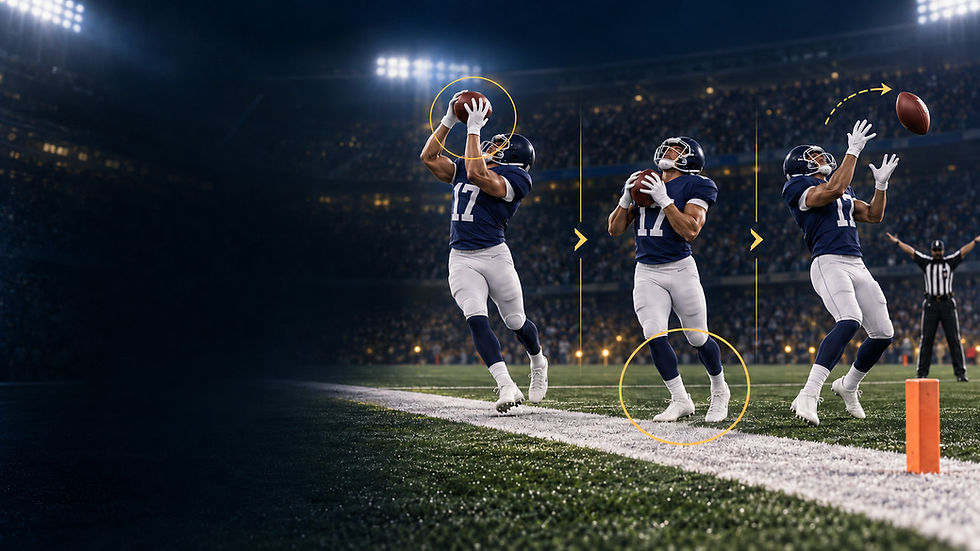
An end-zone catch is different. The receiver must complete the catch while inbounds; merely carrying the ball across the plane in midair is not enough. Football Nation’s incomplete-pass guide explains why a bobble can erase an apparent score. Near the sideline, use the down-by-contact rule first, then ask whether the ball reached the scoring plane.
A field goal ends at a vertical plane
A field goal is not judged by where the ball lands. It must be a legal place kick or drop kick from on or behind the line of scrimmage, or a fair catch kick; it cannot touch the ground or an offensive player after the kick; and the entire ball must pass through the vertical plane above the crossbar and between the uprights, or between their outside edges when above them.
A carom off an upright can score if the ball passes fully through. If it never does, the kick fails and may remain live under the missed-kick rules.
Safety and touchback depend on impetus
Both results occur in an end zone, but they point in opposite directions. A safety generally results when a team’s own impetus sends the ball behind its goal line and the ball becomes dead there in that team’s possession or goes out behind the line. A touchback generally results when the opponent supplied the impetus and the ball becomes dead in the end zone defended by the team awarded possession.
A loose ball can cross the goal line without ending the play; it must reach a dead-ball condition before a safety or touchback is made. An incomplete pass in the offense’s end zone is not a safety. The momentum exception can return the ball to the possession spot when a defender’s interception or recovery carries him into the end zone. Kickoffs use additional touchback placements.
The Try is its own scoring down
The Try is one untimed scrimmage down. It ends when either team scores or the ball is dead by rule. The offense can score one point with a kick or two with a touchdown; after a turnover, the defense can advance a live ball for two. A play producing what would ordinarily be a safety awards one point to the opponent.
Example 1: the runner reaches, then loses it
On third-and-goal, a runner dives from the 1. While he controls the ball, its tip breaks the front plane. A defender then strikes his arm, and the ball comes loose in the end zone.
Ruling: touchdown. The scoring condition was satisfied when the possessed ball reached the plane, and Rule 7-2-1(m) made it dead. Replay may still examine whether possession existed at that instant or whether the runner was down first.
Example 2: a field goal bounces through
With three seconds left, a legal place kick hits the left upright, redirects across the goal, and the entire ball passes through above the crossbar before falling behind the goal.
Ruling: successful field goal and dead ball once the entire ball passes through. The upright contact does not invalidate it. If the ball ricochets back without passing fully through, it is not a score and the missed-field-goal rules control.
The common misunderstanding
The official’s raised arms or whistle does not create the score. Those signals communicate a ruling. The rulebook creates the dead-ball moment through possession, location, flight and play type.
The opposite mistake is assuming “dead” means the points cannot change. A live-ball foul can nullify a score, offsetting fouls can require another down, and replay can show the scoring condition never occurred. A dead-ball foul after a valid score normally does not erase it, though enforcement may carry to the Try or kickoff.
Why it matters during a game
This rule separates a touchdown from a goal-line fumble, a made kick from a live miss, and a safety from a touchback. It tells replay where to freeze the video: the best angle shows the ball, the relevant plane and control together—not merely the celebration or signal.
Football Nation’s guide to when a play becomes live covers the other endpoint: a legal snap or kick opens the interval. Kickoff plays add landing-zone rules, while free-kicker protections can create penalties without changing the scoring trigger.
What fans should watch for
On a goal-line run, watch the forward point of the ball and control. On an end-zone catch, watch the complete catch process. On a kick, imagine the vertical plane above the crossbar. On a loose ball in an end zone, ask who supplied the impetus and what made it dead.
Then wait for the second layer: flags and replay. Officials can correctly rule that the play ended at a scoring moment and still remove the points after enforcement or review.
FAQ
Can a player fumble after scoring a touchdown? No. Once a valid touchdown is made, the ball is dead. Replay can show possession was lost before the ball reached the plane, but a loss afterward is not a live fumble.
Is a field goal good as soon as the ball is above the crossbar? Only if the entire ball passes through the goal’s vertical plane and the other requirements of Rule 11-4-1 are satisfied.
Does every ball that crosses a goal line become dead? No. A loose ball, missed kick or kickoff can remain live. The down ends only when a defined score, touchback or Try result has actually been made.
The exact authority is the 2026 NFL Rulebook, Rule 7, Section 2, Article 1(m), supported by Rule 11’s scoring sections. Football Nation’s bottom line: identify the scoring condition first, then separate it from flags and replay. The score ends the action at a precise legal moment—even when the signal and scoreboard update arrive later.


Comments