What Is a Catch in Football? NFL Catch Rule Explained
- Football Nation
- 5 days ago
- 5 min read
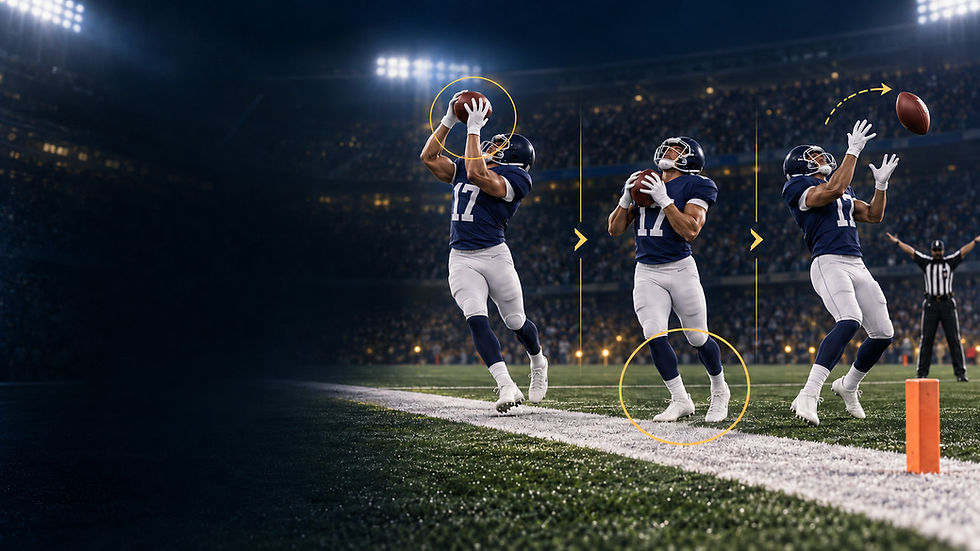
An NFL catch requires three things: control, an inbounds touch and a football move. A player must secure the ball before it hits the ground, touch inbounds with both feet or another qualifying body part, and then perform an act common to the game—or maintain control long enough to do so. If control is lost before that sequence finishes and the ball touches the ground, the pass is incomplete.
That three-part test explains why two feet alone do not guarantee a catch. It also explains why slight movement of the football does not automatically erase one. Officials judge the entire possession sequence, not a single frozen frame.
The framework comes from Rule 8, Section 1 of the official 2026 NFL Rulebook. The NFL Football Operations glossary summarizes the same three requirements: secure control, get inbounds, then complete or have time to complete an act common to the game.
What counts as a catch in the NFL?
A forward pass is complete for the offense—or intercepted by the defense—when an inbounds player completes all three requirements in order:
Secure control of the ball in the hands or arms before the ball touches the ground.
Touch the ground inbounds with both feet, or with any part of the body other than the hands.
After control and the inbounds requirement, perform an act common to the game or maintain control long enough to do so.
The NFL gives examples of the third element: tucking the ball away, extending it forward, taking an additional step, turning upfield, or avoiding or warding off an opponent. Officials do not need one specific gesture. They decide whether the receiver completed the possession process and became a runner.
Step 1: What does control mean?
Control means the player has the football firmly enough in the hands or arms to direct and possess it. The ball can shift slightly without control being lost. A slow-motion wobble is not automatically an incompletion.
A useful viewing clue is whether the receiver is guiding the ball or chasing it. A firm grip against the hands, arms or body supports control. A ball rolling through the hands or bouncing off the chest does not. The ground cannot create possession: if the player only traps a loose ball after it contacts the turf, the pass is incomplete.
Step 2: Do both feet have to be inbounds?
In the NFL, a receiver usually needs two feet to touch inbounds while control is maintained. The feet can land at different times. A toe tap counts when each foot touches green turf and neither touch reaches the white boundary, because the boundary line itself is out of bounds.
Two feet are not the only route. One knee, elbow, hip, shoulder or another body part other than the hands can satisfy the inbounds requirement. One hand on the ground does not replace the two-foot requirement.
Step 3: What is a football move?
After control and the inbounds touch, the player must perform an act common to the game or hold the ball long enough to do so. Turning upfield, tucking the ball, reaching for the goal line, taking another step or bracing against a defender can complete the process.
Order matters. Extending the arms while first receiving the pass is not necessarily the later football act. The act—or enough time to make one—must follow control and the inbounds element.

Does a receiver have to survive the ground?
The phrase survive the ground describes a common situation, but it is not a separate fourth requirement. If a player controls the ball and gets the required feet or body part down but has not completed the football-move element, the player must maintain control through contact with the ground.
If the player completes all three elements and becomes a runner before going down, a later loss is judged under fumble and down-by-contact rules. The timing of completed possession is the dividing line.
Catch, incomplete pass or fumble?
Ask when the player finished the three-part catch process:
Incomplete pass: the player never completes all three elements, loses control, and the loose ball touches the ground.
Catch: the player completes control, the inbounds touch and the football act before the play ends.
Fumble: the player completes the catch, becomes a runner, and then loses possession before being down or out of bounds.
The same ball movement can lead to different rulings depending on timing. Before the catch is complete, it can erase the completion. After the receiver becomes a runner, it can create a live ball. Football Nation’s fumble guide explains what happens next when possession is lost.
How does the rule work at the sideline and goal line?
Sideline catches compress the decision into inches. Officials look for control before or during two valid inbounds touches, then decide whether the possession process was completed. Dragging both toes can count. A heel that comes down on the white boundary does not.
Contact from a defender does not remove the catch requirements. If the question is whether the defender arrived before the ball, Football Nation’s pass interference guide explains the restrictions that apply while a pass is in the air.
The same catch process applies in the end zone. Once the receiver completes the catch while possessing the ball across the goal line, the touchdown makes the ball dead. A casual release afterward does not undo the score. The difficult cases are the ones in which the ball moves or contacts the ground before the receiver finishes the third element.
What happens on a simultaneous catch?
If an eligible offensive player and an eligible defender gain control at the same time and both retain it, the ball belongs to the passing team. That is the basis of the phrase tie goes to the receiver. It is not simultaneous possession when one player controls the ball first and the opponent establishes joint control afterward.
Why replay can change a catch ruling
Catch decisions are reviewable because video can isolate control, boundary contact and the timing of the football act. One angle may show the toes while another shows the ball moving. Replay applies the three elements; it does not ask whether the play looked impressive.
A coach must still use the review process correctly. Football Nation’s 2026 challenge-flag explainer covers who may initiate a challenge and when. Our defensive coverages guide adds the route and leverage context behind many contested catches.
Five practical catch-rule examples
A receiver controls the ball, taps both feet inbounds and turns upfield: catch.
A receiver gets two feet down, immediately loses the ball against the ground before a football move, and the ball touches the turf: incomplete.
A receiver secures the pass, takes another step, becomes a runner and then loses the ball before being down: catch and fumble.
A receiver controls the ball with one knee inbounds and completes the football act: catch without two feet.
A player pins a loose ball against the ground and only gains control afterward: incomplete.
The strongest misconception
The biggest misconception is that replay must find a perfectly motionless football. The rule requires control, not an absence of every tiny movement. Officials must decide whether the player maintained meaningful possession through the inbounds and football-act elements. Slow motion helps locate the sequence, but it should not replace the rule’s functional test.
Football Nation takeaway
Use the same three questions every time: Did the player control the ball? Did the player get two feet or another qualifying body part inbounds? After those steps, did the player make or have time to make a football move? Three yes answers mean a catch. If control disappears before the sequence finishes and the ball touches the ground, the pass is incomplete.


Comments