top of page

Why Do Football Players Wear Towels? What the Gear Actually Does

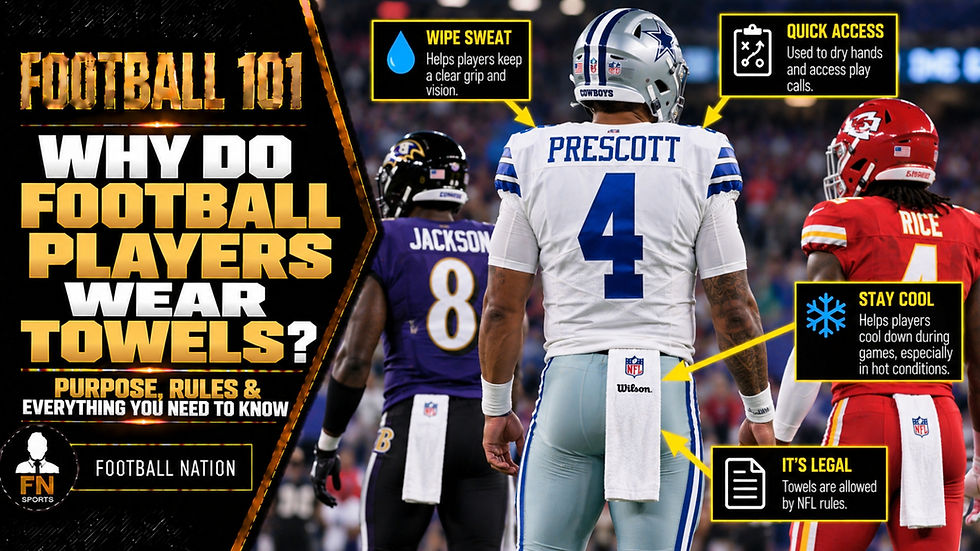
Football players wear towels to keep their hands dry and preserve control of the ball. The small white towel tucked into a waistband gives a quarterback, center, receiver or ball carrier a fast way to remove rain, sweat and field moisture between snaps. It is optional equipment, not decoration and not the same thing as the padded hand warmer that players wear in cold weather.


The idea is simple: moisture reduces usable friction between skin, gloves and leather. A quick wipe cannot make a soaked game dry, but it can improve the next exchange, grip or catch. Kansas City offensive coordinator Doug Pederson once summarized the wet-weather problem by noting that dry conditions provide a better grip and that his quarterback kept his hands dry during a rainy game. That practical detail is why the towel is most common on players who regularly touch the football.


What the football towel actually does


A football towel is an on-body drying station. Its main job is to remove moisture before the player handles the ball. That matters at several different moments: the center must deliver a clean snap, the quarterback must secure the exchange and control the release, and receivers and running backs must finish a legal catch without letting the ball move. Any of those actions can become harder when hands are slick.


The towel does not create stickiness. It removes water or sweat so the player's natural grip—or the designed surface of approved gloves—can work more predictably. That distinction matters because the NFL prohibits adhesive or slippery foreign substances on a player's body, equipment or uniform. Drying is legal; adding an unapproved grip substance is not.


Three-step Football Nation diagram showing wet hands, a player using a white waist towel, and a controlled snap and throw, plus towel versus hand warmer.
Football Nation teaching graphic: moisture is wiped away before the next exchange or throw; a towel dries hands while a hand warmer retains heat.

Which positions wear towels?


Any player may use an approved towel, but it is most useful to players whose assignments depend on a clean, repeatable relationship with the football.


  • Quarterbacks: They wipe the throwing hand before taking the snap, especially in rain, snow, heat or high humidity. A secure grip supports both ball security and a consistent release.

  • Centers: The center controls the ball first on nearly every offensive play. Dry hands help with both under-center and shotgun exchanges.

  • Running backs and receivers: They may use a towel before a carry, route or return. The goal is to reduce avoidable moisture before contact, when a loose ball can become a fumble.

  • Return specialists and defensive backs: A returner must field kicks cleanly, while defenders may need sure hands when an interception opportunity appears. Their towel use depends on role and conditions.


Linemen and defenders who rarely handle the ball may still wear one, but the benefit is smaller. It is also common for multiple players to share the responsibility of keeping an exchange clean. On a fast-motion play such as a jet sweep, for example, the quarterback and receiver both depend on precise timing and secure contact with the ball.


Why is the towel tucked into the waistband?


The waistband keeps the towel available without requiring a trip to the sideline. Players usually place it at the front or side of the hip, where one hand can reach it quickly between the huddle and the snap. The location is a preference, not a position label. A quarterback may want it near the throwing hand; another player may move it away from pads, tape or a hand warmer.


The attachment also has to survive normal running and contact. NFL rules do not allow players to throw loose towels or other hand-drying material onto the field. Keeping one approved towel secured to the uniform gives the player access without leaving debris that could interfere with the play.


NFL rules for player towels


The 2026 NFL Rulebook treats a hand towel as part of the visible uniform. Rule 5, Section 4 says visible game-day items must be issued by the club or league, or approved in advance. The towel provision is unusually specific:


  • The towel must be white.

  • It must be a licensed towel approved by the league office.

  • A player may wear no more than one towel.

  • Players cannot add personal messages, names, symbols, illustrations or unapproved logos.

  • Loose towels and other hand-wiping material cannot be discarded on the playing field.


That is why even an item as ordinary as a towel is checked within the NFL's uniform system. The league's football glossary explicitly includes visible hand towels in the definition of a uniform. Uniform inspectors can require a player to correct a noncompliant towel, and an unresolved violation can keep that player out until the equipment is fixed.


Towel vs. hand warmer: they solve different problems


A towel dries the surface of the hands. A hand warmer is the insulated pouch worn around the waist, often with chemical heat packs inside. The pouch helps maintain warmth and finger mobility; it does not absorb water as efficiently as a towel. In cold rain or snow, a quarterback may wear both because cold hands and wet hands are separate problems.


Gloves are a third tool. NFL reporting on modern receiver gloves explains that their rubberized palms improve grip. A towel solves a different problem by removing moisture before the next ball-handling task. Players choose combinations based on position, temperature and personal feel. Some quarterbacks prefer a bare throwing hand and a towel; many receivers prefer gloves; neither choice eliminates the need for sound technique.


Does a towel prevent fumbles or bad throws?


No. It reduces one controllable source of risk, but it cannot overcome poor mechanics, a bad exchange, defensive contact or a fully waterlogged ball. The Chiefs' wet-weather explanation is useful because it frames rain correctly: dry hands help, yet players still have to execute the throw. A towel is preparation, not protection from every mistake.


That same limit applies after the ball arrives. The NFL's fumble rules still depend on possession and whether the play is dead. Officials do not excuse a loose ball because the field was wet, and a towel does not change the standard for completing a catch.


The biggest misconception


The towel is not a secret signal, a style accessory or a substitute for gloves. Its primary value is routine: wipe, reset and handle the ball with the driest practical surface. The NFL regulates it because every visible accessory is part of the uniform and because loose material cannot be left on the field.


That is also why a towel belongs in the same broad equipment conversation as helmet radios: each item looks simple from the stands but supports a specific job under tightly controlled game-day rules.


Football Nation takeaway


When you see a player reach for the white cloth at his waist, read it as a ball-control routine. He is removing rain or sweat before the next snap, carry or catch. The towel offers a small practical advantage, and the league keeps that advantage standardized: one approved white towel, no personal artwork and nothing loose on the field.


Frequently asked questions


Why do quarterbacks wear towels?

Quarterbacks use towels to dry the throwing hand before the snap. Removing rain or sweat can help them secure the exchange and maintain a more consistent grip and release.

Are NFL players required to wear towels?

No. A towel is optional. Players choose one based on position, weather and personal preference, but any towel worn on the field must meet league uniform rules.

Why are NFL player towels white?

The 2026 NFL Rulebook requires on-field player towels to be white, licensed and approved by the league office. A player may wear only one and cannot add personal messages or artwork.

Is a football towel the same as a hand warmer?

No. A towel absorbs moisture from the hands. A hand warmer is an insulated waist pouch designed to retain heat. Players may use both in cold, wet conditions.

Can a towel stop a player from fumbling?

No. A towel can reduce moisture, but ball security still depends on the exchange, grip, technique and contact from defenders. It lowers one avoidable risk; it does not guarantee possession.

Comments


bottom of page