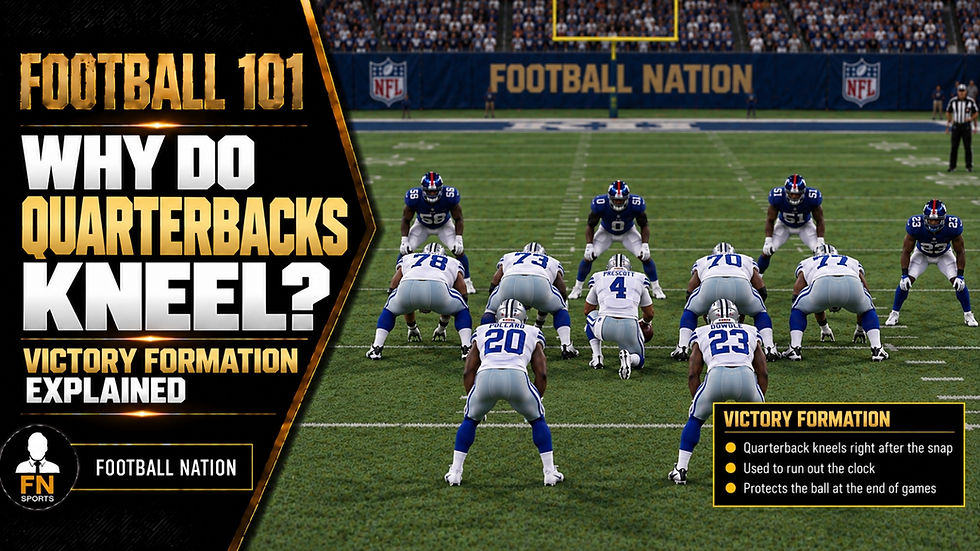
Why Do Quarterbacks Kneel? Victory Formation Explained
- Football Nation
- 13 hours ago
- 5 min read
Quarterbacks kneel to end a game with the lowest practical risk of a turnover, injury or clock-stopping mistake. After a legal snap, the quarterback immediately drops to one knee or clearly simulates doing so. Officials rule the ball dead, the offense sacrifices one down, and the game clock normally keeps running. If the remaining time is shorter than the clock the offense can legally drain—and the defense lacks enough timeouts—the game is effectively over.
Victory formation is the compact alignment built around that decision. The quarterback is under center, linemen reduce interior penetration, and backs align close enough to protect against an exchange mistake. It is not a special scoring play or an automatic end-of-game declaration. The offense still must snap legally, possess the ball and manage every remaining second.
What exactly makes the quarterback down?
The 2026 NFL Rulebook makes the answer explicit. Under Rule 7’s dead-ball provisions, the ball is dead when a quarterback immediately drops to his knee—or simulates dropping to his knee—behind or beyond the line of scrimmage. A runner can also declare himself down by kneeling and clearly making no immediate effort to advance.
That is why no defender has to touch the quarterback. The ruling differs from an ordinary runner who slips to the turf and may still be live without defensive contact. Once the quarterback performs the recognized give-up action, officials end the down at that spot. A small loss of yardage is recorded, but possession security matters far more than the lost yard.
Clock-management piece | Verified NFL value | What it means |
|---|---|---|
Ordinary play clock after the prior play ends | 40 seconds | The offense can wait before the next legal snap while the game clock runs. |
Charged team timeouts available in a half | 3 | The defense can interrupt up to three running-clock intervals if all remain. |
Down used by one quarterback kneel | 1 down | Starting on first down, three kneels move the offense to fourth down unless time expires first. |
Quarterback immediately drops to or simulates a knee | Ball dead | The play ends without requiring a defender to tackle the quarterback. |
Source: NFL Rules 4, 7 and the league’s timeout provisions. The exact number of seconds one sequence removes can vary with the snap, whistle, timeouts, administrative stoppages and when possession began.

How victory formation runs out the clock
The first kneel consumes a down and only a few seconds of live action. The major drain comes afterward. The normal play clock is 40 seconds after the preceding play ends, and the offense can wait until late in that countdown before snapping again. If the game clock is still moving, most of that waiting period disappears from the game.
Repeat the cycle and the offense can remove a large block of time without exposing the ball to a handoff, pass rush or open-field tackle. The quarterback still protects the exchange with the center, and the offense usually waits to kneel until the clock situation is secure. Taking the knee too early can leave an unnecessary fourth down or force another snap.
The two-minute warning and the way the game clock restarts also matter. A kneel does not create the same clock result as running out of bounds. Football Nation’s out-of-bounds clock guide explains why some dead-ball results restart on the referee’s signal while late-half boundary plays wait for the snap. The kneel strategy works because an inbounds dead ball normally lets the game clock continue.
Why timeouts change the answer
A defense can spend a charged timeout immediately after a kneel. That stops the game clock and forces the offense to use another down without receiving the full waiting interval. If the defense owns all three timeouts, victory formation may still be correct, but it may not be enough by itself to end the game. The offense must calculate time, downs and timeout inventory together.
This is why television graphics often show “kneel-downs needed” or a mathematical game-ending threshold. There is no universal time such as two minutes that makes every game safe. A fresh first down with no defensive timeouts is radically different from second down against a defense holding all three. Penalties, injuries, replay corrections and an exchange error can also change the plan.
Why not just spike the ball?
A quarterback spike does the opposite job. The spike is an intentionally incomplete forward pass used to stop the game clock when the offense needs more time. A kneel keeps the clock moving when the offense wants less time. Both sacrifice a down, but they solve opposite clock problems.
The same resource logic explains other late-game decisions. A team might decline a penalty if accepting it creates an unwanted replayed down, or even choose an intentional safety when exchanging two points for clock and field position improves its chance to win. Victory formation is the safest version because it usually gives away only downs and a few yards—not points or possession.
Why are backs positioned behind the quarterback?
The extra backs are insurance. They are positioned to recover a mishandled snap and discourage a defender from finding a clean path through the center of the formation. Linemen crowd the interior, maintain legal alignment and prepare for contact even though both sides usually understand the quarterback’s intention.
The formation does not prevent the defense from playing. The ball is live after the snap until the quarterback is ruled down, and a bad exchange can still become a fumble. The defense also may attack the formation, though forceful late contact after the quarterback gives himself up can draw a foul. NFL reporting has documented the controversy around defenses crashing a victory formation, which is why the offense treats the snap as real rather than ceremonial.
The biggest misconception
Victory formation does not automatically end the game. It is a normal legal formation used to execute a low-risk play. Officials still place the ball, administer substitutions and confirm the offense is legally set. If an official stands over the ball before the snap, the quarterback cannot ignore that control and snap anyway. The play clock remains a real deadline.
Nor is the formation a promise that the offense will kneel. In January 2024, the Saints aligned in victory formation against Atlanta and then handed the ball off for a touchdown, a choice the head coach publicly said was not the called decision. The NFL’s account of that play shows why defenses must remain alert until the ball is dead, even when convention strongly suggests a kneel.
Frequently asked questions
Does a quarterback lose rushing yards on a kneel?
Yes. In NFL team and player statistics, the kneel is recorded as a rushing attempt and the yardage lost at the dead-ball spot is charged to the quarterback.
Does the clock stop when a quarterback kneels?
The clock stops briefly because the play is dead, then normally continues under the applicable timing rule unless a timeout, period break, penalty or another rule creates a stoppage.
How many times can a team kneel?
A team can kneel on any scrimmage down. From first down it has three kneels before reaching fourth down, unless it earns another first down or the game ends first.
Can the defense try to force a fumble in victory formation?
Yes during the live interval after the snap, but the quarterback is down immediately when he gives himself up. Late or unnecessary contact can be penalized.
Is victory formation required before a quarterback kneel?
No. The rule recognizes the quarterback’s immediate kneel, not a named formation. Victory formation is the preferred protective alignment, not a prerequisite for the dead-ball ruling.
Football Nation takeaway
When a team enters victory formation, check three things before assuming the game is over: the down, the defense’s remaining timeouts and the game clock. Then watch the sequence—not just the knee. A legal snap begins the down, the quarterback’s immediate give-up ends it, and the 40-second play clock supplies most of the drain. Victory formation is simple because the situation has already been won; its job is to remove the final avoidable risks.


Comments