top of page

2026 NFL Overtime Rules Explained: Does Each Team Get the Ball?

Updated: 1 day ago

Overtime used to be the NFL’s fastest route from a coin toss to an argument. In 2026, a touchdown on the first drive no longer automatically ends a regular season game. Both teams receive an opening opportunity to possess the ball, but the 10 minute clock can still create an ending many fans do not expect.

This guide explains the complete 2026 NFL overtime rule, including regular season and playoff differences, field goals, touchdowns, two point tries, sudden death, ties, timeouts, the coin toss, and the one safety exception that can end the game immediately.


Quick answer: Both teams must have an opening opportunity to possess the football in regular season and postseason overtime, except when the kickoff team scores a safety on the receiving team’s first possession. In the regular season, one 10 minute period is the maximum, so the clock can expire before the second team finishes or even begins its possession.

Updated: August 9, 2026. This article is based on Rule 16 of the official 2026 NFL Rulebook.


What changed in the NFL overtime rule?


The major change was approved for the 2025 season and remains in effect in 2026. The league aligned the opening possession rule for regular season and postseason overtime. The team receiving the opening kickoff can score a touchdown and the opponent still gets an opportunity to answer.


The regular season did not become identical to the playoffs. Regular season overtime remains limited to 10 minutes and can end in a tie. Playoff overtime uses 15 minute periods and continues until a winner is decided.


NFL Football Operations explains the change and the strategy it creates in the official video below.


Does each team get the ball in NFL overtime?


Usually, yes, but the exact rule says each team must have an opportunity to possess the ball once. That wording matters because there are two exceptions.


  • Safety exception: If the team that kicks off scores a safety on the receiving team’s initial possession, the kickoff team wins immediately.

  • Regular season clock exception: The overtime period ends after 10 minutes even if the second team has not received the ball or has not completed its opening possession.


Outside those situations, a first possession touchdown does not end the game. The second team can answer with a touchdown, choose between an extra point and a two point try, and potentially win immediately.


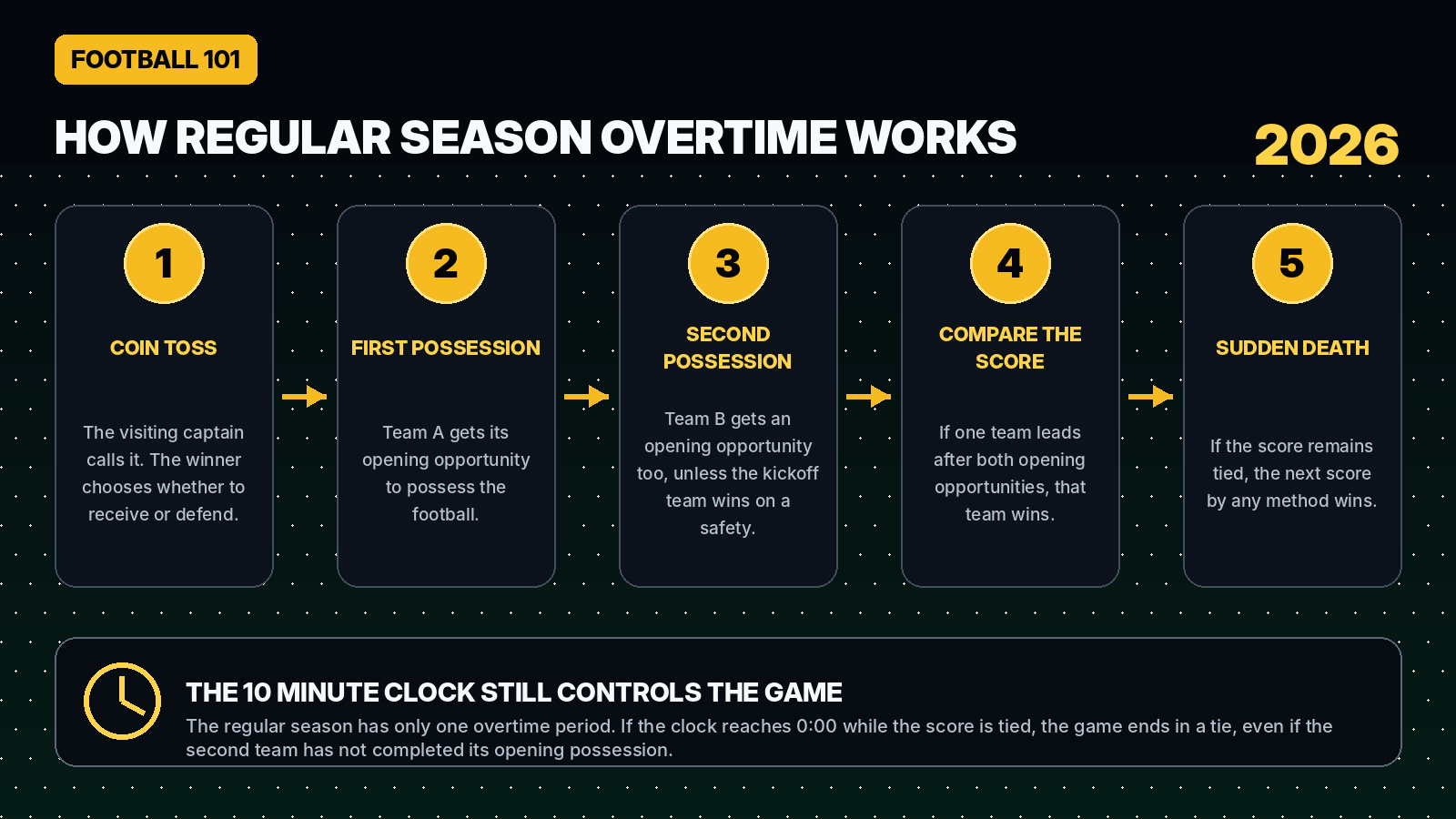
Five step diagram explaining how 2026 NFL regular season overtime works from the coin toss through sudden death

Regular season overtime moves from the coin toss to two opening opportunities, then to sudden death if the score remains tied.


How regular season overtime works in 2026


  1. After regulation ends in a tie, there is an intermission of no more than three minutes.

  2. The captains meet for a new coin toss. The visiting team calls it, and the winner chooses whether to receive or which goal to defend.

  3. One 10 minute overtime period begins. Each team receives two timeouts, and fourth quarter timing rules generally apply.

  4. Both teams receive an opening opportunity to possess the ball, subject to the safety and clock exceptions.

  5. After both opening opportunities, the team with more points wins. If the score is tied, the next score by any method wins.

  6. If the score is tied when the 10 minute clock reaches 0:00, the regular season game ends in a tie.


What happens after the first team’s possession?


If the first team does not score

The second team wins with any score. A field goal is enough. If the second team also fails to score, the game moves into sudden death if time remains.


If the first team kicks a field goal

  • A touchdown by the second team wins the game.

  • A field goal by the second team ties the score and starts sudden death.

  • No score by the second team ends the game in favor of the first team.


If the first team scores a touchdown

  • If Team A scores a touchdown and kicks the extra point for 7, Team B can score a touchdown and kick the extra point to tie.

  • If Team A leads 7 to 0, Team B can score a touchdown and convert a two point try to win 8 to 7.

  • If Team A scores a touchdown and converts a two point try for 8, Team B must score a touchdown and convert a two point try to tie.

  • If Team B fails to match or exceed Team A’s score, Team A wins.


If the kickoff team scores a safety

The game ends immediately. This is the rule based exception that allows overtime to end before both offenses get a possession. The team that kicked off is the winner.


Can the second team win with a two point conversion?


Yes. When the first team scores a touchdown and kicks the extra point, the second team can score a touchdown and attempt a two point conversion for the win instead of kicking to extend the game.


The second team has an information advantage because it knows the exact score required. It can also use all four downs more aggressively because a failed possession ends the game. The first team can counter by attempting its own two point try and building an 8 point lead.


Side by side comparison of 2026 NFL regular season overtime rules and playoff overtime rules

Both formats give each team an opening opportunity, but the period length, timeout structure, and possibility of a tie are different.


Regular season vs playoff overtime rules


  • Regular season period length: 10 minutes.

  • Playoff period length: 15 minutes.

  • Regular season maximum: one overtime period.

  • Playoff maximum: no limit. Play continues until there is a winner.

  • Regular season tie: possible when the score is tied at 0:00.

  • Playoff tie: impossible because additional periods are played.

  • Regular season timeouts: two per team.

  • Playoff timeouts: three per team during each overtime half.

  • Opening possession rule: both teams must have an opportunity in both formats, subject to the safety exception.


The 10 minute clock is the most important wrinkle


Many summaries say both teams are guaranteed a possession. That is an understandable shortcut, but the official regular season rule contains a major clock limitation.


The regular season has a maximum of one 10 minute period, even if the second team has not possessed the ball or its initial possession has not ended. If the score is tied when time expires, the game ends in a tie.

That creates a rare possibility: the first team can use most of the clock, score, and leave the second team with very little time. Clock management is therefore part of overtime strategy, not merely an afterthought.


Is NFL overtime sudden death?


Not at the start. The opening phase gives both teams an opportunity to possess the ball. Sudden death begins after both opening opportunities are complete and the score remains tied. Once sudden death begins, the next field goal, touchdown, or safety wins.

Who should receive the ball first?


  • Why receive first: You can take the lead, force the opponent to chase the score, and use the 10 minute regular season clock.

  • Why kick first: You know exactly what result is required, can use all four downs more aggressively, and can choose whether to attempt a two point conversion after a touchdown.

  • Why conditions matter: Wind, field direction, kicker range, defense quality, offensive confidence, and remaining clock can change the decision.


There is no automatic best choice. In the playoffs, the information advantage of possessing second can become more attractive because the game cannot end in a tie. In the regular season, the 10 minute cap gives the team receiving first an additional clock based advantage.


Six simple 2026 NFL overtime examples


  1. Team A punts. Team B kicks a field goal. Team B wins.

  2. Team A kicks a field goal. Team B kicks a field goal. The score is tied and the next score wins.

  3. Team A scores a touchdown and kicks the extra point. Team B scores a touchdown and kicks the extra point. The next score wins if time remains.

  4. Team A scores a touchdown and kicks the extra point. Team B scores a touchdown and converts a two point try. Team B wins.

  5. Team A scores a touchdown and converts a two point try. Team B scores a touchdown but kicks only the extra point. Team A wins.

  6. Team A receives the opening kickoff and is tackled for a safety. Team B, which kicked off, wins immediately.


Frequently asked questions


Does a touchdown on the first drive win NFL overtime in 2026?

No. In both regular season and playoff overtime, the opponent receives an opening opportunity to possess the ball after a first possession touchdown, subject to the safety exception and the regular season clock limit.


Can an NFL regular season game end in a tie?

Yes. If the score remains tied when the single 10 minute overtime period expires, the game ends in a tie.


How long is NFL overtime?

Regular season overtime lasts a maximum of 10 minutes. Each playoff overtime period lasts 15 minutes, and more periods are played until a winner is determined.


How many timeouts does each team get in overtime?

Each team gets two timeouts in regular season overtime. In the playoffs, each team gets three timeouts during an overtime half.


Can a field goal win NFL overtime?

Yes. If the first team fails to score, the second team can win with a field goal. After both teams complete their opening opportunities with the score tied, any field goal ends the game.


Are the regular season and playoff rules the same?

The opening possession rule is similar, but the clock and ending are different. The regular season uses one 10 minute period and can end in a tie. The playoffs use 15 minute periods and continue until somebody wins.


The bottom line


The 2026 NFL overtime rule is fairer than the old first touchdown format, but it is not as simple as saying both teams are guaranteed the ball. Both teams receive an opening opportunity, a safety can end the game immediately, and the regular season’s 10 minute cap can stop the second possession before it begins or finishes.

Remember the sequence: two opening opportunities, compare the score, then sudden death if the game is still tied and time remains. In the playoffs, keep playing until somebody wins.


Official sources and more Football 101

Comments


bottom of page