


NFL Clock Rules: Starts, Stops and Late Half Decisions
Updated: 6 hours ago
NFL regulation contains four fifteen minute quarters. Two different clocks govern the game: the game clock measures remaining playing time, while the play clock limits how long a team can wait to start the next play.
Part of Football 101. Explore the guide to choose your next topic.

The game clock can run between plays. That is why possession, timeouts and getting the next snap organized can matter as much as the yards gained.
When the game clock runs
An ordinary tackle inbounds generally leaves the clock running. Earning a first down does not by itself create a routine NFL clock stoppage until the next snap.
An incomplete forward pass stops the clock, which normally restarts on the next snap. A change of possession, charged timeout or scoring play also creates its own clock administration.
When a runner goes out of bounds, the clock initially stops. It ordinarily restarts when the ball is ready, except in designated situations. After the two minute warning of the first half and during the final five minutes of the second half, it ordinarily waits for the snap. The out of bounds clock guide explains that distinction.
An official ruling forward progress stopped inbounds can produce different timing from a runner voluntarily reaching the sideline.
Forty seconds or twenty five?
The normal play clock starts at forty seconds when the previous down ends. After specified administrative stoppages, a twenty five second clock begins on the referee’s signal. Examples include a charged timeout, penalty administration and the two minute warning.
A running game clock and an expiring play clock are independent problems. A team may still need to snap even while trying to consume game time. Deliberately exhausting the play clock can bring delay of game.
Timeouts and the two minute warning
Each team has three charged timeouts per half. Unused first half timeouts do not carry into the second half. The two minute warning is a separate official stoppage; if a play is live at 2:00, officials allow it to finish before the warning.
A legal spike spends a down to stop a running clock. The under center quarterback must begin the throwing action immediately after receiving the snap. It is not permission to throw the ball into the ground after delaying for a broken play.
Runoffs and the end of a period
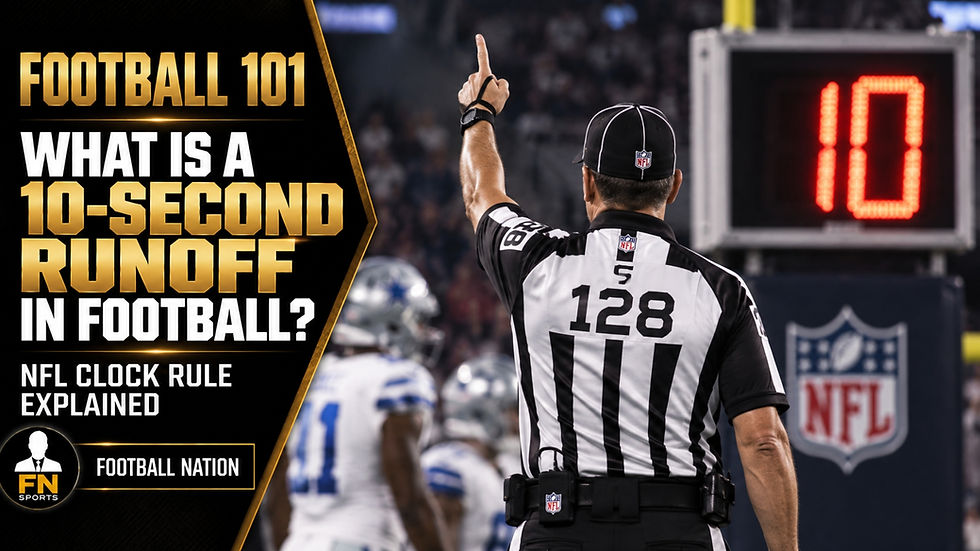
Certain late half acts, injury situations and replay corrections can require a ten second runoff. The trigger and available timeout options differ. A runoff is not an automatic addition to every offensive penalty, and replay runoffs do not follow all the same choice rules as fouls.
A live play continues when the game clock reaches zero. Accepted defensive fouls and other specified situations can extend a period with an untimed down. Conversely, an offensive foul does not automatically buy another snap.
For a close ending, first identify why time stopped, then what restarts it, then whether a runoff or extension applies. Those three questions prevent most clock misunderstandings.
Keep learning
The play clock: Study forty versus twenty five seconds.
Ten second runoffs: Compare the triggers and timeout options.
Overtime timing: Learn why the regular season and playoffs differ.
Browse the Football 101 collection.
NFL rules reviewed October 10, 2026. 2026 NFL Rulebook. Rule 4, Sections 1 through 8.


Comments