


Baker Mayfield Contract: Buccaneers Agree to $165M Extension
Baker Mayfield and the Tampa Bay Buccaneers have agreed to a three-year, $165 million contract extension, according to the report that broke Tuesday and an official NFL social announcement. The agreement carries a $55 million annual average and is expected to keep Mayfield under contract through the 2029 season.
The headline answer is clear: Tampa Bay has chosen long-term quarterback stability before Week 1. The full financial structure is not yet public, however. Guaranteed money, signing bonus, cash flow, option language and year-by-year salary-cap charges remain unconfirmed and will determine how much flexibility the contract really gives the club.
What is confirmed about Mayfield’s new contract
The reported agreement adds three years and $165 million to Mayfield’s existing deal. That means the extension begins after the final season of the three-year contract he signed in March 2024. At $55 million per added year, the new average is above the roughly $50 million annual level Mayfield had reportedly sought during the summer.
The timing is significant because negotiations had stalled. In late July, the Buccaneers explained that Mayfield was entering the final year of his deal after he set a personal deadline and paused talks. Reuters reported that Mayfield felt undervalued and wanted the market to reflect his production and importance to the franchise. The new average suggests Tampa Bay ultimately moved beyond that public benchmark.
What has not been confirmed is just as important. A $165 million headline does not reveal how much money is fully guaranteed at signing, whether later guarantees vest, or whether the final seasons contain roster bonuses or exit points. Those details—not the maximum value alone—will show how firmly both sides are tied together.

Why Tampa Bay made the commitment
Mayfield earned the leverage by stabilizing a position that had become the franchise’s central question after Tom Brady’s retirement. Across three regular seasons with Tampa Bay, Mayfield started 51 games and threw for 12,237 yards, 95 touchdowns and 37 interceptions. The Buccaneers went 27–24, won the NFC South in 2023 and 2024, and remained in contention late in a disappointing 8–9 season in 2025.
His 2025 line—3,693 passing yards, 26 touchdowns and 11 interceptions—was not his statistical peak with Tampa Bay, but it reinforced the floor he provides. The front office did not need to project a young quarterback or enter an uncertain veteran market. It could pay the quarterback who already knows the offense, the locker room and the pressure attached to replacing Brady.
That continuity matters inside a division Football Nation examined in its 2026 NFC South predictions. Tampa Bay is trying to rebound without resetting the most important position. A new quarterback would have introduced schematic, timing and leadership risk at the same moment the club is trying to return to the playoffs.
How the deal fits the quarterback market
The extension is another reminder that quarterback contracts are priced by scarcity, timing and leverage as much as by a simple ranking of players. Football Nation’s coverage of C.J. Stroud’s Week 1 contract deadline and Lamar Jackson’s future negotiations shows why clubs prefer clarity before deadlines harden. Tampa Bay allowed its talks to pause, then chose to finish the agreement before the season created more variables.
The comparison to Christian Gonzalez’s record Patriots extension is useful for a different reason: top-of-market numbers can define a position while still hiding the real risk allocation. Mayfield’s $55 million average is the immediate market signal. His guarantees and cap schedule will determine the practical commitment.
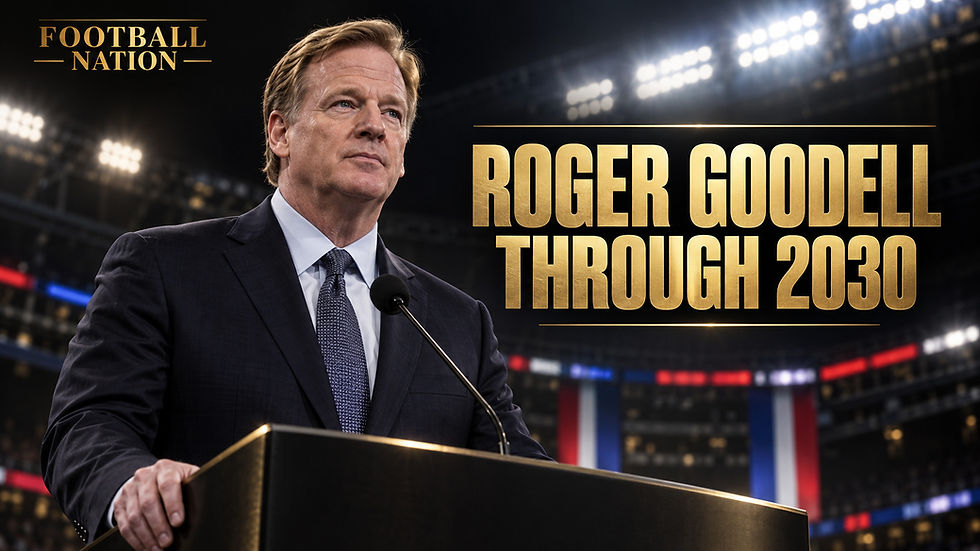
Leaguewide extensions also arrive in different strategic contexts. Roger Goodell’s new contract is about institutional continuity, while Mayfield’s is a football decision with weekly competitive consequences. Still, both reflect the value organizations place on avoiding uncertainty at the most influential leadership position.
What changes for the Buccaneers
Nothing about the Week 1 depth chart changes overnight: Mayfield was already the starter. What changes is the planning horizon. Tampa Bay no longer has to carry an expiring-quarterback question through every press conference and every result. Coaches can build around Mayfield through 2029, and the front office can approach future drafts without forcing a quarterback selection.
The structure may also shape every other decision. Large signing-bonus proration could lower early cap hits but push costs into later years. Strong guarantees could make this a firm multi-season commitment; softer guarantees could preserve an exit. Until the contract is filed and the figures are reported, claims about cap savings or long-term flexibility would be speculation.
The broader roster lesson resembles the Rams’ choice to make a major veteran investment when Aaron Donald returned to Los Angeles. Once a club believes it can contend, certainty around a foundational player can be more valuable than keeping every future option open. Tampa Bay is betting that Mayfield’s competitiveness and durability preserve that window.
Fantasy impact
For fantasy managers, the extension is meaningful for long-term confidence but should not change immediate Week 1 projections. Mayfield’s role, surrounding personnel and opening matchup were already known. The agreement removes contract noise and strengthens the case that Tampa Bay’s pass catchers will continue with the same quarterback beyond 2026.
It should not be treated as proof of a statistical leap. Contracts reward expected value and positional leverage; they do not create more attempts, touchdowns or rushing production. The actionable fantasy takeaway is continuity, not an automatic upgrade. Managers should still value Mayfield according to league format, weekly matchup and the health of Tampa Bay’s receiving corps.
The biggest uncertainty and next checkpoint
The next checkpoint is the complete contract structure: full guarantees, injury guarantees, signing bonus, annual cash flow, salary-cap charges and any option or void years. An official Buccaneers release and Mayfield’s first media availability after the agreement should also clarify why negotiations restarted and how both sides describe the commitment.
Until those details arrive, the responsible conclusion is limited but important. Tampa Bay has agreed to pay Mayfield like a long-term franchise quarterback. Whether the deal is aggressive, flexible or both cannot be judged from the $165 million maximum alone.
Football Nation verdict
This is a defensible commitment at the most difficult position to replace. Mayfield arrived as a reclamation project and became the organizing force of Tampa Bay’s offense. The Buccaneers had evidence from 51 starts, two division titles and three seasons of leadership; walking him toward free agency would have exchanged a known answer for a much larger risk.
The price is substantial, and the 2025 miss gives skeptics a fair question about the team’s ceiling. But Tampa Bay did not pay for last season alone. It paid to preserve quarterback competence through 2029 and to keep the roster plan coherent. Football Nation’s verdict: the extension is strategically sound, while the eventual grade must wait for the guarantees and cap structure.
Cover: Original Football Nation editorial illustration created with generative AI.


Comments