


Field Safety vs Boundary Safety in College Football
Updated: 6 hours ago
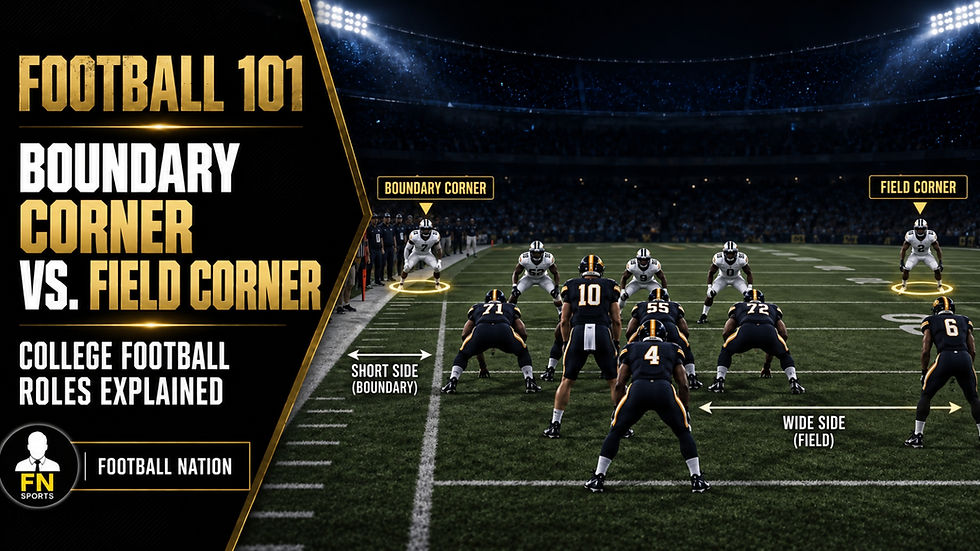
The field safety works toward the wider side of the field; the boundary safety works toward the shorter side. These labels start with the ball’s position between the sidelines. They do not automatically translate to free safety and strong safety.
Part of Football 101. Explore the guide to choose your next topic.

When the ball sits on a hash mark, one sideline is much closer. College hash marks are wider apart than NFL hashes, making that imbalance especially useful for organizing a defense.
Geography before assignment
The field side gives an offense more horizontal space for multiple receivers, screens and routes toward the sideline. The boundary compresses that width and can create isolated receiver matchups or a shorter path for pressure.
Those tendencies influence safety duties, but they do not dictate them. A coverage can rotate either safety deep, bring one into a run fit or match a receiver. Quarters coverage and other matching systems can change responsibilities as routes develop.
A team example
Pitt’s 2017 spring report discussed Jordan Whitehead learning both field and boundary safety. Coaches described different demands and greater coverage work in the field role. That is a useful historical explanation of why a defense might teach separate positions.
It does not establish a universal body type rule. Both safeties still need tackling, communication and coverage skills. A boundary player is not excused from covering fast receivers, and a field player must still support the run.
What happens when the ball or formation moves?
If the next play begins on the opposite hash, the wide and short sides reverse. Some defenses move the players to preserve their field and boundary roles; others retain left and right alignments or adjust according to formation strength.
That is why offensive motion can trigger communication without necessarily moving both safeties. The coaches decide which landmarks govern the call.
To recognize the difference on television, find the ball first, identify the wider side, and then follow the safeties after the snap. The initial geography tells you what space they face. Their movement tells you what coverage and run responsibilities they actually received.
Examples and illustrations

Keep learning
Field and boundary corners: Apply the same geography outside.
The Money position: See field/boundary language in linebacker roles.
Cover 6: Learn how one defense can combine different coverage sides.
Browse the Football 101 collection.
Rules reviewed October 10, 2026. Pitt spring practice report, 2017. 2026 NFL Rulebook field markings (Field markings, item 10).


Comments