


Colts at Vikings Week 7 Guide: Injuries, Fantasy, Odds and Prediction
Updated: 21 hours ago
Football Nation call: Minnesota remains the cleaner Week 7 pick because its defense has controlled third down, the red zone and explosive passes while creating pressure without sacrificing coverage structure. Indianapolis is now 2 and 4 after a 26 to 20 home loss to Tennessee in which the Colts led 13 to 0 at halftime. The Week 6 collapse reinforces the need to protect the ball, finish drives and avoid decisive special teams errors. Our projection remains Vikings 24, Colts 20. This guide was refreshed at 2026-10-19T02:33:20.376Z; season long comparison rates remain labeled through Week 5, while the official Week 6 final is now included.
Game details, records and context
Indianapolis visits Minnesota in NFL Week 7 on Sunday, October 25, 2026, at U.S. Bank Stadium. Kickoff is 12:00 p.m. Central, 1:00 p.m. Eastern. CBS carries the television broadcast, and the Vikings game center lists NFL+ among the streaming options. Minnesota is 5 and 0 after its Week 6 bye. Indianapolis is 2 and 4 after a 26 to 20 loss to Tennessee, so the Vikings own both the rest advantage and the cleaner preparation window.
The standings stakes are different. Minnesota is protecting an unbeaten start and an NFC North lead. Indianapolis is trying to avoid losing contact in the AFC South. The travel is manageable, but the rest imbalance is real: the Colts must play, recover and travel after Minnesota has spent a full week resetting its protection plan and defensive pressure menu.
The most meaningful recent meeting is Minnesota's 39 to 36 overtime win in December 2022, when the Vikings erased a 33 point halftime deficit for the largest comeback in NFL history. That result has little predictive personnel value in 2026, but it is a useful reminder that game state alone cannot carry Indianapolis. The Colts need possession finishing and turnover control for four quarters.
Recent form and the statistical matchup
Indianapolis' last two results expose the central concern. The Colts reached scoring territory repeatedly but settled for field goals in a 34 to 22 Week 5 loss at Pittsburgh, then surrendered a 13 to 0 halftime lead in a 26 to 20 Week 6 loss to Tennessee. The Titans forced three turnovers, blocked a punt for a touchdown and intercepted Daniel Jones at the Tennessee 11 yard line to stop a scoring threat. Through five games, TeamRankings listed Indianapolis at 24.8 points and 293.8 yards per game while allowing 27.6 points and 384.2 yards. Those comparison rates remain a labeled Week 5 baseline rather than a claim that the Week 6 box score has already been folded into every season average.
Minnesota's statistical identity is almost the inverse. The Vikings have scored 21.8 points per game but allowed only 12.8. They have held opponents to 259.8 yards and 4.6 yards per play, converted takeaways into a plus 1.2 turnover margin per game, allowed only 22.2 percent on third down, and permitted touchdowns on only 25 percent of opponent red zone trips. The defense has generated a 9.83 percent sack rate. Those are dominant early season numbers, although the small sample and Minnesota's upcoming schedule still demand caution.
The official team pages reinforce the personnel story. Daniel Jones had completed 108 of 176 passes for 1,021 yards, three touchdowns and four interceptions through Week 5. Jonathan Taylor had 398 rushing yards and six touchdowns on 101 carries. Rookie tight end Tyler Warren led Indianapolis with 30 receptions, while Josh Downs had 249 receiving yards. For Minnesota, Kyler Murray had 662 passing yards, Aaron Jones had 410 rushing yards, Justin Jefferson had 258 receiving yards and three touchdowns, and T.J. Hockenson had 23 catches for 202 yards. Dallas Turner had 5.5 sacks, Andrew Van Ginkel had four, and Byron Murphy Jr. had three interceptions.
ESPN's 2026 team statistics pages were checked during preparation, but the public pages did not return a stable usable table in this session. No ESPN number was guessed or substituted. The comparisons above come from the official club stat pages and TeamRankings, with the period labeled through Week 5.
Injuries and availability
The Week 7 injury reports are not yet available. Indianapolis' final Week 6 report ruled linebacker Jaylon Carlies out with a rib injury and wide receiver Ashton Dulin out with a hamstring injury. Tight end Tyler Warren was questionable with a groin injury after a limited Friday practice. Indianapolis activated tight end Will Mallory from injured reserve Saturday and lifted Mallory's questionable designation. Daniel Jones, Josh Downs and Jonathan Taylor finished the week as full participants without game designations. The Week 6 game is now final; official postgame updates and the first Week 7 practice report are the next availability checkpoints.
Minnesota's last official injury report before the bye was for Week 5. Left tackle Christian Darrisaw was out with a concussion, receiver Jordan Addison was out with a hamstring injury, and right tackle Brian O'Neill and Justin Jefferson carried question marks before Jefferson ultimately played. The bye gives Minnesota time, but it does not guarantee clearance. Darrisaw and O'Neill matter directly against Indianapolis' best defensive front pieces, and Addison's return would change how aggressively the Colts can tilt coverage toward Jefferson.
Replacement consequences are straightforward. If Minnesota is missing a starting tackle, DeForest Buckner and the Colts edge group gain a path to compress Murray's pocket. If Addison remains limited, Hockenson and the backs should absorb more middle of field volume. If Carlies cannot return for Indianapolis, the Vikings can test the second level with Jones, play action and Hockenson.
Scheme keys and each team's clearest path
Indianapolis' best formula begins with Taylor, but not with predictable first down runs into a loaded box. Minnesota has allowed only 86.6 rushing yards per game and has paired that front with elite third down defense. The Colts need motion, split flow and play action that force the Vikings linebackers to honor Warren and the crossing game. Jones has protected reasonably well by raw sack rate, yet Minnesota's rush is the most dangerous unit he has faced in this matchup profile. Empty formations and long developing routes invite the Vikings' four man pressure to dictate the game.
The Colts also need to finish drives. A 66.7 percent offensive red zone touchdown rate is encouraging, but the Pittsburgh loss showed how a handful of stalled goal to go snaps can erase otherwise efficient movement. Warren is the matchup piece: he can block, settle against zone and threaten the seam. Downs supplies the quickest answer against pressure. Indianapolis should make Murray and the Vikings offense drive the long field rather than chasing explosives after turnovers.
Minnesota's offensive path is to make Indianapolis tackle for sixty minutes. The Colts have allowed 130.2 rushing yards per game and five yards per carry. Aaron Jones can keep the Vikings out of obvious passing downs, where Indianapolis' third down defense has been far better than its overall yardage numbers. Murray's movement also stresses the edges, but the Vikings must manage a protection unit that has allowed sacks on 9.68 percent of pass attempts.
Jefferson remains the player Indianapolis cannot defend with one static answer. The Colts can bracket him on money downs, rotate late and force Murray to work through Hockenson and the backs. The tradeoff is lighter boxes for Jones. Minnesota's offense does not need a volume shootout if the defense continues creating short fields; patience is a feature here, not a weakness.
Odds, total and line movement
No current executable spread, total or moneyline from a legal sportsbook was publicly verified during this check, so Football Nation is not presenting a bettable price. A dated eDraft consensus snapshot from October 15 showed Minnesota minus 4.5 after an opening number of minus 2.5, with a total of 43.5 after opening at 45.5. That page estimated an implied score near Minnesota 24, Indianapolis 19.5. Treat those figures as a market history snapshot, not a live quote.
The football interpretation is more useful than the stale price. Minnesota deserves favoritism because of rest, defense and turnover margin. At Vikings minus three or better, that profile would be more attractive. Around minus six, Indianapolis' Taylor driven floor and strong third down defense create too much backdoor and low possession risk. A total in the low forties is consistent with Minnesota's defensive control, but a healthier Vikings offensive line and the return of Addison would raise the scoring ceiling.
Player workload and prop watch
Real Week 7 player prop lines were not available from a publicly accessible legal market at the cutoff. These are workload checkpoints, not bets: Jonathan Taylor averaged 20.2 carries through five games and remains Indianapolis' clearest volume anchor. A later rushing line must be judged against Minnesota's 86.6 rushing yards allowed per game and the risk that negative game state shifts touches toward Warren and Downs.
Daniel Jones averaged 35.2 pass attempts through Week 5, but Minnesota's pressure makes attempts and completions safer discussion points than raw passing yards. Tyler Warren averaged six receptions per game and is the most natural quick game answer; his final Week 6 health is essential. Josh Downs averaged 49.8 receiving yards and can win underneath if the Vikings keep their safeties on top of explosive routes.
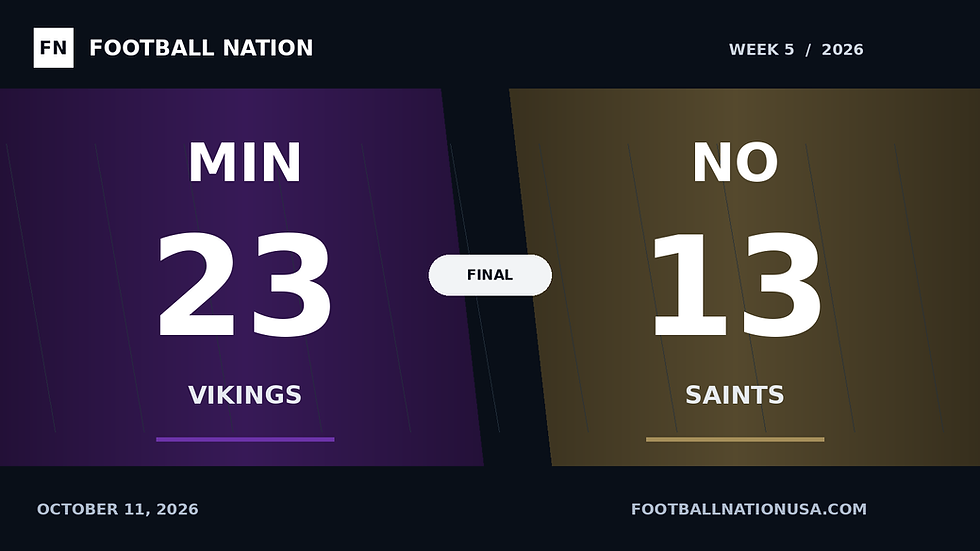
Aaron Jones averaged 82 rushing yards per game and carried 25 times for 113 yards in Minnesota's 23 to 13 Week 5 win at New Orleans. His later rushing and attempts markets will depend on Colts Week 6 defensive health. Justin Jefferson averaged 51.6 receiving yards through five games despite three touchdowns, while Hockenson averaged 4.6 catches. Both receiving profiles have room to grow if Addison remains limited, but any posted number must be checked after Minnesota's first Week 7 practice report.
Touchdown prices were also unavailable. Taylor's six rushing scores and Jefferson's three receiving scores establish the roles, but scoring markets should not be evaluated without current odds. Warren's goal line usage, Jones' receiving work and Hockenson's red zone routes are the three most important role checks after Week 6.
Fantasy football guidance
Format: half PPR, one quarterback. Jonathan Taylor remains a volume based RB2 with RB1 upside, even in a difficult matchup. Tyler Warren is a startable TE1 or high end streamer if his groin and Week 6 workload are clean. Josh Downs is a flex candidate in deeper leagues because pressure can funnel targets underneath. Daniel Jones is a sit in standard one quarterback formats and a matchup dependent superflex option.
For Minnesota, Justin Jefferson remains a must start. Aaron Jones profiles as an RB2 because Indianapolis has allowed five yards per rush, although his touchdown ceiling depends on the Vikings maintaining red zone efficiency. Hockenson is a TE1 range start when healthy. Murray is a high end QB2 and streamer whose rushing can offset modest passing volume. Minnesota's defense and special teams is a strong start because Indianapolis entered Week 6 with eight giveaways and Minnesota had produced ten takeaways.
Replacement guidance: if Addison is inactive again, Hockenson and the secondary receivers gain target stability, but fantasy managers should not force a speculative wideout into shallow lineups. If Taylor is limited during Week 7 preparation, the Colts' backfield replacement must be identified from the official depth chart and practice reps before waivers or lineup decisions. Do not assume a handcuff without that evidence.
Football Nation prediction
Prediction: Vikings 24, Colts 20. Minnesota's defense is the most trustworthy unit in the matchup, and the bye creates time to repair the offensive line while Indianapolis plays and travels. The Vikings can win without asking Murray to chase explosive passes if Jones controls early downs and the defense continues owning third down and the red zone.
Strongest counterargument: Indianapolis has the best individual rushing scorer in the game, a tight end who can punish pressure, and a defense that has been excellent on third down. If the Colts protect the ball and turn three red zone trips into touchdowns, Minnesota's modest scoring average leaves an upset lane.
Upset path: Taylor creates efficient second downs, Jones gets the ball out before the rush arrives, and Indianapolis finishes plus two in turnovers. The fact that would change the call is a Week 7 injury report showing Minnesota still down both starting tackles while Indianapolis exits Week 6 healthy. A move to Vikings minus six or higher would also change the price sensitivity, even if it would not automatically change the straight up pick.
Game day checklist
1. Review Indianapolis' official Week 6 snap counts and postgame injury updates. 2. Read both official Wednesday through Friday Week 7 reports, especially the Vikings tackles, Addison, Jefferson, Carlies, Warren, Downs and Taylor. 3. Confirm the official inactive list about ninety minutes before kickoff. 4. Recheck any executable spread, total, moneyline, player props and touchdown prices with a timestamp. 5. Confirm U.S. Bank Stadium operations; the fixed roof makes exterior weather a minor football variable. 6. Reassess the prediction if Minnesota's protection or Indianapolis' backfield materially changes.
Sources and factual cutoff
Factual cutoff: 2026-10-19T02:33:20.376Z. The official Week 6 final is Tennessee 26, Indianapolis 20; Indianapolis is 2 and 4, while Minnesota is 5 and 0 after its bye. Season comparison rates remain labeled through completed Week 5 games until their source tables refresh. Market information is a dated October 15 consensus snapshot and is not an executable quote.

Comments