top of page

What Is the Flood Concept in Football? Three-Level Stretch Explained

The flood concept is a passing design that places three eligible receivers at three different depths along the same sideline. One route clears the deep defender, one attacks the intermediate sideline and one controls the flat. The quarterback reads that vertical stretch—usually from deep to short or according to the coverage—and throws where the defense cannot maintain three layers with only two nearby defenders.

That is the direct answer. Flood is also called a three-level stretch, and some playbooks use “sail” for a closely related version. The names can vary, but the geometry is the same: overload one side of the field, force the defense to choose a level and give the quarterback clear space to evaluate.

How the flood concept is built

A basic flood starts with a deep clear route, often a go, corner or deep post that occupies the outside corner and safety. Beneath it, a receiver runs a sail, corner or deep out toward the sideline. The short option releases to the flat. Those routes come from the broader football route tree, but flood is a concept because the routes work together rather than as three separate ideas.

The exact depths change with field position, down and distance, formation and coaching language. The offense wants enough vertical spacing that one zone defender cannot cover two routes at once. If the deep defender carries the clear route and the flat defender drives downhill, the intermediate sail should appear between them. If the flat defender sinks under the sail, the short route becomes the outlet.

NFL.com film analysis has used the same description in real game planning. A Kansas City breakdown showed a play-action flood with Travis Kelce running the sail route into the void of a three-deep zone, producing a 23-yard gain. A separate Ravens analysis described a traditional flood as a go, sail and flat combination. Those examples confirm the structure while also showing that teams can attach different formations, fakes and personnel. See the Chiefs All-22 breakdown and Ravens concept discussion for the original context.

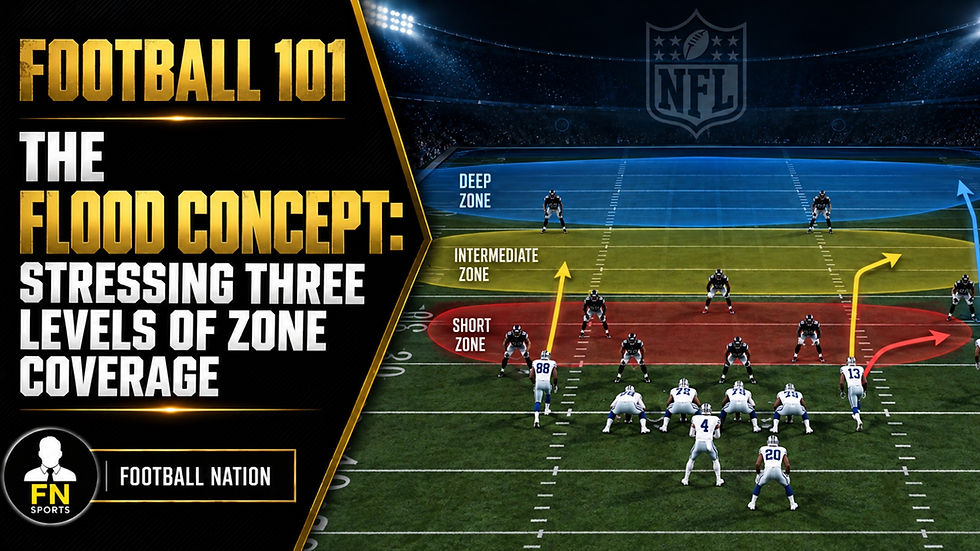
Top-down Football Nation diagram of the flood concept with deep, sail and flat routes stretching the right sideline.
Football Nation teaching diagram: a deep route, sail route and flat route stretch one sideline at three levels. Original AI-assisted graphic, editorially reviewed for tactical accuracy.

Why flood stresses zone coverage

Flood is designed to put a mathematical problem on the outside of zone coverage. Many coverages assign one defender to the deep outside area and another to the flat or curl-flat area. Three routes entering those two layers create an overload. The offense is betting that the quarterback can identify which defender widens, sinks or drives before the pass rush arrives.

Against a three-deep structure, the outside corner often protects the deep third. The underneath defender must decide how far to sink with the sail route without conceding the flat. If that defender gains too much depth, the quarterback takes the easy completion underneath. If the defender attacks the flat, the ball goes over the defender and outside the nearest linebacker. If the corner squats, the deep route becomes available.

Why quarterbacks often move with the concept

Flood frequently appears with a bootleg or rollout because moving the quarterback toward the overloaded sideline shortens the throw and changes the launch point. A convincing play-action fake can pull linebackers toward the run before they recover into the passing lanes. The quarterback then has the three-level picture directly in front of him.

The rollout is useful but not required. Offenses can run flood from the pocket, from empty formation or after pre-snap motion. Motion can move a defender away from the target side or reveal whether the defense is playing man or zone. A condensed or bunch formation can also give receivers cleaner releases and disguise which player will occupy each level.

What the quarterback reads

The quarterback first checks protection and the deep defender. If the clear route wins with leverage and the safety cannot help, the deep throw may be available. Otherwise the eyes move to the intermediate sail. That is usually the money route because it attacks the window created when the corner gains depth and the flat defender drives downhill.

If the sail is capped or the quarterback feels pressure, the flat route is the built-in answer. A disciplined passer does not force the intermediate throw simply because the play was called for it. The short completion can still produce useful yards, especially when the receiver catches with the sideline as a natural boundary and only one defender in position to tackle.

Flood versus similar concepts

A basic curl-flat combination stretches one underneath defender with two routes. Flood adds the deep route and creates three distinct levels. A screen pass invites the rush and releases blockers; flood uses normal route spacing and protection. Mesh attacks the middle with crossing routes, while flood concentrates three options toward one sideline.

The strongest misconception is that “flood” always means the quarterback rolls right and reads exactly go-to-sail-to-flat. Coaches can flip the concept, tag a backside route, change the clear route, use a tight end as the sail receiver or keep the quarterback in the pocket. The family resemblance is the three-level sideline stretch, not one frozen drawing.

How defenses stop flood

  • Match the routes. Pattern-match rules can convert zone defenders into route-specific coverage once the distribution becomes clear.

  • Sink the flat defender. A curl-flat player can gain depth under the sail and rally downhill to the checkdown.

  • Carry the sail with safety help. The corner can squeeze the intermediate route when the safety owns the deep clear.

  • Pressure the rollout. An edge defender who stays outside can force the quarterback to stop, retreat or throw before the levels develop.

Each answer creates another opening. A sinking flat defender concedes the short throw. A corner who jumps the sail risks the deep route. A defense that sends extra pressure may leave fewer bodies in coverage. Flood works because it makes those tradeoffs visible to the quarterback.

How to recognize flood on television

Start with the sideline, not the ball. Look for one receiver running deep, a second breaking toward the boundary 10 to 18 yards downfield and a third releasing immediately to the flat. Then watch the outside defenders. If two defenders are responsible for three routes, the offense has created the desired stretch. The quarterback's movement and play fake are clues, but the vertical stack of routes is the confirmation.

Football Nation takeaway

Flood is one of football's clearest examples of attacking space instead of chasing a specific player. Three routes occupy three depths on one side, forcing the defense to surrender something. The play is not automatic: protection, timing and spacing still decide whether the quarterback reaches the correct window. But once viewers learn to identify the deep clear, sail and flat, a complicated-looking rollout becomes a simple question— which level did the defense leave open?

Visual disclosure: The cover and teaching diagram are original Football Nation graphics created with generative AI and reviewed by the editorial workflow. They do not depict a real player or team.

Comments


bottom of page