top of page

What Is a Bunch Formation in Football? Bunch vs. Stack Explained

A bunch formation places three eligible receivers close together, usually in a small triangle or staggered cluster. Offenses use it to create cleaner releases, force defenders to communicate and manufacture favorable leverage. A stack formation is the two-receiver version: one eligible receiver aligns directly or nearly directly behind another.

That distinction matters because the extra receiver in a bunch creates more possible releases, route combinations and coverage exchanges. The formation is not a single play. It is a starting structure that can produce quick throws, vertical shots, crossing routes, screens or runs without changing personnel.

Bunch vs. stack at a glance

Structure

Eligible receivers in cluster

Typical legal alignment

Shape

Immediate defensive problem

Bunch

3

Usually one on the line, two off

Triangle or stagger

Three releases and multiple possible exchanges

Stack

2

Usually one on the line, one off

Vertical or nearly vertical

Two releases that can cross or switch

Alignment terminology and defensive calls vary by team. The on-the-line/off-the-line examples show common ways to keep the eligible receivers legally arranged, not the only possible formations.

Bunch versus stack teaching diagram with three gold bunch receivers and two gold stack receivers aligned against blue defenders.

Football Nation teaching diagram. AI-assisted original artwork; no photograph, player likeness or team logo is used.

What makes a bunch formation legal?

The cluster can include wide receivers, tight ends or running backs. Personnel does not define the formation; spacing does. A heavy grouping might place two tight ends and a back together, while a spread offense can build the same shape with three wide receivers. The Kansas City Chiefs' explanation of offensive play calling even distinguishes heavier and lighter bunch personnel packages.

The offense still has to satisfy normal formation rules. Under the 2026 NFL Rulebook, an offense must have at least seven players on the line of scrimmage at the snap, and only the eligible players at the ends of that line may release as receivers. That is why a three-player bunch commonly has one receiver on the line and two a step behind it. Coaches can vary the exact spacing, but they cannot make a covered interior player eligible simply by clustering him near teammates.

For viewers, the easiest identification rule is visual: find three eligible receivers packed within a few yards of one another. If there are only two, it is more accurately called a stack. If they are separated at normal receiver splits, it is neither.

Why offenses use bunch formations

The first benefit is a free release. A cornerback playing press coverage wants to crowd a receiver at the line and disrupt the route. In a bunch, defenders cannot comfortably line up nose-to-nose with all three receivers without risking collisions or losing track of a switch release.

The second benefit is leverage. The point receiver can run outside, inside or vertically. The two off-line receivers can release on either side of him. A defender who starts outside may suddenly be responsible for an inside-breaking route; a defender positioned inside can be widened by an out route or flat route.

The third benefit is information. Motioning a receiver into or out of the cluster can reveal whether the defense is leaning toward man coverage or zone coverage. It does not prove the coverage—defenses disguise and exchange assignments—but it gives the quarterback another clue before the snap.

An NFL.com film example from New England shows the practical effect. The Patriots began with a two-man stack, motioned Danny Amendola across to create a three-man bunch and used the defense's reaction to isolate Julian Edelman against off coverage. Edelman converted a 10-yard out. The bunch did not magically create the completion; it shaped the matchup and gave the quarterback a cleaner picture.

The route concepts you will see from bunch

Because the formation changes the release angles, many familiar routes look different from a cluster. Viewers who know the basic football route tree can watch for five common families:

Spot or snag: One receiver settles inside, one attacks the corner and one stretches the flat. The triangle forces a zone defender to choose which level to protect.

Mesh or shallow crossers: Two receivers cross underneath while a third clears space. Against man coverage, the intersecting paths test defenders' ability to trail without colliding.

Switch releases: Receivers exchange lanes immediately after the snap. The inside player may release outside while an outside player pushes vertically.

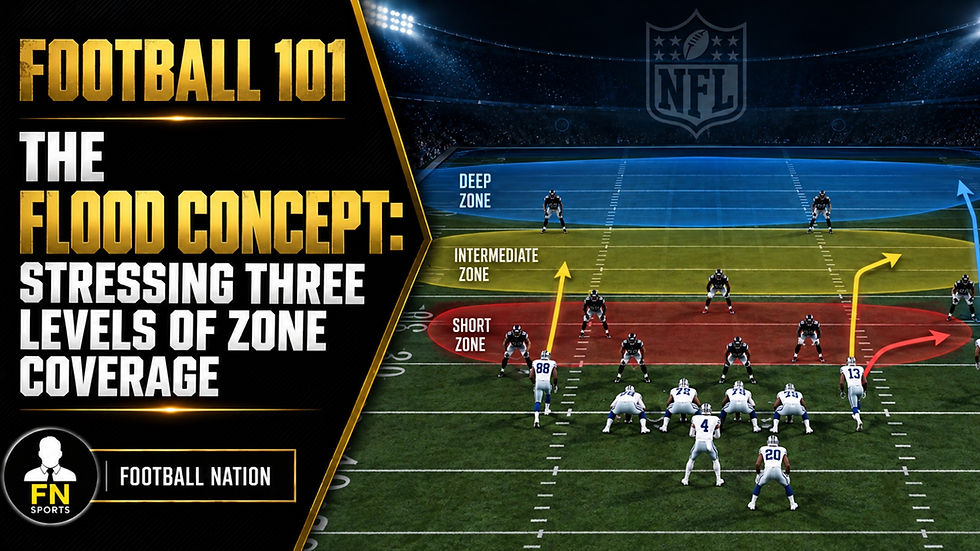
Flood: Three routes attack short, intermediate and deep areas on the same side, stressing a zone horizontally and vertically.

Quick screen: The offense throws immediately to one receiver while the other eligible receivers block within the rules.

The formation can also help the run game. By compressing receivers near the formation, the offense brings potential blockers closer to the box. A defense that sends extra defensive backs toward the bunch may lighten the opposite edge. A defense that stays spread can surrender favorable blocking angles at the point of attack.

Is a bunch route combination an illegal pick play?

Not automatically. This is the most important misconception.

Receivers are allowed to run routes through nearby space, and defenders sometimes collide while trying to exchange assignments. A legal rub uses timing and route spacing to create natural traffic. It becomes offensive pass interference when an offensive player materially restricts a defender in a way prohibited by the rule, such as initiating an illegal block or deliberately screening a defender beyond what the route permits.

The ruling depends on contact, timing, location and the receiver's action—not merely on the fact that two routes crossed. Football Nation's guide to pass interference explains the broader standard. When watching a replay, focus on whether the receiver is genuinely running a route and looking for the ball, or instead changes course to block a defender pursuing someone else.

How defenses answer bunch formations

Defenses have several sound responses, but every answer requires clear communication.

In lock coverage, each defender stays with his original receiver regardless of the release. That can preserve the matchup, but it makes defenders navigate traffic. In a banjo or switch call, two defenders exchange receivers based on whether they release inside or outside. Against three receivers, teams may use a box or three-over-three principle that distributes routes by area and depth rather than by a fixed pre-snap matchup.

Zone defenses can also keep eyes on the quarterback and pass routes from one defender to another. The danger is poor spacing: if two defenders jump the same short route, a vertical or corner route can open behind them. A pressure call adds another tradeoff. Sending a blitz reduces the number of defenders available to sort the cluster, so the pass rush must arrive before the quarterback exploits the matchup.

Some defenses press the point receiver and play the other two off. Disrupting the front of the cluster can alter the timing of every route behind it. The offense, however, can counter by releasing the point receiver vertically or using him as a decoy while the off-line receivers escape cleanly.

How to recognize the real advantage on television

Do not stop at identifying three receivers close together. Before the snap, note which receiver is on the line, whether a player used pre-snap motion, and whether the defense has three defenders at the same depth or one defender pressed at the point.

After the snap, watch the first two steps. Did the routes release in the same lanes, cross immediately or fan in three directions? Then watch the defenders. If they point, trade assignments or pause, the bunch has forced a communication decision. If the quarterback throws away from the cluster, the bunch may still have done its job by pulling coverage to one side.

Football Nation takeaway

A bunch formation is a three-receiver spacing tool, not a trick play. Its value comes from the number of release combinations it creates and the precision it demands from a defense. A stack uses two receivers and presents a simpler version of the same problem.

The best offenses do not rely on traffic alone. They use bunch to identify coverage, protect releases and create leverage, then pair those advantages with sound route timing. The best defenses survive it by deciding before the snap how they will exchange routes—and communicating that decision before the ball moves.

Frequently asked questions

Does a bunch formation always mean a pass?

No. Teams can run, throw a screen, use play-action or send the three receivers into a conventional route combination. The condensed alignment can also create useful blocking angles.

Can a defense play man coverage against a bunch?

Yes. It can lock defenders onto individual receivers or use a switch call that assigns routes after the release. The challenge is avoiding traffic while preserving leverage.

Comments


bottom of page